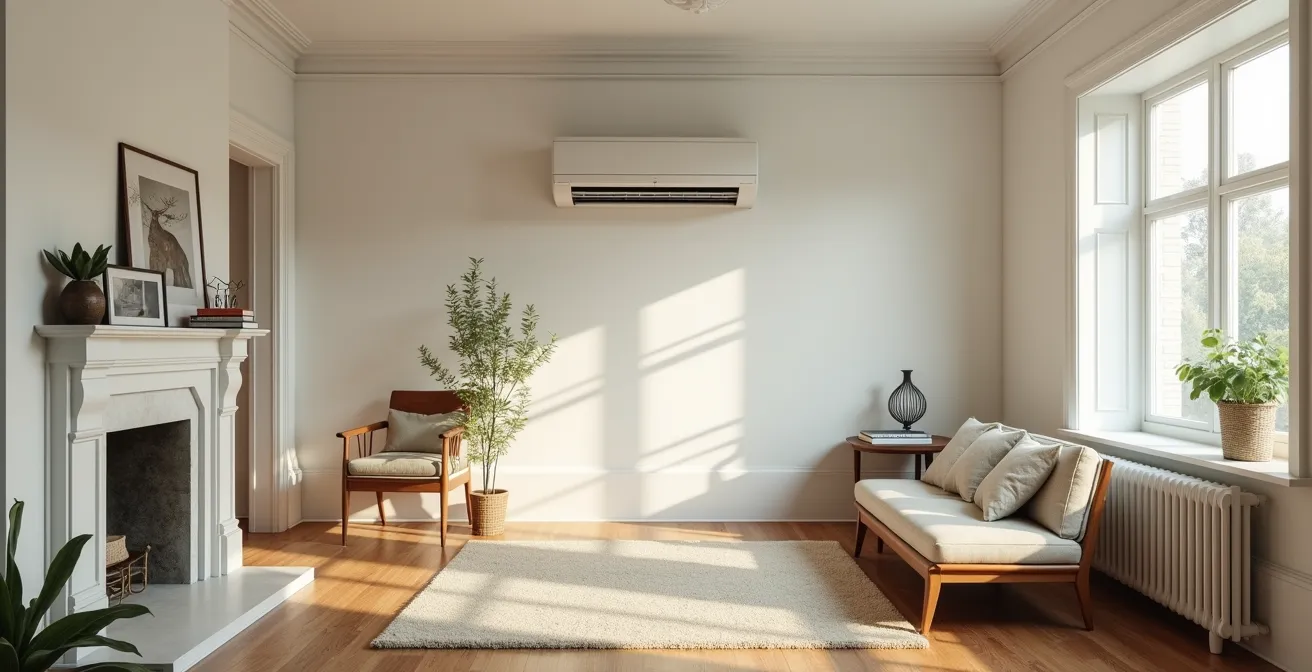
The best HVAC system for an older home is not about ducted vs. ductless; it’s about creating a holistic comfort ecosystem that respects the building’s integrity while maximizing efficiency.
- Ductless systems offer superior zone control and avoid the energy loss common in old or non-existent ductwork.
- Modernizing the ‘building envelope’ with proper insulation is a more impactful first step than simply oversizing a new HVAC unit.
Recommendation: Prioritize an ‘envelope-first’ approach, then choose a right-sized ductless system for targeted, room-by-room comfort that preserves your home’s character.
For owners of older homes, the familiar hum of an aging furnace or the window-rattling groan of a seasonal AC unit is often a source of deep frustration. The challenge isn’t just about temperature; it’s about drafty rooms, uneven heating between floors, and energy bills that feel punishingly high. The conventional wisdom often presents a stark choice: either undertake a costly, disruptive renovation to install modern ductwork or settle for inefficient window units. This debate frames the problem as a simple technological head-to-head between ducted and ductless systems.
But what if this entire premise is flawed? The true key to modernizing climate control in a historic property isn’t about the hardware alone. It’s about shifting perspective from a brute-force heating and cooling approach to creating a holistic “comfort ecosystem.” This means understanding how your home breathes, loses heat, and retains it. It requires looking at the building envelope—its insulation, windows, and air leaks—as the foundation upon which any mechanical system, ducted or ductless, must be built. This guide reframes the decision, moving beyond a simple comparison to offer a strategic roadmap for achieving superior comfort, healthier indoor air, and long-term efficiency without sacrificing your home’s unique architectural character.
For those who prefer a visual format, the following video offers an excellent overview of how modern HVAC technology, like the systems discussed, operates to deliver efficient climate control.
To help you navigate this strategic approach, we will explore the critical factors that influence performance and comfort in older homes. This article breaks down everything from air quality and temperature balancing to system sizing and insulation, providing a comprehensive framework for your decision.
Summary: The Definitive Guide to HVAC Modernization in Historic Houses
- Why Your Old Furnace Filter Is Faking 50% of Indoor Dust?
- How to Use Dampers to Balance Temperatures Between Floors?
- Air Source Heat Pumps: Do They Really Work in Below-Freezing Climates?
- The ‘Oversizing’ Mistake That Causes Short-Cycling and Humidity Issues
- When to Replace Your AC Unit: The 15-Year Efficiency Drop-Off
- Why Your Energy Bill Spikes by 30% in an Open-Plan House?
- Why Your Smart Thermostat Needs 2 Weeks to Learn Your Habits?
- Spray Foam vs Mineral Wool: Which Insulation Is Best for Cathedral Ceilings?
Why Your Old Furnace Filter Is Faking 50% of Indoor Dust?
That filter you diligently change in your old furnace offers a false sense of security. In many older ducted systems, a significant portion of the air bypasses the filter entirely due to poor seals and pressure imbalances. This “filter bypass” means dust, allergens, and pollutants are simply recirculated throughout your home, accumulating on sensitive components like the evaporator coil. This buildup not only degrades your indoor air quality but also forces your system to work harder, leading to inefficiency. In fact, leaky ductwork in older homes is a major source of waste, with some estimates showing up to 30% energy loss through leaky ductwork alone.
Ductless mini-split systems fundamentally solve this problem by decentralizing filtration. Instead of one single, often leaky, filtration point, each indoor unit has its own multi-stage filtration system. These filters are integrated directly into the sealed unit, eliminating the possibility of bypass. The air in each room is cleaned at the source, capturing a much higher percentage of particulate matter. This approach not only results in genuinely cleaner air but also protects the system’s internal components, maintaining its efficiency over time. While it requires more frequent (but simpler) cleaning of individual filters, the payoff is a healthier living environment and a more effective HVAC system.

As the image above illustrates, the hidden accumulation of dust on an HVAC coil acts as an insulating blanket, severely impairing the system’s ability to transfer heat. This is the direct, physical consequence of ineffective single-point filtration, a problem that multi-point ductless systems are designed to prevent.
The following table from a filtration news analysis highlights the fundamental differences in how these two system types approach air quality, demonstrating the inherent advantages of a distributed filtration model.
| Feature | Traditional Ducted (Single-Point) | Ductless (Multi-Stage) |
|---|---|---|
| Filter Location | One central filter | Individual unit filters |
| Common MERV Rating | 6-8 (standard) | Multi-stage including electrostatic |
| Filter Bypass Issue | Common in older systems | Minimal – sealed units |
| Maintenance Frequency | Every 1-3 months | Every few weeks per unit |
| Efficiency Impact | 5-15% when clean | Consistent performance |
Ultimately, choosing a system with distributed filtration is a direct investment in your home’s air quality and the long-term health of your climate control equipment.
How to Use Dampers to Balance Temperatures Between Floors?
In a traditional ducted system, dampers are the go-to solution for balancing temperatures. These manually adjusted flaps inside the ductwork are used to restrict or increase airflow to certain areas, theoretically pushing more conditioned air to the rooms that need it most. However, in an older home with aging, often unsealed ducts, this is a flawed and inefficient strategy. Closing dampers creates back-pressure, which can exacerbate leaks elsewhere in the system, strain the central blower motor, and lead to noisy, whistling vents. You might solve a hot upstairs bedroom only to create a new problem in the living room, all while wasting energy through newly stressed duct joints.
The modern, more effective solution is to abandon the concept of “balancing” a single, powerful air source and instead adopt true per-room control. Ductless multi-zone systems achieve this by design. As noted in case studies of historic property retrofits, these systems allow one room to be heated while another is being cooled simultaneously, completely independent of each other. This is impossible with a dampered ducted system. For an older home with complex layouts and varying insulation levels, this means you can set the precise temperature needed for each space without compromising comfort or efficiency elsewhere. It eliminates the floor-to-floor temperature battles common in multi-story houses.
Instead of wrestling with inefficient dampers, a ductless approach provides a targeted solution that respects the unique thermal properties of each room. This is a far more elegant and effective strategy for achieving consistent comfort throughout an older home, and it avoids the significant expense and disruption of installing new, properly sealed ductwork, which can easily be in the $5,000 to $15,000 typical cost range.
Case Study: Ductless Multi-Zone Implementation in Older Homes
Bryant reports that ductless mini-split systems offer true per-room control in historic properties without requiring dampers. Their case studies show VRF systems can heat one room while cooling another in complex older home layouts, solving floor-to-floor imbalances without disrupting original architecture.
By delivering conditioned air exactly where it’s needed, you move from a system of compromises to one of precision comfort.
Air Source Heat Pumps: Do They Really Work in Below-Freezing Climates?
A common myth surrounding air source heat pumps is that they are ineffective in climates with harsh winters. While this was true for older models, modern cold-climate heat pumps have made remarkable technological strides. Equipped with inverter-driven compressors, they can efficiently extract heat from the air even when outdoor temperatures dip well below freezing. These advanced systems are not just viable; they are a highly efficient primary heating source for many older homes. Compared to traditional electric resistance heating (like baseboard heaters or furnace heat strips), modern heat pumps can reduce electricity used for heating by up to 65%.
For older homes in the coldest regions, where a single system might struggle on the most frigid days of the year, a “dual-fuel” or hybrid strategy offers the perfect balance of efficiency and reliability. This approach involves installing a high-efficiency heat pump to handle the vast majority of your heating needs (e.g., for 95% of the winter). Your existing gas or oil furnace is retained not as the primary system, but as a supplemental backup that only activates during extreme cold snaps (e.g., below 5°F or -15°C). A smart thermostat manages the automatic switchover, ensuring you are always using the most cost-effective heating source for the given outdoor temperature.
This dual-fuel strategy allows owners of older homes to reap the massive energy-saving benefits of a heat pump for most of the year without any anxiety about performance during polar vortex events. It’s a practical, powerful way to modernize your heating without a complete overhaul of your existing infrastructure.
Your Action Plan: Implementing a Dual-Fuel Hybrid System Strategy
- Evaluate existing ductwork condition and determine if it can support a heat pump.
- Install a high-efficiency heat pump as the primary heating source (15 SEER minimum).
- Retain the existing gas furnace for extreme sub-zero days only.
- Configure a smart thermostat for automatic switchover based on outdoor temperature.
- Monitor energy usage to optimize the switchover temperature point.
By leveraging this technology, you can achieve significant cost savings and superior comfort, even in the most challenging climates.
The ‘Oversizing’ Mistake That Causes Short-Cycling and Humidity Issues
One of the most common and costly mistakes in HVAC replacement is “oversizing”—installing a unit that is too powerful for the home. Contractors often do this to ensure the system can handle the hottest days, but it creates significant problems. An oversized system will cool the space too quickly, hitting the thermostat’s setpoint in short, aggressive bursts. This phenomenon, known as short-cycling, is highly inefficient. The system never runs long enough to reach its peak operational efficiency, and the constant starting and stopping causes excessive wear and tear on the compressor, shortening the unit’s lifespan.
More importantly for comfort, short-cycling fails to properly dehumidify the air. A key function of an air conditioner is to run for extended periods, allowing moisture from the air to condense on the cold evaporator coils. When the system only runs for a few minutes at a time, this process doesn’t happen effectively, leaving you with a space that feels cool but damp and clammy. This is particularly noticeable in older, less airtight homes. Ductless systems with inverter technology combat this issue directly. Their compressors can modulate their output, with many models able to run at as low as 20-30% of their minimum capacity. This allows them to run continuously at a very low power level, perfectly matching the home’s cooling load and providing excellent dehumidification.
Your HVAC contractor should verify the proper size system for your home using a tool called ‘Manual J’ – a calculation of the amount of heating and cooling your home requires
– ENERGY STAR, ENERGY STAR Ductless Heating & Cooling Guide
Insisting on a Manual J calculation is non-negotiable. This detailed analysis considers factors like your home’s square footage, insulation levels, window types, and air leakage to determine the precise heating and cooling load. This ensures your new system is “right-sized,” not oversized, leading to better comfort, lower humidity, and greater long-term efficiency.
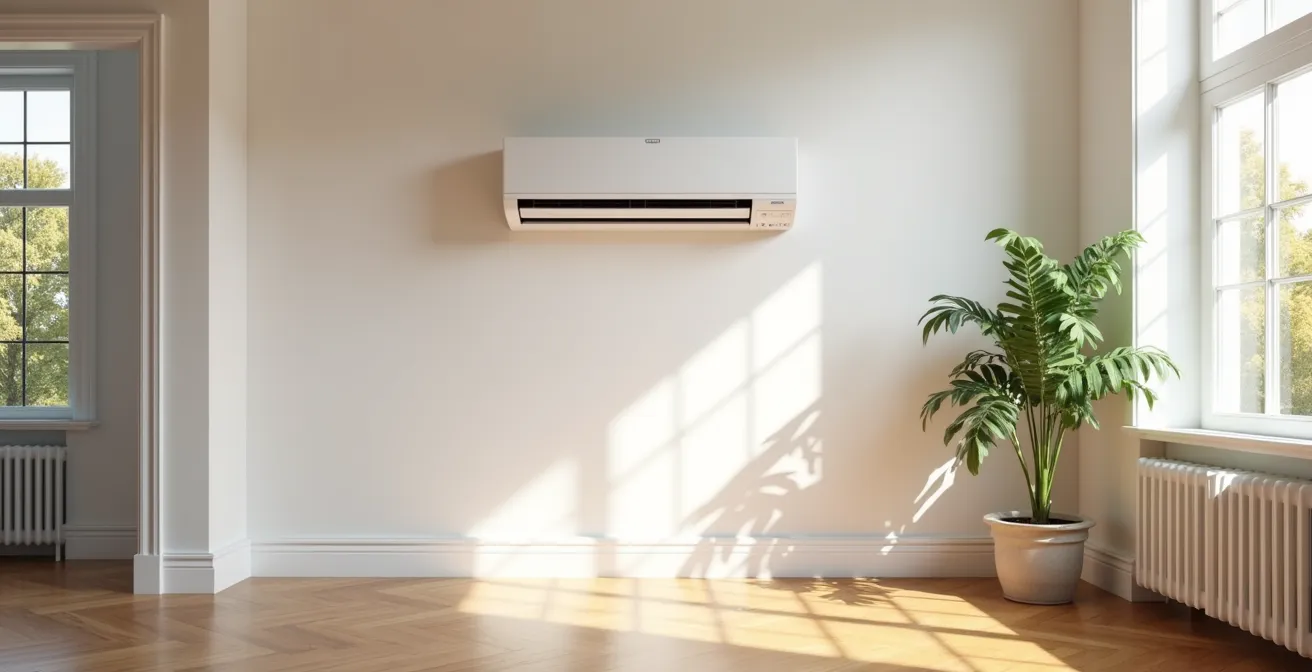
A right-sized system is the cornerstone of an efficient and comfortable home, delivering just the right amount of conditioning without waste.
When to Replace Your AC Unit: The 15-Year Efficiency Drop-Off
Clinging to an old air conditioning unit beyond its 15-year lifespan might seem like a frugal choice, but it’s often a costly mistake. After a decade and a half of service, an HVAC system’s efficiency plummets. Components wear out, seals degrade, and the technology becomes obsolete compared to modern standards. An older system may be operating at only 60% of its original efficiency, meaning it works much harder and consumes significantly more energy to produce the same amount of cooling. This slow, steady decline in performance is often accompanied by an increase in repair frequency, leading to a cycle of expensive emergency calls and patchwork fixes.
The financial case for replacement becomes compelling when you consider the total cost of ownership. According to the U.S. Department of Energy, simply upgrading and properly maintaining your heating and cooling systems can slash your home’s energy consumption by a staggering 20-50%. For the average American household, that translates into hundreds of dollars in wasted energy every year. Instead of pouring money into an aging, inefficient machine, investing in a new, high-efficiency system (whether ducted or ductless) starts paying for itself immediately through dramatically lower utility bills.
While the upfront cost of a new system is significant, viewing it as a long-term investment clarifies the decision. The energy savings alone often allow the new system to pay for itself within a few years, especially when factoring in the avoided costs of frequent repairs. Holding onto a 15-plus-year-old unit is not saving money; it’s financing inefficiency.
This comparative analysis from an industry blog breaks down the long-term financial implications, showing how the cumulative costs of keeping an old system quickly outpace the initial investment in a new one.
| Factor | Keep 15+ Year System | Replace with New System |
|---|---|---|
| Annual Energy Costs | Increasing 5-10% yearly | Reduced by 20-40% |
| Repair Frequency | 2-3 times per year | Minimal for 5+ years |
| Emergency Repair Risk | High probability | Warranty coverage |
| 5-Year Total Cost | Higher cumulative | Lower after year 3 |
Upgrading is not just about restoring lost performance; it’s about investing in a new standard of efficiency and reliability for your home.
Why Your Energy Bill Spikes by 30% in an Open-Plan House?
Open-plan living spaces, with their high ceilings and large, interconnected areas, are an architectural hallmark of many homes, but they are notoriously difficult and expensive to heat and cool with a traditional central HVAC system. A single thermostat attempts to manage a massive volume of air, leading to significant temperature stratification—hot air rising to the ceiling in winter, and cool air pooling near the floor in summer. The system runs constantly in a futile attempt to condition the entire space to a single temperature, resulting in huge energy waste. This inefficiency is a primary reason why energy bills can be up to 30% higher in homes with large, open areas.
Ductless systems offer a far more intelligent and efficient solution by creating “comfort zones.” Instead of trying to heat or cool the entire air volume, you can use strategically placed units to condition only the areas you are actually using. For example, a discreet ceiling cassette can provide general ambient temperature control for the main area, while a floor-level console can be placed near a primary seating area to deliver targeted warmth or cooling right where you feel it. This zonal approach allows you to maintain a comfortable temperature in your immediate vicinity while letting the temperature in unoccupied parts of the room drift, leading to substantial energy savings. In fact, for older homes without existing ductwork, ductless air conditioners can save $1000 to $2000 annually in running costs.
This strategy is about being smart with your energy usage—heating and cooling people, not empty space. By adopting a zonal approach, you can enjoy the aesthetic of your open-plan home without being penalized by exorbitant energy bills.
Your Action Plan: Strategic Ductless Placement for Open-Plan Living
- Map air circulation patterns in your open-plan space to identify stratification zones.
- Install a discreet ceiling cassette unit for general coverage of the main area.
- Add a floor-level console near the primary seating area for targeted comfort.
- Create ‘comfort zones’ rather than conditioning the entire air volume.
- Use a higher thermostat setpoint in summer (or lower in winter) for potential 30% energy savings.
By focusing on comfort zones, you can finally gain control over both the climate and the cost of your open-concept living area.
Why Your Smart Thermostat Needs 2 Weeks to Learn Your Habits?
A smart thermostat connected to a traditional ducted system is a significant upgrade, learning your schedule over a couple of weeks to optimize when to heat or cool your home. However, it’s still fundamentally limited: it’s a single brain trying to control an entire house based on the temperature in one location (the hallway where it’s mounted). It cannot account for an unused guest room, a sun-drenched home office, or a cool basement. It makes educated guesses for the whole home based on partial information, which is efficient, but not precise.
Modern ductless multi-zone systems represent a leap forward into distributed intelligence. This is a fundamentally different concept. Instead of one central brain, each indoor unit acts as its own smart device, complete with sensors that monitor the temperature and conditions of its specific room. A central controller or app then functions as an “orchestrator,” not a dictator. It allows you to set unique schedules and temperatures for each zone independently. As explained by industry experts, this enables a level of room-by-room optimization far beyond what a single thermostat can achieve. Some advanced systems even use infrared sensors to detect human presence, automatically directing airflow toward people or entering an energy-saving mode when a room is empty.
Each indoor unit is a smart device with its own sensors. A central smart controller then acts as an ‘orchestrator’, enabling true room-by-room scheduling and optimization far beyond what a single thermostat can achieve
– Mitsubishi Electric, Diamond Contractor Training Materials
This is the difference between an educated guess and precise knowledge. A single smart thermostat optimizes a schedule; a distributed intelligence system optimizes real-time comfort and efficiency room by room. For an older home with varied use patterns and thermal inconsistencies, this level of granular control is not just a luxury—it’s the key to unlocking maximum comfort and savings.
Case Study: Distributed Intelligence in Modern Ductless Systems
This Old House explains how modern ductless systems with infrared sensors can detect human presence and body temperature, automatically directing airflow for customized comfort or entering energy-saving mode when rooms are empty – features impossible with traditional single-thermostat ducted systems.
This intelligent orchestration ensures that no energy is wasted conditioning empty spaces, providing a smarter and more responsive comfort experience.
Key takeaways
- Prioritize the Building Envelope: Before choosing an HVAC system, invest in insulation and air sealing. A well-sealed home requires a smaller, less expensive, and more efficient system.
- Right-Sizing is Non-Negotiable: Insist on a Manual J calculation to avoid the common mistake of oversizing your system, which leads to inefficiency, poor dehumidification, and a shortened lifespan.
- Ductless Offers Precision Comfort: Ductless systems provide true room-by-room control, solving the temperature imbalances and energy waste common in older, multi-story, or open-plan homes.
Spray Foam vs Mineral Wool: Which Insulation Is Best for Cathedral Ceilings?
When modernizing an older home, the most impactful investment you can make is not in the HVAC machine itself, but in the building envelope—the shell that separates the conditioned interior from the outdoors. Cathedral ceilings, common in many older home additions or renovations, are a major source of heat loss in winter and heat gain in summer. Properly insulating them is critical. The choice often comes down to spray foam versus mineral wool. Spray foam (specifically closed-cell) provides a superior R-value per inch and acts as an air and vapor barrier in one step, making it excellent for creating an airtight seal. Mineral wool, on the other hand, offers excellent thermal performance, superior fire resistance, and sound dampening qualities.
The “envelope-first” strategy argues that spending more on high-performance insulation and air sealing allows you to install a smaller, less expensive, and more efficient HVAC system. By dramatically reducing the home’s heating and cooling load, you are solving the problem at its source. This approach can lead to long-term energy use reductions of 40-50%, far greater than the 20-30% savings from an HVAC upgrade alone. While it may require a higher initial investment in insulation, the payoff comes from both lower monthly energy bills and a lower upfront cost for the downsized mechanical equipment. Properly sealing drafts can result in 5-30% annual savings in energy costs before even touching the HVAC system.
This table contrasts the two investment philosophies, clearly showing that prioritizing the envelope yields greater long-term returns and a more comfortable, resilient home.
| Investment Priority | Envelope First | HVAC First |
|---|---|---|
| Initial Cost | Higher insulation cost | Higher equipment cost |
| HVAC Size Required | Smaller, less expensive | Larger capacity needed |
| Long-term Energy Use | 40-50% reduction | 20-30% reduction |
| Ventilation Needs | HRV/ERV required | Natural air exchange |
| System Compatibility | Works with ducted or ductless | Limited by heat load |
By focusing on insulation and air sealing first, you create a foundation for a truly high-performance comfort ecosystem, ensuring any HVAC system you choose can operate at its peak efficiency.