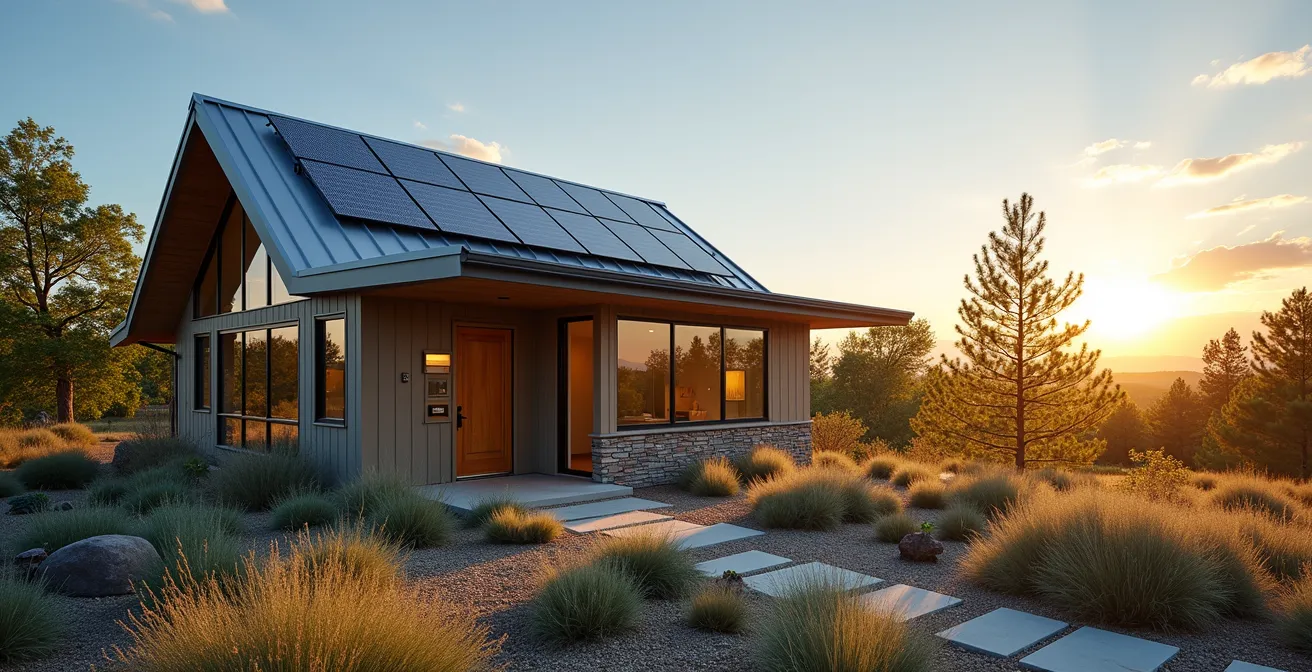
Achieving an energy-positive home is not about adding more solar panels; it’s an exercise in holistic systems engineering where the building itself becomes an integrated living machine.
- Success hinges on radical airtightness and a high-performance thermal envelope to minimize energy demand to near zero.
- Surplus generation is achieved by treating waste streams—like solar heat and greywater—as valuable resources to be harvested and reused within the home’s ecosystem.
Recommendation: Shift your focus from individual eco-friendly products to the synergistic design of the entire building system, from the foundation’s thermal mass to the strategic placement of deciduous trees.
The conversation around sustainable building has long been dominated by the concept of “net-zero”—a home that produces as much energy as it consumes. While a noble goal, it represents a state of equilibrium, not abundance. For aspiring off-gridders and eco-pioneers, the true frontier lies beyond this balance: the energy-positive home. This is not merely a house with solar panels; it is a meticulously engineered ecosystem designed from the ground up to generate a significant surplus of power, effectively turning your dwelling into a micro power plant.
Many discussions stop at insulation and efficient appliances, treating the home as a collection of parts. This approach is fundamentally limited. The leap from net-zero to net-positive requires a paradigm shift. We must stop thinking about a house as a static shelter that consumes energy and start envisioning it as an integrated living machine. In this model, every element works in concert. The sun’s heat isn’t just blocked; it’s captured, stored, and redistributed. The water from your shower isn’t just waste; it’s a resource for non-potable uses. The very air you breathe is part of a managed, heat-exchanging cycle.
This guide moves beyond the basics of photovoltaics and explores the core architectural principles that underpin a truly energy-positive structure. We will dissect the critical role of thermal mass, the engineering behind radical airtightness, and the untapped potential of waste streams. By understanding these interconnected systems, you will grasp how to design a home that not only frees you from the grid but actively contributes to it, embodying a future of resilient, decentralized energy production.
This article provides a blueprint for that vision. We will explore the technical design strategies, the necessary lifestyle adaptations, and the financial realities of creating a home that gives back more than it takes. Let’s delve into the architectural science of energy surplus.
Summary: A Blueprint for Energy-Positive Living
- How to Design Thermal Mass to Store Free Solar Heat in Winter?
- Greywater Systems: Is Filtering Shower Water for Toilets Legal and Safe?
- Achieving 0.6 ACH: Why Airtightness Is Key to Energy Positive Homes?
- The Lifestyle Changes Required to Live in an Energy-Positive Home
- Do Buyers Actually Pay a Premium for Net-Positive Certifications?
- Net Metering Explained: How Much Does the Grid Pay You Back?
- The Carbon Cost of Shipping Italian Marble vs Local Stone
- How to Build a Resilient Backyard Ecosystem That Survives Climate Extremes?
How to Design Thermal Mass to Store Free Solar Heat in Winter?
The most elegant energy source is the one you don’t have to pay for. In an energy-positive home, passive solar design is the foundational principle for minimizing heating demand. The core of this strategy is thermal mass—the building’s intrinsic ability to absorb, store, and later release thermal energy. Instead of relying solely on active heating systems, we engineer the structure itself to act as a thermal battery, capturing free heat from the low-angled winter sun through south-facing glazing and releasing it slowly overnight.
The selection of materials is paramount. Dense materials like concrete, stone, or brick are traditional choices due to their high heat capacity. A polished concrete slab floor exposed to direct winter sunlight is a classic and effective application. Water walls, containing large volumes of water, are even more efficient, storing roughly five times more heat per unit volume than concrete. However, the next frontier lies in Phase Change Materials (PCMs). These are substances engineered to melt and solidify at specific temperatures, absorbing or releasing vast amounts of energy in the process. Integrated into walls or floors, they can store four times more energy than water in the same volume. According to the Department of Energy, paraffin PCMs have typical material costs of $20-40/kWh of storage capacity, making them an increasingly viable technology for high-performance homes.
Effective design is about more than just material choice; it’s about orchestration. The ratio of south-facing glass to thermal mass surface area must be precisely calculated for your climate zone to prevent overheating, even in winter. Strategic overhangs or automated blinds are essential to block the high-angled summer sun while allowing maximum winter solar gain. This is not a bolt-on feature; it is a fundamental design decision that integrates the building’s orientation, massing, and material palette into a passive heating system.
Greywater Systems: Is Filtering Shower Water for Toilets Legal and Safe?
In a truly integrated home, there is no such thing as “waste,” only misplaced resources. Greywater—the gently used water from showers, baths, and laundry—is a prime example. Instead of sending this thermally-charged and relatively clean water directly to the sewer, an energy-positive home captures it, treats it, and reuses it for non-potable applications like toilet flushing and subsurface irrigation. This strategy simultaneously reduces municipal water consumption, lessens the load on sewage treatment facilities, and can even reclaim a small amount of thermal energy.
The primary concerns for homeowners are legality and safety. Regulations for indoor greywater reuse are a complex patchwork that varies dramatically by state and even municipality. Some regions embrace it, while others restrict it to outdoor irrigation or ban it entirely. For indoor use like toilet flushing, a permit is almost always required, and the system must meet stringent filtration and disinfection standards to prevent health risks from bacteria and pathogens. For instance, according to an analysis by Greywater Action, a resource for sustainable water solutions, states like California and Texas have established clear pathways for permitting indoor reuse, often requiring dual plumbing (purple pipe) and specific treatment technologies. This makes professional design and installation non-negotiable.
A typical residential greywater system for toilet flushing involves a multi-stage filtration process. This is not simply a pipe from the shower to the toilet. The water first passes through a coarse filter to remove hair and lint, then into a surge tank to handle high-volume flows. From there, it undergoes finer filtration and often a disinfection stage, which can involve UV light or a chemical treatment like chlorine, to ensure it meets health standards like those outlined in the NSF/ANSI 350 standard for onsite water reuse. The diagram below illustrates the key components of such a system.

As you can see, the complexity ensures safety. The treated greywater is then stored in a dedicated tank, ready to supply the home’s toilets. While the initial investment can be significant, the long-term water savings and the philosophical alignment with a closed-loop resource model make it a cornerstone of advanced eco-pioneering. The legal landscape is constantly evolving, with more jurisdictions recognizing the value of onsite water reuse as a climate resilience strategy.
Achieving 0.6 ACH: Why Airtightness Is Key to Energy Positive Homes?
Houses can be up to 800% energy-positive based on the average household usage of 4000KwH per annum
– CurveBlock Engineering Team, CurveBlock Energy Positive Homes Report
That staggering figure is not achieved by simply adding more solar panels. It is the result of a radical reduction in energy demand, and the single most important factor in this equation is airtightness. An energy-positive home is fundamentally a sealed system. Uncontrolled air leakage through cracks and gaps in the building envelope is the primary driver of energy loss in a conventional home, forcing heating and cooling systems to work constantly to compensate for conditioned air escaping and unconditioned air infiltrating. By creating a virtually airtight structure, we dramatically reduce this parasitic load to almost zero.
The industry benchmark for a high-performance building is the Passive House standard, which mandates a maximum of 0.6 Air Changes per Hour (ACH) at 50 Pascals of pressure (ACH50). To put this in perspective, a typical new construction home might test at 3.0 to 5.0 ACH50, while an older home can easily exceed 10.0 ACH50. Achieving the 0.6 target means that when the house is depressurized, only 60% of the total air volume inside leaks out over the course of an hour. This level of performance requires meticulous attention to detail during design and construction, focusing on a continuous air barrier around the entire building envelope.
This air barrier isn’t a single material; it’s a system. It involves sealing every joint, penetration, and potential weak point. The “Big Six” leakage points that require obsessive attention are:
- Junctions between the foundation and the floor system (rim joists).
- Gaps around window and door frames.
- Penetrations for electrical, plumbing, and HVAC services.
- Attic access hatches.
- Recessed lighting fixtures that puncture the ceiling plane.
- The top and bottom plates of wall frames.
With such a tight envelope, mechanical ventilation becomes essential. A Heat Recovery Ventilator (HRV) or Energy Recovery Ventilator (ERV) is used to supply fresh, filtered air while exhausting stale, moist air. In this process, it transfers up to 90% of the thermal energy from the outgoing air to the incoming fresh air, providing ventilation without the energy penalty. This combination of an airtight shell and controlled, heat-recovering ventilation is the engine of efficiency in an energy-positive home.
The Lifestyle Changes Required to Live in an Energy-Positive Home
Engineering a net-positive home is only half the battle. Living in one requires a shift in mindset from passive consumer to active system manager. While the house is designed to be highly automated, achieving a significant energy surplus often involves conscious participation from its occupants. This doesn’t mean a life of austerity; it means a life of awareness. You become attuned to the rhythms of the house and the environment, making small adjustments to optimize the performance of the integrated systems you inhabit.
The most significant change is the transition to real-time energy management. Instead of receiving a monthly utility bill, you interact with a dashboard that provides instantaneous feedback on your home’s energy production and consumption. This simple act of making the invisible visible is a powerful behavioral driver. You learn to schedule high-draw activities like charging an electric vehicle or running a load of laundry for the middle of the day when solar production is at its peak. Conversely, you might delay running the dishwasher until the home’s battery is fully charged. This active load-shifting is a key component of maximizing self-consumption and ensuring a surplus is available to sell back to the grid.
This is beautifully illustrated by the real-world experience of eco-pioneers. As one net-positive homeowner noted about their high-demand lifestyle, which includes an EV and running three computer servers 24/7:
Our usage is vastly higher than average… Just eliminating [the servers] would put us net positive.
– Powerhouse Designs
This highlights that a net-positive home provides a robust energy budget, but conscious choices about extreme loads remain relevant. It’s about understanding the impact of your activities and making informed decisions. This engaged lifestyle is not a chore but a source of deep satisfaction, connecting you directly to your environment and the performance of your home.
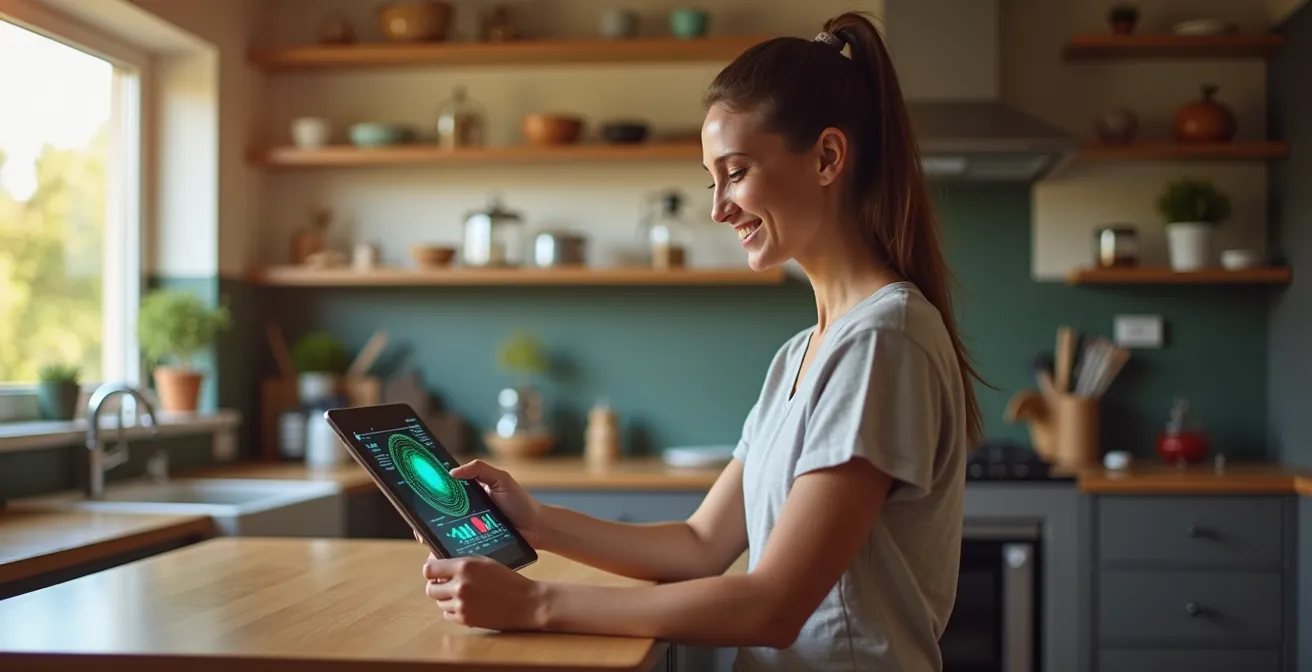
Ultimately, living in an energy-positive home is an interactive experience. It’s about more than just flipping a switch; it’s about orchestrating the flow of energy through your personal ecosystem, turning a daily routine into a conscious act of sustainability and resilience.
Do Buyers Actually Pay a Premium for Net-Positive Certifications?
For eco-pioneers, the primary motivation for building an energy-positive home is often philosophical. However, the financial implications, particularly regarding resale value, are a critical consideration. The evidence is increasingly clear: buyers are willing to pay a significant premium for homes that offer not just energy savings but also resilience and superior comfort. The value proposition extends far beyond a lower monthly utility bill.
Market studies consistently show that certified high-performance homes command higher prices. Certifications like Passive House (PHIUS) or the Living Building Challenge (LBC), which have rigorous energy performance requirements, can add a 5-10% premium to a home’s value compared to a standard new construction. A LEED Platinum certification, while also valuable, typically results in a slightly lower premium of 3-7%. This premium is driven by several factors. The most obvious is the direct financial benefit of zero or even negative energy bills. A home that generates income is a fundamentally more valuable asset.
However, sophisticated buyers are looking beyond immediate savings. They value the resilience that comes with a net-positive home. The ability to maintain power during a grid outage (with battery storage) is a major selling point in an era of increasingly frequent extreme weather events. Furthermore, these homes offer superior indoor air quality and thermal comfort due to the airtight construction and mechanical ventilation, which are tangible quality-of-life benefits. Buyers are also forward-looking, anticipating future energy price volatility and potential carbon taxes that would make standard, inefficient homes more expensive to operate and therefore less desirable.
The main challenge is often in the appraisal process. Standard appraisal methodologies can fail to capture the full value of these advanced systems. It is crucial for homeowners to provide appraisers with a “Green Addendum”—a document that details the home’s features, certifications, and a history of its energy performance and utility savings. By quantifying the asset’s performance, you can help ensure its true market value is recognized.
Net Metering Explained: How Much Does the Grid Pay You Back?
Generating a surplus of energy is a remarkable technical achievement, but monetizing that surplus is what closes the financial loop on an energy-positive home. The mechanism that governs how you are compensated for the excess electricity you send to the grid is known as net metering (or a related policy). Understanding your local utility’s specific program is crucial, as the financial returns can vary dramatically based on the compensation structure.
The policies for grid compensation generally fall into a few main categories, each with different financial implications for the homeowner. A comparative analysis from the Zero Energy Project shows the main differences. The classic “Net Metering 1.0” model is the most favorable: for every kilowatt-hour (kWh) you export to the grid, you receive a one-to-one credit against a kWh you import later. You are essentially using the grid as a giant, free battery, and you are compensated at the full retail rate. However, as solar adoption has grown, many utilities have shifted to less generous models.
The following table breaks down the most common compensation systems:
This table from the Zero Energy Project provides a clear comparison of how different grid feedback systems operate.
| System Type | How It Works | Typical Compensation | Best For |
|---|---|---|---|
| Net Metering 1.0 | 1:1 credit for excess energy | Full retail rate | Areas with legacy agreements |
| Net Billing | Buy at retail, sell at wholesale | 30-50% of retail rate | Homes with battery storage |
| Time-of-Use (TOU) | Variable rates by time of day | 2-4x difference peak vs off-peak | Flexible consumption patterns |
| Virtual Power Plant | Aggregated battery services | $50-200/month additional | Advanced storage systems |
Under Net Billing (also called “net purchase and sale”), you buy all your electricity from the grid at the retail rate but sell all your solar-generated electricity at a lower, wholesale “avoided cost” rate. This significantly reduces the value of exported energy and makes battery storage, which allows you to store your own energy instead of selling it cheap, almost essential. Time-of-Use (TOU) rates create another layer of complexity, where the price of electricity changes throughout the day. This can be highly advantageous for homes with battery storage, as you can store solar energy during the day and sell it back to the grid during peak evening hours when the price is highest. The most advanced model is participating in a Virtual Power Plant (VPP), where a third-party aggregator coordinates with your battery system to provide grid-stabilizing services, generating additional revenue.
Key Takeaways
- An energy-positive home is an integrated system, not a collection of parts; success depends on synergy between components.
- Radical airtightness (targeting 0.6 ACH) is the non-negotiable foundation for minimizing energy demand before generation is even considered.
- Value is created by treating “waste” streams like solar heat, greywater, and embodied carbon as resources to be managed and optimized.
The Carbon Cost of Shipping Italian Marble vs Local Stone
A truly visionary approach to energy-positive design looks beyond operational energy (the kWh on your meter) and considers embodied carbon. This is the total carbon footprint of a material, accounting for its extraction, manufacturing, transportation, and eventual end-of-life. A home can be net-zero in operation but have a massive upfront carbon debt due to poor material choices. Choosing locally sourced, low-carbon, or recycled materials is a critical component of a holistically sustainable project.
The difference between two seemingly similar materials can be immense. Shipping heavy Italian marble across the Atlantic carries an enormous transportation carbon cost compared to using a durable, beautiful stone quarried 50 miles from the build site. As a design principle, we prioritize materials with a low lifecycle impact. This philosophy is perfectly articulated by master builder Ben Bogie in his approach to a net-positive project for Green Building Advisor:
This project minimizes the use of virgin foam insulation, reduces concrete where appropriate, is engineered to avoid the use of steel, and incorporates products with high levels of recycled content
– Ben Bogie, GreenBuildingAdvisor Sustainable Build Series
This is a masterclass in carbon-conscious design. It involves a fundamental re-evaluation of conventional building materials. Instead of foam insulation derived from petrochemicals, we might use cork, hempcrete, or wood fiber. We can specify concrete mixes that replace a portion of the high-carbon Portland cement with recycled fly ash. We opt for reclaimed timber instead of virgin wood and choose natural finishes over high-VOC paints and sealants. Every material choice becomes an opportunity to reduce the home’s upfront carbon debt.
Conducting a formal Lifecycle Assessment (LCA) is the most rigorous way to compare material options, but a few key principles can guide your decisions even without a full analysis. Prioritizing local, natural, and recycled materials is the cornerstone of this approach.
Action Plan: Auditing Your Material’s Embodied Carbon
- Compare Lifecycles: Conduct a lifecycle assessment (LCA) comparing extraction, manufacturing, transport, and end-of-life impacts for your top material choices.
- Source Locally: Prioritize sourcing materials from within a 500-mile radius to dramatically cut transport emissions.
- Choose Reclaimed & Recycled: Actively seek out materials like reclaimed wood, recycled steel, and crushed recycled glass aggregate.
- Opt for Bio-Based: Integrate bio-based materials where performance allows, such as bamboo flooring, cork insulation, or hempcrete walls.
- Document Everything: Meticulously document your material sources and their carbon footprint data for future home value assessments and certifications.
How to Build a Resilient Backyard Ecosystem That Survives Climate Extremes?
The final layer of an energy-positive design extends beyond the walls of the house and into the landscape itself. The property should not be viewed as a static lawn but as a dynamic, productive ecosystem that contributes to the home’s overall resilience and performance. By applying principles of permaculture and strategic landscape architecture, the backyard becomes an integral part of the home’s integrated living machine, helping it to moderate temperature, manage water, and even produce food.
Strategic planting can have a direct and measurable impact on energy consumption. Thoughtfully placed deciduous trees on the south and west exposures provide cooling shade in the summer when their leaves are full, then drop their leaves in winter to allow the warming sun to reach the house and its thermal mass. Evergreen trees and dense shrubs planted as windbreaks on the north and northwest sides can significantly reduce heat loss from cold winter winds. According to some studies, this kind of strategic landscaping can reduce heating and cooling loads by as much as 25-30%, a massive saving achieved with a completely passive, living system.
Beyond energy, a resilient landscape is designed to manage water and temperature extremes. As demonstrated by Net Positive Studio, integrating earthworks like swales and rain gardens does more than just prevent stormwater runoff. These features capture rainwater, allowing it to slowly percolate into the ground, recharging the local water table and providing passive irrigation for plants. This stored soil moisture creates a stable microclimate around the house, moderating temperature swings and further reducing the load on HVAC systems. This approach can support highly productive food gardens that increase a household’s self-sufficiency and resilience against food supply chain disruptions.
This is the ultimate expression of systems thinking: the house supports the garden with harvested rainwater and composted organic waste, and in return, the garden supports the house by providing passive cooling, wind protection, and nutritious food. It completes the cycle, transforming the entire property into a net-positive ecosystem that is more resilient to the challenges of a changing climate.
Building an energy-positive home is the ultimate statement of environmental stewardship and personal resilience. By moving beyond simple conservation and embracing a design philosophy of active harvesting and system synergy, you can create a dwelling that not only meets its own needs but contributes to a more sustainable future for everyone. Begin today by applying these principles to your own project, starting with a deep analysis of your site, climate, and material choices.
Frequently Asked Questions About Energy-Positive Homes
How do net-positive homes compare to standard homes in appraisals?
Standard appraisals often fail to capture the full value of energy-positive features. Homeowners should prepare a ‘Green Addendum’ documenting energy savings, certifications, and utility data to educate appraisers.
Which certifications command the highest premiums?
Passive House and Living Building Challenge certifications typically command 5-10% premiums, while LEED Platinum adds 3-7% to home value, according to market studies.
Is the premium just about current energy savings?
No, buyers increasingly value resilience against future energy price volatility, potential carbon taxes, and changing building codes that may make standard homes obsolete.