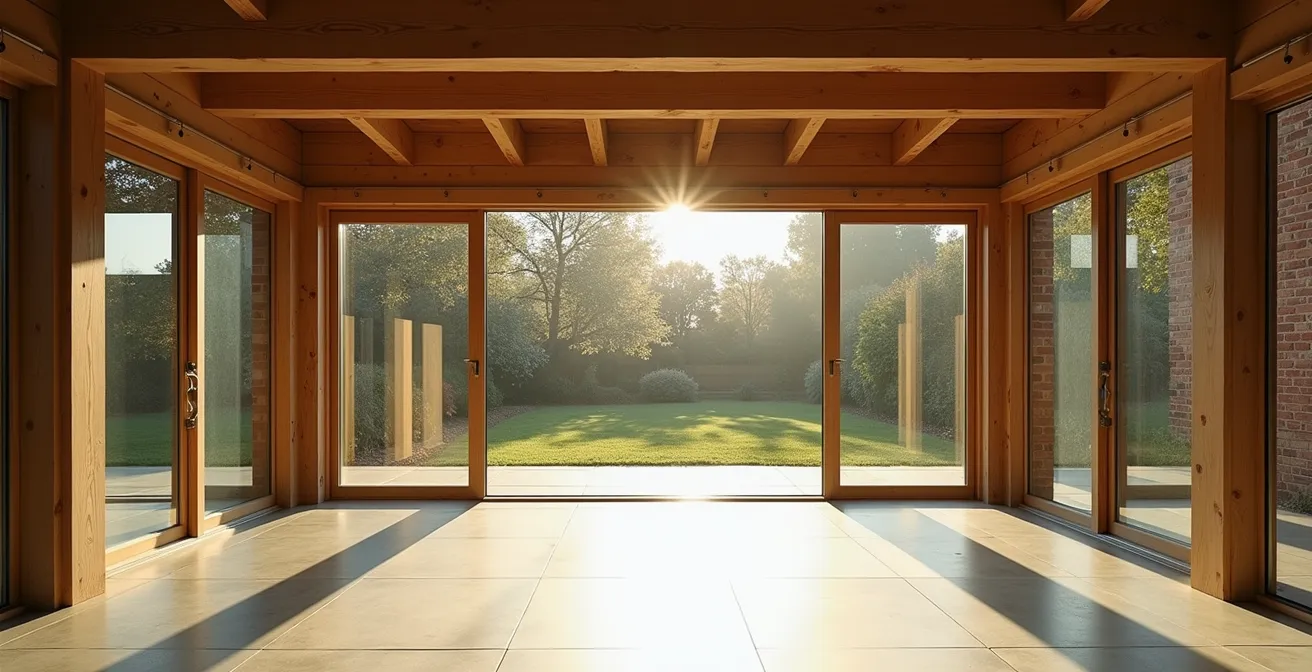
The best timber frame choice depends on embracing a philosophy: kiln-dried offers predictable precision, while green oak provides a living structure that gains character over centuries.
- Green oak’s initial movement (shrinkage and cracking) is a feature that tightens traditional joints, not a structural flaw.
- Kiln-dried timber provides immediate stability and is ideal for projects requiring tight tolerances and integration with modern materials like glass.
Recommendation: Choose green oak if you value a building with a story, patina, and structural honesty. Opt for kiln-dried if your design prioritizes seamless integration and dimensional stability from day one.
The dream of a timber-framed extension often starts with an image: light flooding through a vaulted space, the warm, solid presence of exposed beams overhead. But this dream quickly meets a fundamental question: should the frame be built from green oak or kiln-dried timber? The common debate pits the rustic, traditional feel of green oak against the stable, modern precision of its dried counterpart. Many will advise that kiln-dried is safer, a known quantity, while green oak is a wild card, prone to unpredictable movement.
This conversation often revolves around controlling the material, forcing it to behave. But what if the true art of a timeless timber extension lies not in fighting the nature of wood, but in understanding its living character? The real choice isn’t just about wet versus dry; it’s about deciding what kind of story you want your home to tell. A structure built from living timber that moves, breathes, and settles over decades has a different soul than one engineered for perfect stillness from the outset.
This guide reframes the debate. We will explore the unique journey of a green oak frame, understanding its movement not as a flaw to be eliminated, but as a force that strengthens and authenticates the structure. We will also honor the clean precision of kiln-dried wood, identifying where its stability is non-negotiable. By the end, you will be equipped to choose not just a material, but a philosophy that will define the character and longevity of your home for generations to come.
To help you navigate these critical decisions, this article breaks down the key considerations, from the science of shrinkage to the art of seamless integration with your existing home. The following sections will provide a clear path to making an informed choice.
Contents: A Guide to Choosing Your Timber Frame’s Character
- Why Your Green Oak Frame Cracks and Shrinks in the First 2 Years?
- How to Insulate an Oak Frame House Without Hiding the Beams?
- Oil vs Varnish: Which Finish Protects Oak Frames from UV Graying?
- Mortise and Tenon vs Steel Plates: Which Joinery Lasts Longer?
- The Hidden Costs of Building with Oak Frames Compared to Softwood
- Why Exposed Brick Walls Create Emotional Connection to History?
- How to Connect a New Roof Pitch to an Existing Structure Without Leaks?
- Seamless Home Extensions: How to Match New Brickwork to an Old House?
Why Your Green Oak Frame Cracks and Shrinks in the First 2 Years?
The most distinctive—and often misunderstood—characteristic of a green oak frame is its initial movement. In the first few years after construction, you will hear creaks and witness cracks, known as ‘checks’, appearing on the surface of the beams. This is not a sign of failure; it is the wood’s natural and expected response to its new environment. Green oak is timber that has been recently felled and holds a high moisture content. As it slowly dries and acclimatizes to the heated interior of a home, it sheds this moisture and, consequently, shrinks. This process is the essence of living timber finding its final form.
The degree of shrinkage is significant. As the following data shows, oak has one of the highest shrinkage values among common structural timbers. Understanding this is key to designing a successful frame.
| Wood Species | Maximum Shrinkage (%) | Typical Application |
|---|---|---|
| Oak | 7.5% | Traditional frames (from green to heated house) |
| Douglas Fir | 4% | Structural beams |
| European Larch | 4.5% | External cladding |
| Sweet Chestnut | 5.5% | Frame alternatives |
This movement is not a problem to be solved, but a dynamic to be harnessed. In a traditionally joined frame, this shrinkage actually tightens the mortise and tenon joints, locking the oak pegs in place and making the structure stronger over time. It is a slow, powerful process that embodies structural honesty. Far from being a modern liability, this principle is proven over centuries.
Case Study: The Enduring Strength of Westminster Hall
The magnificent hammerbeam roof in Westminster Hall has been standing since 1398. It serves as the ultimate testament to the longevity of properly designed green oak structures. Despite over 600 years of natural shrinkage, movement, and environmental changes, the frame remains structurally sound, proving that green oak’s initial movement period is precisely what strengthens the joints and guarantees its durability for centuries.
How to Insulate an Oak Frame House Without Hiding the Beams?
A common concern with oak frame extensions is how to achieve modern levels of thermal efficiency without burying the beautiful timber structure behind layers of plasterboard. The goal is a breathing structure that is both beautiful and warm. The solution lies in insulating from the outside in, typically using Structural Insulated Panels (SIPs) or an external encapsulation system. This method wraps the entire oak frame in a highly efficient, airtight thermal blanket, leaving the full depth of the beams exposed internally.
SIPs are particularly effective because they are prefabricated panels consisting of a rigid foam core sandwiched between two structural facings. They create a continuous, uninterrupted layer of insulation, drastically reducing the ‘thermal bridging’ that occurs in conventional stud walls where heat escapes through the timber elements. The real-world performance advantage is significant; a study from the Structural Insulated Panel Association shows that a conventional 2×6 wall with R-19 fiberglass actually performs at only R-13.7 due to thermal bridging, a problem that SIPs largely eliminate.
Another approach is a built-up ‘wrap’ system using wood fibre or mineral wool insulation installed outside the frame, often held within a secondary stud work layer. This allows for the use of natural, vapor-permeable materials that align well with the ethos of an oak frame. Regardless of the method, the key is placing the insulation layer externally and paying meticulous attention to airtightness. Taping joints and sealing gaps around windows and foundations prevents drafts and ensures the insulation performs at its maximum potential, creating a comfortable space that celebrates its structural honesty.
Oil vs Varnish: Which Finish Protects Oak Frames from UV Graying?
Once your oak frame is standing, the next decision is how to protect it. Exposed to sunlight, all oak will naturally transform from its warm, honey-gold color to a distinguished silver-grey. This is the time’s patina, a graceful aging process caused by UV rays breaking down the lignin in the wood’s surface. Your choice of finish determines whether you embrace this process, slow it down, or attempt to prevent it entirely. The two main philosophies are represented by oils and varnishes.
A varnish, or modern polyurethane coating, sits on top of the wood, forming a plastic-like film. This film provides a hard, durable barrier against moisture and UV, effectively sealing the wood. While it offers strong initial protection and a higher gloss finish, it has a critical downside: it’s a static layer on a dynamic material. As the oak moves, this film can crack and peel, allowing moisture to get trapped underneath, which can lead to blackening and decay. It prevents the wood from breathing and requires complete sanding back to bare wood for reapplication.
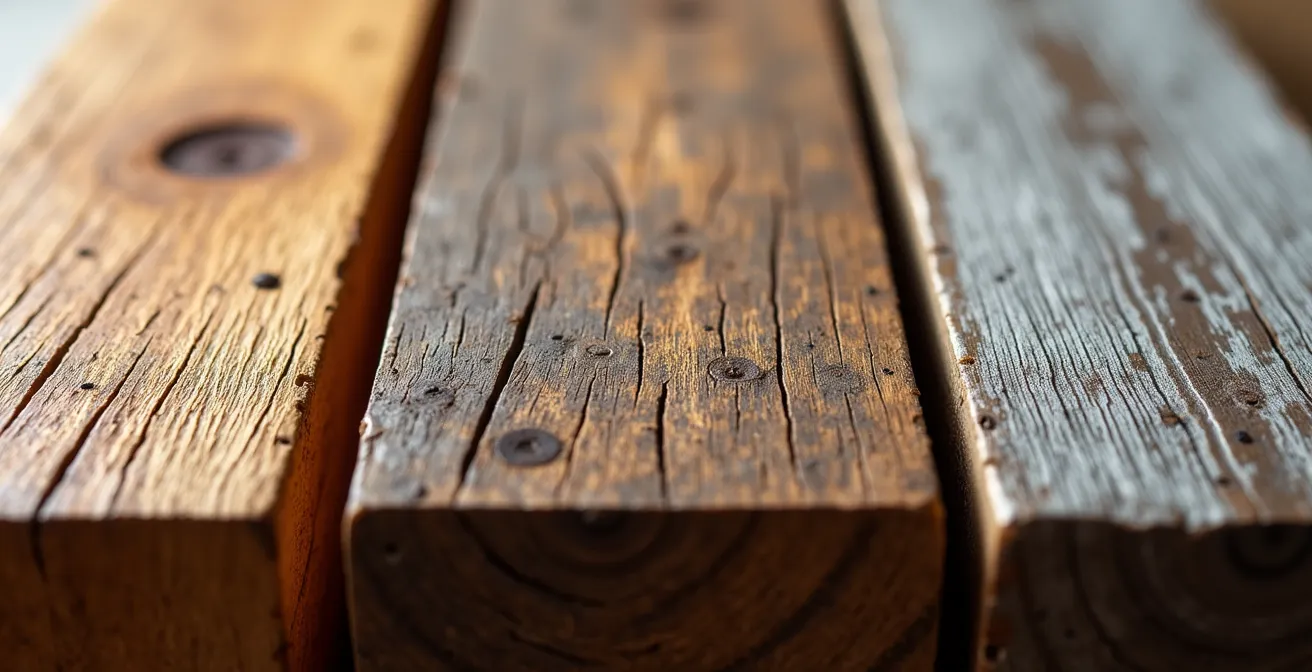
In contrast, a finishing oil, particularly one with UV inhibitors, works by penetrating into the wood fibers. It nourishes the timber from within and enhances the natural grain, providing a more matte, tactile finish. It doesn’t form a film, so it won’t crack or peel. Instead, it allows the wood to breathe and move naturally. While oil finishes require more regular reapplication (typically every 12-18 months), maintenance is simple: a light clean and another coat. It works *with* the wood, not against it, slowing the graying process rather than trying to encase it in plastic. For those who respect the material, oil is almost always the superior choice for maintaining the health and authentic appearance of the timber.
Mortise and Tenon vs Steel Plates: Which Joinery Lasts Longer?
The method used to connect the beams of your frame is fundamental to its integrity and aesthetic. The age-old debate pits traditional, hand-crafted mortise and tenon joints, secured with oak pegs, against modern engineered connections using steel plates, flitch plates, and bolts. While steel offers calculable strength and precision, the longevity and resilience of traditional wood-on-wood joinery are often underestimated, especially in the context of a living timber frame.
Mortise and tenon joinery is an elegant system designed to work in harmony with green oak’s movement. As the frame shrinks, the joints pull tighter, increasing their strength. This method relies on the skill of the carpenter and the inherent compressive strength of the wood itself. It offers a clean, uninterrupted timber aesthetic that is the hallmark of structural honesty. Modern engineering, however, often favors visible or concealed steel plates for their predictable load-bearing capacity and speed of assembly, creating a more industrial or hybrid look.
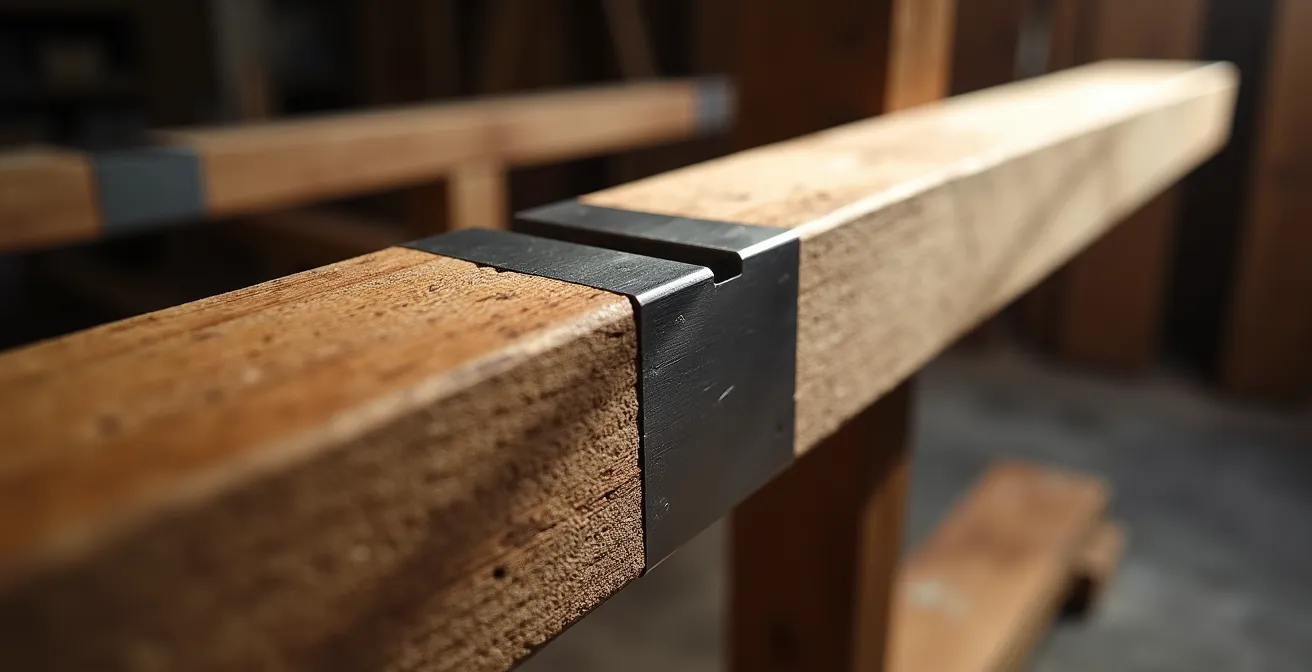
But which lasts longer? While steel seems intuitively more durable, it has a critical vulnerability that wood does not: fire. In a fire, steel heats up quickly, loses its structural integrity, and can fail suddenly and catastrophically. An oak beam, by contrast, performs in a predictable way.
Case Study: The Superior Fire Performance of Traditional Oak Joinery
Building Regulations and fire safety tests confirm a counter-intuitive truth: heavy timber joints maintain their integrity longer in a fire than unprotected steel. When exposed to fire, a large oak beam develops a thick layer of char on its surface. This char acts as an insulator, protecting the core of the wood and allowing it to maintain its load-bearing capability for a predictable period. In contrast, an unprotected steel connection can reach its failure temperature much more quickly. This makes pegged wooden joints a surprisingly resilient choice for structural safety.
The Hidden Costs of Building with Oak Frames Compared to Softwood
When budgeting for an extension, it’s tempting to compare the raw material cost of an oak frame to a standard softwood alternative. On this metric, oak is undeniably more expensive. However, this simple comparison misses the “hidden” value and long-term costs that define the true investment. The upfront cost of a timber frame extension is significant; recent data shows that in the UK, current construction costs for timber frame extensions range between £1,600 and £2,700 per m², with oak at the higher end of that spectrum.
So, where is the hidden value? First, longevity and durability. A properly constructed oak frame is a multi-generational structure that adds significant, lasting value to a property, unlike a standard softwood frame which is considered a more temporary construction method. Second, the cost of oak includes the artisan craftsmanship required to cut and fit the joints, an investment in skill that is part of the building’s story. Third, there is the aesthetic value; an exposed oak frame is both structure and finish in one, eliminating the cost of plasterboarding, skimming, and decorating large areas.
Finally, and increasingly important, is the environmental cost. Wood is a carbon sink, and choosing a timber frame over masonry or steel has a profound impact on the project’s carbon footprint. This “hidden” saving is a critical part of the modern cost equation.
Case Study: The Carbon Dividend of Timber Construction
Choosing timber is a direct investment in sustainability. Wood has the lowest CO₂ cost of any commercially available building material. For context, every cubic metre of wood used in construction saves approximately one tonne of CO₂ from being emitted into the atmosphere. A typical three-bedroom detached house built with a timber frame can save three tonnes of CO₂ from its 20-tonne carbon footprint compared to using conventional materials. This makes an oak frame not just a structural choice, but an environmental one.
Why Exposed Brick Walls Create Emotional Connection to History?
When a new timber extension meets an old house, one of the most powerful design choices is to leave the original exterior wall exposed on the interior. This act of preservation creates a rich material dialogue between past and present. An exposed brick or stone wall is more than a surface; it’s a textured document of the home’s history. The subtle variations in color, the imperfections, and the patina of age evoke a deep sense of permanence and authenticity that a new, perfect wall simply cannot replicate. It connects us emotionally to the generations of craftspeople who built the original structure.
This connection is deeply personal and transforms the character of the new space. It provides a narrative anchor, a story that can be seen and touched. As one homeowner experienced when renovating their historic property:
The original exterior stone wall of our 17th-century property has become an enchanting interior feature. Its light sand, beige and brown tones shaped the neutral color palette of our new oak frame extension, creating a magical dialogue between centuries of craftsmanship.
– Heritage Building Renovation Experience, Grand Designs Magazine
This historical element provides a tactile link to the past. By learning to “read” the features of the brick or stonework, you can deepen this connection, uncovering stories about when and how your home was built. Every mark and pattern has a meaning.
Your Action Plan: How to ‘Read’ Historical Brick Features
- Look for frog marks: Check for indentations in the brick face, which can often identify the brickmaker and provide clues to the approximate date of manufacture.
- Identify firing patterns: Observe color variations from light to dark, which indicate the brick’s original position within the kiln and the intensity of the heat it received.
- Examine mortar joints: Analyze the type of mortar (gritty lime vs. smooth cement) and its profile (such as weather-struck, flush, or recessed) to reveal the construction era.
- Note brick bonds: Identify the laying pattern, such as Flemish, English, or Stretcher bond, as these different styles indicate specific historical periods and regional building preferences.
- Check for reused materials: Look for a mix of different brick types or sizes, which suggests the structure was built in multiple phases or used salvaged materials from even older buildings.
How to Connect a New Roof Pitch to an Existing Structure Without Leaks?
The single most critical technical challenge in any extension project is the junction where the new roof meets the existing building. A poorly executed connection is a guaranteed source of leaks, drafts, and long-term structural issues. The key to success is understanding that the new and old parts of the building will move differently. A new green oak frame will shrink vertically, while the existing masonry or timber structure will expand and contract thermally. The connection must be robust yet flexible, creating a weatherproof seal that can accommodate this differential movement.
This is achieved through a carefully detailed system of flashings. Typically, a lead or a modern lead-alternative flashing is let into a channel cut into the existing wall’s mortar joint. This flashing is then dressed down over a stepped sequence of underlying trays and soakers that integrate with the new roof’s tiling or slates. This multi-layered approach ensures that any water that gets past the primary flashing is safely channeled away. It is not a single line of defense, but an overlapping system designed for resilience.
The choice of specific connection method depends entirely on the materials being joined. You cannot use a rigid connection designed for two similar structures when joining timber to masonry. Each combination requires a unique approach to manage movement.
| Existing Structure | New Extension | Connection Method | Key Consideration |
|---|---|---|---|
| Masonry | Timber Frame | Stainless steel channel ties | Allow vertical & horizontal movement |
| Brick | Green Oak | Flexible flashing system | Account for up to 7.5% shrinkage |
| Timber Frame | Timber Frame | Standard rigid connection | Similar expansion rates |
| Any type | SIPs | Movement joint with sealant | Different thermal properties |
Getting this detail right is a non-negotiable part of the build. It requires a deep understanding of material science and experienced craftsmanship. It is the invisible detail that ensures the long-term health and integrity of your entire home, preventing the heartache of water ingress for decades to come.
Key takeaways
- Green oak’s movement is a feature that strengthens traditional joints; kiln-dried timber provides immediate, predictable stability.
- Exposing the beams requires an ‘outside-in’ insulation strategy, typically with SIPs, to achieve modern thermal performance.
- Oil finishes work with the wood’s nature to manage its aging patina, while varnishes create a film that can fail over time.
Seamless Home Extensions: How to Match New Brickwork to an Old House?
When extending a brick house, creating a seamless transition between the old and new is an art form. The immediate impulse is to find a “perfect” brick match, but this often leads to a disappointing result where the new section looks like a flat, soulless imitation of the original. A truly successful blend goes beyond color to encompass texture, bond pattern, and mortar. As experts note, the visual rhythm of the bricklaying is just as important as the hue.
The art of matching brickwork isn’t just about color – the laying pattern is just as critical as matching the brick colour for a truly invisible blend
– Grand Designs Magazine, Oak-framed extensions guide
To achieve a seamless look, you must first source bricks that match the size, texture, and color range of the originals, often from a reclamation yard. Then, your bricklayer must replicate the historical bond (e.g., Flemish or English bond). Finally, the mortar must be matched in color, texture (by using the right sand), and joint profile. This meticulous process is the only way to make the new work feel like a genuine continuation of the old.
However, there is an alternative and equally valid philosophy: honest architecture. Instead of trying to imitate the past, this approach seeks to create a clear, deliberate, and beautiful contrast between the old and the new. It celebrates both the heritage structure and the modern addition, creating a dialogue between two different moments in time.
Case Study: Honest Architecture and Deliberate Contrast
In the extension of an Edwardian vicarage, the architects chose not to match the old brickwork. Instead, the contemporary oak frame extension was clad in cut face stone. While the material was different, its proportions and tones were carefully chosen to be sympathetic to the original building. This created an “honest” dialogue, establishing a clear and beautiful distinction between the original structure and the modern addition without any attempt to deceive the eye. It celebrates both elements for what they are.
Whether you choose the living character of green oak or the engineered precision of kiln-dried timber, the success of your extension hinges on this deep respect for the material. By understanding its properties, embracing its journey, and designing in harmony with its nature, you create more than just a space—you build a lasting part of your home’s story. The next logical step is to bring this material philosophy into the conversation with your architect and builder, ensuring your vision is realized with both structural integrity and soulful character.
Frequently Asked Questions about Green Oak vs Kiln-Dried
What’s the best finish for exterior oak frames exposed to weather?
A wood oil such as Osmo UV Protection Oil Extra feeds and nourishes the wood while protecting it from weathering. It contains UV filters that slow down the color bleaching process, working with the wood rather than sealing it under a film.
How often do oil finishes need reapplication compared to varnish?
Marine-grade varnishes often require annual maintenance coats, which involve significant sanding if the film has been breached. In contrast, quality oil finishes typically need a simple clean and re-oiling every 12-18 months, depending on the degree of sun and rain exposure.
Can I embrace the natural silvering process?
Yes, absolutely. Allowing oak to weather naturally to a silver-grey patina is a valid, low-maintenance choice. This look complements minimalist, rustic, and biophilic designs beautifully and is a testament to the wood’s graceful aging.