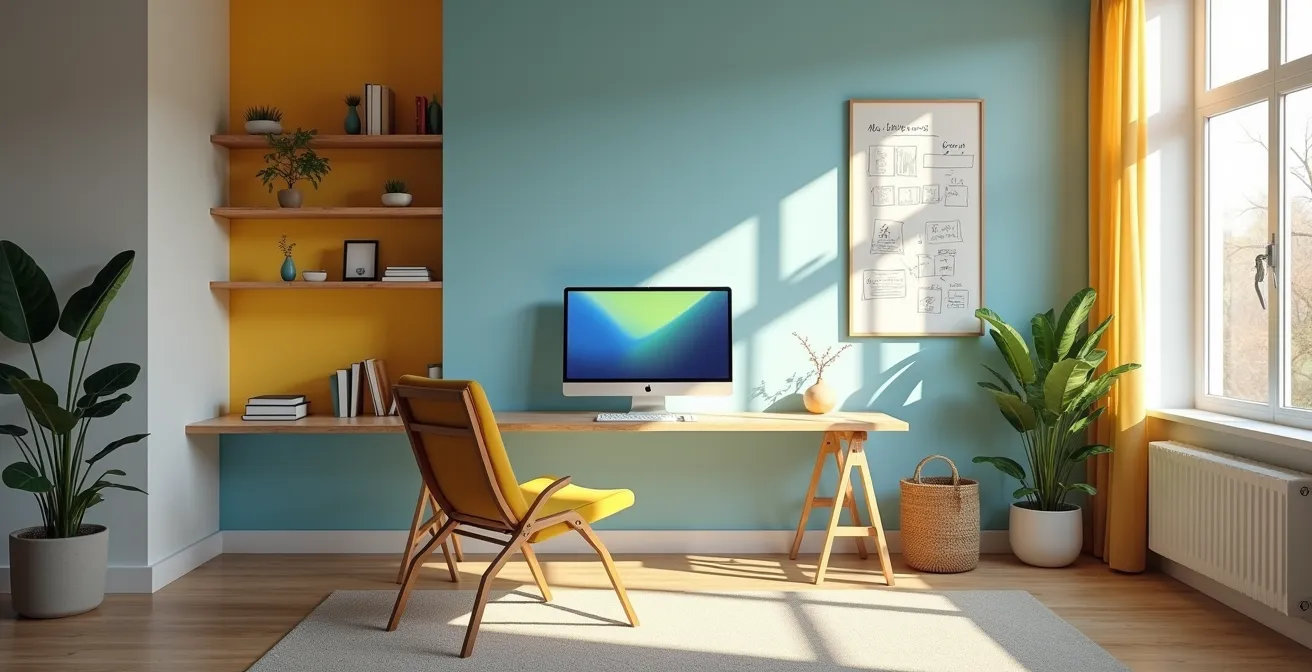
Contrary to popular belief, simply painting your office blue won’t magically boost productivity; success lies in using color as a strategic tool to manage your brain’s cognitive load and neurochemical responses.
- Your environment’s colors directly influence focus and creativity by either increasing or decreasing visual stimulation and stress signals.
- Elements like visible clutter and excessive ornamentation are not just messy; they actively increase cortisol levels and drain the mental energy needed for deep work.
Recommendation: Stop thinking about color as static decoration and start treating it as a dynamic environmental system you can adjust to support specific tasks and psychological states.
For the modern remote worker, the home office is both a sanctuary and a battleground. The struggle to maintain focus amidst household distractions is a familiar challenge, leading many to seek solutions in environmental design. The most common advice centers on color psychology, a field often reduced to simplistic maxims: blue for focus, green for calm, yellow for creativity. While there’s a kernel of truth in these suggestions, they barely scratch the surface of a much deeper neuroscientific reality. The belief that a single coat of paint can solve complex productivity issues overlooks the fundamental mechanism at play.
The true impact of color on performance is not about the hue itself, but about its strategic application. It’s a matter of intensity, proportion, and context. From a behavioral psychology perspective, the colors in your workspace are constantly sending signals to your brain, influencing everything from your heart rate to your ability to think critically. An environment saturated with the “wrong” color—or even too much of the “right” one—can elevate cognitive load, induce eye strain, and subtly increase stress hormones. The key isn’t to find one perfect color, but to design a visual ecosystem that actively supports your mental state throughout the workday.
This guide moves beyond the platitudes to provide a scientific framework for using color as an instrument of productivity. We will deconstruct how specific color applications can manage your focus, why physical and visual clutter sabotages your efforts, and how to build a balanced, responsive workspace. By understanding the underlying principles, you can transform your office from a passive backdrop into an active partner in your professional success.
To navigate these concepts effectively, this article is structured to build from foundational color principles to advanced environmental strategies. The following summary outlines the key areas we will explore to help you master your workspace’s psychological impact.
Summary: Mastering Color and Environment for Peak Home Office Productivity
- Why Blue Tones Improve Focus for Analytical Tasks?
- How to Apply the 60-30-10 Rule for a Balanced Color Palette?
- Warm Yellow vs Cool Grey: Which Is Better for a Creative Studio?
- The Neon Mistake That Causes Eye Strain and Headaches
- When to Change Your Wall Colors: Signs Your Environment Is Stagnant
- Why Excessive Ornamentation Increases Cognitive Load in Small Homes?
- Why Visible Clutter Increases Cortisol Levels in the Evening?
- How to Introduce Vibrant Textile Accents into a Neutral Room Without It Looking Cheap?
Why Blue Tones Improve Focus for Analytical Tasks?
The common association of blue with focus and productivity is not arbitrary; it’s rooted in physics and neurobiology. Blue light has a shorter wavelength than warmer colors like red and yellow. This means our eyes do not have to work as hard to process it, leading to a state of reduced visual stimulation. For tasks requiring deep, analytical concentration—such as writing, coding, or financial analysis—an environment that minimizes extraneous visual “noise” allows the brain to allocate more resources to the task at hand. A pale or muted blue acts as a cognitive filter, creating a serene backdrop that supports sustained mental effort.
However, the type of task is critical. While blue supports broad concentration, some research suggests a different approach for tasks that are highly detail-oriented. For instance, a notable UBC study on color and performance indicated that red, often dismissed as aggressive, can actually be more effective for proofreading or data entry. This is because red acts as a powerful attention signal, prompting a state of heightened awareness. This doesn’t mean you should paint your office red, but it highlights a crucial principle: the most “productive” color is entirely dependent on the nature of the work being performed.
To harness the focusing power of blue without creating a monotonous or cold environment, strategic application is key. The goal is to create a calming foundation that can be layered with other elements. The following checklist provides a practical guide for implementation.
Action Plan: Implementing Blue Shades for Optimal Focus
- Assess Your Tasks: Identify the primary activities performed in the space. Use deep, grounding shades like Navy Blue for areas designated for ‘deep work’.
- Apply with Restraint: Use Pale Blue on a single accent wall to gain the anxiety-reducing benefits without the color overwhelming the room and feeling cold.
- Control Light Reflection: Choose matte blue finishes over glossy ones. Matte surfaces absorb light and minimize distracting glares and visual hot spots.
- Balance with Warmth: Pair blue walls with warm lighting (around 2700K color temperature) in the evenings to counteract the cool tones and prevent color fatigue.
- Maintain Proportional Balance: Ensure blue does not dominate more than 60% of the room’s color scheme to prevent the space from feeling sterile and uninspiring.
How to Apply the 60-30-10 Rule for a Balanced Color Palette?
The 60-30-10 rule is a timeless interior design principle that is exceptionally relevant for creating a psychologically balanced home office. Its power lies in preventing cognitive overload caused by competing visual stimuli. The rule dictates that you should select three colors and use them in a specific ratio: 60% for your dominant color, 30% for a secondary color, and 10% for an accent color. From a neurological standpoint, this hierarchy creates a clear visual order that the brain can process effortlessly, freeing up mental energy for productive tasks.
The 60% dominant color typically covers the largest surfaces, such as walls, establishing the overall mood of the room. The 30% secondary color provides visual interest and should be used on elements like furniture, curtains, or an accent wall. The final 10% is for accent pieces—cushions, artwork, or small decor items—that inject personality and act as focal points without creating chaos. This structure guides the eye smoothly through the space rather than having it dart between competing elements of equal visual weight.
This illustration visually breaks down how these proportions create a harmonious and productive workspace.
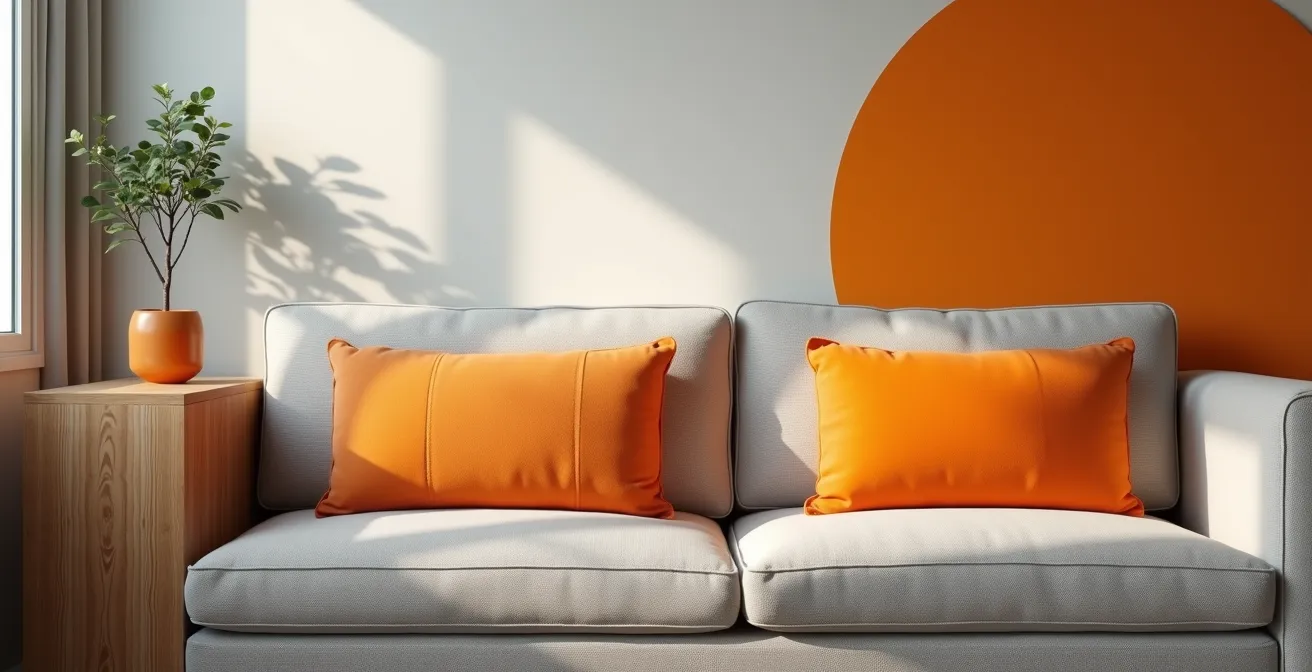
As the image demonstrates, the neutral walls provide a calm foundation (60%), the wooden desk adds warmth and texture as a secondary element (30%), and the single pop of color in the cushion serves as a deliberate accent (10%). This measured approach avoids the visual clutter that leads to distraction. The following table explores different ways to apply this powerful rule depending on your desired aesthetic.
| Application Style | 60% (Dominant) | 30% (Secondary) | 10% (Accent) |
|---|---|---|---|
| Classic Neutral | White/Beige walls | Natural wood furniture | Metallic or velvet accents |
| Bold Contemporary | Charcoal grey walls | Light wood elements | Vibrant color pop (yellow/orange) |
| Digital Integration | Physical wall color | Desktop wallpaper/app themes | Decorative accessories |
| Textural Variation | Smooth painted walls | Natural textures (wood/stone) | Contrasting fabrics |
Warm Yellow vs Cool Grey: Which Is Better for a Creative Studio?
The choice between an energizing warm color and a neutral cool color depends entirely on the type of creativity you wish to foster. This is where a one-size-fits-all approach to color psychology fails. For tasks involving brainstorming, divergent thinking, and innovation, a warm yellow can be a powerful catalyst. Yellow is associated with optimism and energy; it stimulates the nervous system and can encourage a more extroverted, experimental mindset. As color psychology expert Angela Wright notes, this link is profound.
Yellow is energizing and cheerful, associated with innovation and optimism. It takes guts to be creative and come up with something new – that’s why yellow works in that environment.
– Angela Wright, Color Psychology Expert, Interview on Office Productivity
Conversely, a cool grey environment is better suited for creative tasks that require intense focus and refinement, such as design execution, editing, or detailed illustration. Grey provides a neutral canvas that minimizes visual distractions, allowing the creative work itself to be the center of attention. It promotes a state of calm concentration, preventing the overstimulation that can sometimes hinder the final stages of a creative process. The ideal environment, therefore, may not be one color, but a combination of zones.
Case Study: Color Zoning at Google and Amazon
Tech giants like Google and Amazon have moved beyond single-color schemes by implementing “color zoning” in their offices. Through extensive testing, they discovered that employee performance improved when specific colors were assigned to different types of workspaces. As one workplace analysis from Interaction highlights, they use vibrant colors like yellow in collaborative, creative hubs to spark energy and ideas, while employing neutral tones like grey in “focus pods” where deep, individual work is required. This task-based approach demonstrates that the most effective strategy is to match the psychological properties of a color to the cognitive demands of the work performed within that space.
The Neon Mistake That Causes Eye Strain and Headaches
In an effort to combat the monotony of a bland office, many people make a critical error: they overcompensate with neon. While the intention is to inject energy, the result is often the opposite. Highly saturated, fluorescent colors are intense visual stressors. The human eye is not designed to process such high-intensity light for extended periods. Staring at a neon accent wall or decor can lead to visual fatigue, eye strain, and even tension headaches, all of which are profoundly counterproductive. This happens because the rods and cones in our retinas become overstimulated, forcing the brain to work harder to interpret the visual information.
This mistake is often a reaction to the negative psychological effects of an under-stimulating environment. In fact, research from the University of Texas found that bland office colors like gray, beige, and white can induce feelings of sadness and depression in workers. The desire for vibrancy is valid, but neon is a blunt instrument. A much more effective approach is to use fully saturated, but non-fluorescent, primary colors in a measured way. These colors provide the psychological lift you’re seeking without the accompanying physiological strain.
Instead of turning your office into a rave, consider these sophisticated, scientifically-backed alternatives to introduce energy without the negative side effects. The key is to use vibrant color as a strategic accent, not an overwhelming flood.
Your Action Plan: Safe Alternatives to Neon for an Energy Boost
- Choose Saturated, Not Fluorescent: Replace neon pink with a rich Poppy Red or swap lime green for a deep Klein Blue. These colors are vibrant but exist within the natural spectrum the eye can comfortably process.
- Use Indirect or Temporary Light: Incorporate indirect LED lighting with color-changing capabilities. Use the vibrant settings only during short breaks for a quick mental reset, not for continuous work.
- Apply Micro-Accents: Limit bright colors to single, small objects like a pen holder, a mousepad, or the spine of a notebook. This provides a visual “spark” without creating a dominant, straining focal point.
- Focus on Accent Pieces: Instead of walls, use vibrant but non-fluorescent shades on removable items like a single chair cushion, a piece of artwork, or a desk lamp.
- Adhere to the 10% Rule: In any application, ensure that high-saturation colors are strictly limited to the 10% accent portion of your room’s color palette, as defined by the 60-30-10 rule.
When to Change Your Wall Colors: Signs Your Environment Is Stagnant
One of the most overlooked aspects of environmental psychology is a phenomenon known as Chromatic Habituation. This is the brain’s natural tendency to stop registering a constant stimulus over time. The energizing yellow or focusing blue that felt so effective when you first painted your office will inevitably lose its psychological impact as your brain adapts and begins to filter it out. When this happens, the color becomes part of the neutral background, and its benefits diminish. Recognizing the signs of a stagnant visual environment is the first step to revitalizing your workspace and your productivity.
The indicators are often behavioral rather than aesthetic. You might notice a gradual increase in procrastination, a feeling of boredom or lethargy upon entering the room, or a general sense that the space feels “flat” and uninspiring. A key sign is when you no longer consciously “see” the color of your walls; it has become so familiar that it’s invisible. This is your brain telling you that it needs new stimuli to stay engaged. A static environment leads to a static mindset, which is the enemy of both creativity and motivation.
Fortunately, combating chromatic habituation doesn’t always require a complete repaint. The goal is to introduce change and novelty into your visual field. This can be achieved through dynamic solutions that are less permanent and more adaptable. Consider installing smart lighting systems like Philips Hue, which allow you to alter the room’s color and intensity with an app. Another effective strategy is to create an evolving gallery wall where you regularly rotate artwork, photos, or prints. Even something as simple as changing your desktop wallpaper or using large, changeable fabric panels can provide the necessary visual refresh to keep your brain stimulated and your workspace feeling fresh and effective.
Why Excessive Ornamentation Increases Cognitive Load in Small Homes?
In any home office, but especially in smaller spaces, every object in your visual field competes for your brain’s attention. This creates a hidden tax on your mental resources known as cognitive load. Your brain has a finite amount of processing power, and when it’s forced to subconsciously register, identify, and filter out dozens of small, ornamental objects—souvenirs, knick-knacks, multiple small picture frames—it has less capacity available for deep, focused work. While these items may add personality, an excess of them creates a constant, low-level distraction that fragments your attention.
This principle is about signal versus noise. A productive environment is one that has a high signal-to-noise ratio. A few carefully chosen, meaningful items act as a strong “signal,” providing a positive psychological anchor. Conversely, a multitude of small, unrelated objects creates “noise,” forcing your brain into a state of continuous, low-grade multitasking. This is why minimalist design is so often associated with productivity; by reducing the number of visual inputs, it lowers cognitive load and allows for more profound concentration. This is particularly crucial in a work-from-home context, where optimizing the environment is one of the few variables completely within our control.
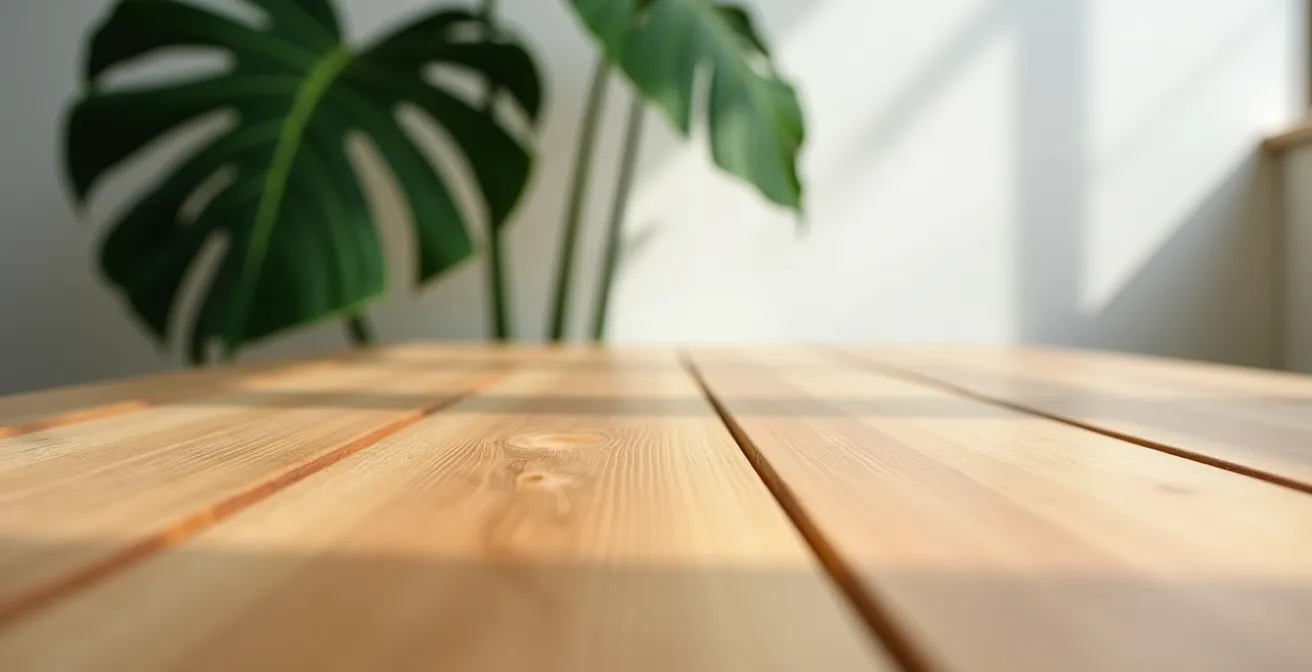
The solution is not to create a sterile, empty box, but to be deliberate. Rather than displaying twenty small items, choose one large, impactful piece. This creates a single, strong focal point instead of a chaotic field of visual information. This concept is powerfully illustrated in biophilic design, which focuses on connecting people with nature.
Case Study: Biophilic Design and Cognitive Load
A recent 2024 study on biophilic design’s impact on productivity found a significant positive correlation. The research revealed that workspaces incorporating singular, large natural elements, such as an oversized plant or a piece of natural wood art, were more effective at improving performance than those with multiple small ornamental objects. The single large element created a powerful, calming focal point, which actively reduced cognitive load and improved focus, while the collection of smaller items tended to increase visual noise and distraction.
Why Visible Clutter Increases Cortisol Levels in the Evening?
Visible clutter is more than just an organizational problem; it is a potent physiological stressor. Throughout the day, your brain perceives a cluttered desk or room as an environment of unfinished business. Each pile of paper, misplaced book, and tangled cable represents a micro-task that is yet to be completed. This continuous visual reminder of your to-do list creates a low-level, persistent stress response. While you may be able to ignore it during the high-energy hours of the workday, its effect becomes particularly damaging in the evening.
As the day wears on, your reserves of willpower and executive function—the mental resources responsible for decision-making, focus, and impulse control—become depleted. It’s at this point that the visual stress of clutter becomes most powerful. Your diminished capacity to “filter out” the mess means it commands more of your attention, leading to a measurable increase in cortisol, the body’s primary stress hormone. This is precisely when your cortisol levels should be naturally decreasing to prepare your body for rest and sleep. As one leading researcher in the field explains, this timing is what makes clutter so insidious.
At night, willpower and executive functions are depleted. Clutter, which represents an unfinished to-do list, becomes a more potent visual stressor, spiking cortisol precisely when it should be decreasing for sleep.
– Dr. Nancy Kwallek, Effects of Office Interior Color on Workers’ Mood and Productivity
This evening cortisol spike can disrupt sleep patterns, increase feelings of anxiety, and prevent the psychological recovery necessary to be productive the next day. The most impactful productivity habit you can build may have nothing to do with your work itself, but with implementing a “shutdown ritual” that involves clearing your physical and digital workspace at the end of each day. This act signals to your brain that the work is complete, allowing your nervous system to switch from a state of high alert to one of rest.
Key Takeaways
- Productivity is task-dependent: Use blue for analytical focus and yellow for creative brainstorming.
- Prevent cognitive overload by using the 60-30-10 rule to create a clear visual hierarchy in your workspace.
- Your environment is dynamic; combat “chromatic habituation” by periodically changing visual elements to keep your brain engaged.
How to Introduce Vibrant Textile Accents into a Neutral Room Without It Looking Cheap?
After establishing a balanced, neutral foundation in your home office, you may wish to add vibrant accents for energy and personality. However, this is where many well-intentioned designs falter, resulting in a space that looks cheap rather than chic. The perceived value of an accent has less to do with the color itself and more to do with the material, texture, and application. Shiny, synthetic fabrics like polyester tend to reflect light harshly and can make even rich colors look garish. They lack the depth and tactile quality that signal sophistication.
The key to introducing vibrant color successfully is to choose natural, rich materials. Fabrics like velvet, linen, or chunky-knit wool have a complex texture that absorbs and refracts light in a more pleasing, nuanced way. A deep jewel-toned velvet cushion has a perceived value far greater than a similarly colored polyester one because its texture adds a layer of sensory richness. This focus on materiality is the dividing line between a sophisticated accent and a cheap-looking addition. The following table highlights how different materials are perceived and where they are best applied.
| Material Type | Perceived Quality | Best Application | Color Saturation |
|---|---|---|---|
| Velvet | Luxurious | Cushions, throws | Deep, rich colors work best |
| Linen | Sophisticated | Curtains, pillow covers | Muted to medium saturation |
| Chunky Knit | Cozy, expensive | Throws, poufs | Any saturation level |
| Shiny Polyester | Cheap | Avoid | Tends to look garish |
Beyond material choice, the strategy of application is crucial. A single, lonely accent can look like an afterthought. A more sophisticated approach involves repeating the accent color in a deliberate, rhythmic way throughout the space. This creates a sense of intention and cohesion.
Action Plan: The Rule of Three for Sophisticated Color Accents
- Select Natural, Rich Materials: Prioritize textiles like velvet, linen, or chunky-knit wool over shiny, synthetic fabrics to ensure a high-quality look and feel.
- Repeat the Accent Color: Purposefully place your chosen accent color in at least three locations of varying scale and height (e.g., a cushion, a piece of art, and a vase).
- Mix Textures within a Color Family: For a designer look, combine different textures in the same accent color, such as a ceramic vase, a fabric throw, and a small metallic object.
- Paint Unexpected Elements: For a subtle but impactful statement, apply your accent color to the interior of a bookshelf, the edge of a door, or a single drawer front instead of adding more textiles.
- Organize by Color: Create intentional color blocks by grouping books on a shelf according to the color of their spines, turning everyday objects into a deliberate design feature.
Now that you are equipped with the scientific principles of color and environmental psychology, the next step is to apply them. Begin today by auditing a single element of your workspace—a cluttered surface, a bland wall, a jarring accent—and implement one of these strategies to reclaim your focus and create an environment that actively supports your best work.
Frequently Asked Questions about Color and Productivity in the Workspace
What is Chromatic Habituation?
The brain’s tendency to stop registering constant color stimuli over time, neutralizing the initial psychological benefits of your chosen colors.
What are behavioral signs that indicate color stagnation?
Noticeable increase in procrastination, feeling of boredom when entering the room, or no longer consciously ‘seeing’ the wall color.
What are alternatives to repainting when experiencing color fatigue?
Use large changeable fabric panels, install smart lighting like Philips Hue to alter room color dynamically, or create an evolving gallery wall to refresh visual stimuli.