
In summary:
- Your garden’s struggle with extreme weather isn’t a plant problem; it’s a system design problem.
- A resilient yard actively harvests water, builds living soil, and uses plant relationships to regulate itself.
- Shift from isolated fixes to creating an integrated ecosystem where every element supports the others.
- This guide provides permaculture strategies to manage everything from drought to downpours naturally.
As a gardener, you’ve likely noticed the unsettling shifts. The heatwaves are hotter and longer, the rain, when it finally comes, arrives in torrential downpours, and plants that once thrived now struggle to survive. The common advice often feels like a losing battle: plant more drought-tolerant species, apply another layer of mulch, or install complex irrigation systems. While these tactics can offer temporary relief, they treat the symptoms, not the root cause of a fragile landscape.
The fundamental issue is that we have been taught to create gardens as collections of individual, dependent plants rather than as integrated, self-sufficient ecosystems. A truly resilient yard doesn’t just endure climate extremes; it is designed to interact with them. It captures and stores every drop of rain, fosters a living soil that acts like a sponge, and uses intelligent plant partnerships to create shade, fix nutrients, and manage pests. This is the core of permaculture design: seeing the yard as a whole system.
But what if the key to a thriving garden wasn’t just in what you plant, but in how you shape the land, build the soil, and foster a web of natural relationships? This approach transforms your role from a constant caretaker into a thoughtful designer of a self-regulating system. Instead of fighting against nature, you begin to work with its powerful, regenerative patterns.
This guide will walk you through the core strategies for redesigning your backyard into a resilient ecosystem. We will explore how to manage water, build a robust soil food web, leverage ancient planting wisdom, and even turn hardscaping into a functional part of your landscape’s climate defense. It’s time to build a garden that works with the weather, not against it.
To help you navigate these powerful concepts, this article is structured around key permaculture interventions. The following table of contents outlines the journey from large-scale water management to the fine details of natural pest control, providing a complete blueprint for your resilient backyard.
Table of Contents: A Blueprint for a Climate-Proof Backyard
- Digging Swales: How to Capture Rainwater Passive for Trees?
- The Three Sisters Guild: Ancient Planting Wisdom for Modern Yards
- No-Till Gardening: Why Tilling Destroys Your Soil’s Resilience?
- How to Attract Ladybugs to Control Aphids Naturally?
- Mulching Strategies to Save Roots During 100°F Heatwaves
- Why You Shouldn’t Amend Soil When Planting Natives?
- How Permeable Pavers Prevent Basement Flooding During Heavy Rains?
- Recirculating Stone Fountains: How to Maintain Water Clarity Without Chemicals?
Digging Swales: How to Capture Rainwater Passive for Trees?
In a conventional landscape, rainwater is a problem to be managed—channeled away from the house and into storm drains as quickly as possible. In a resilient ecosystem, rainwater is the most precious resource, and the goal is to keep every drop on your property. This is where swales come in. A swale is a simple but powerful earthwork: a shallow trench dug on contour, with the excavated soil piled on the downhill side to form a berm. Its purpose is not to move water, but to stop, spread, and sink it.
When it rains, the swale captures runoff, allowing it to slowly infiltrate the soil instead of flowing away. This process recharges the groundwater, creating a lens of moisture deep in the earth that plant and tree roots can access long after the rain has stopped. This is passive irrigation at its finest, a landscape-scale battery for water. The potential is enormous; research shows that a typical residential roof can capture over 22,900 gallons of water annually, which can be directed into a swale system to hydrate your entire yard.
Trees and other perennial plants planted on the downhill berm of a swale thrive, their roots tapping directly into this stored water. Over time, this system dramatically increases the landscape’s drought resistance, reduces the need for supplemental watering, and prevents soil erosion. It’s a foundational shift from viewing rain as a threat to harnessing it as the lifeblood of your garden’s resilience.
The Three Sisters Guild: Ancient Planting Wisdom for Modern Yards
Resilience isn’t just about managing resources like water; it’s also about fostering beneficial relationships between living things. The “Three Sisters”—a traditional planting guild of corn, beans, and squash—is a perfect example of this systems thinking in action. This isn’t just a random grouping of plants; it’s an intelligently designed community where each member supports the others, creating a system that is far more productive and resilient than the sum of its parts.
The corn provides a natural trellis for the climbing beans to ascend. The beans, in turn, are nitrogen-fixers, capturing atmospheric nitrogen and converting it into a form that the nutrient-hungry corn can use. The sprawling squash, with its large leaves, acts as a living mulch, shading the ground to retain moisture, suppress weeds, and create a cool microclimate for the roots of all three plants. But the true genius of this guild lies beneath the surface.
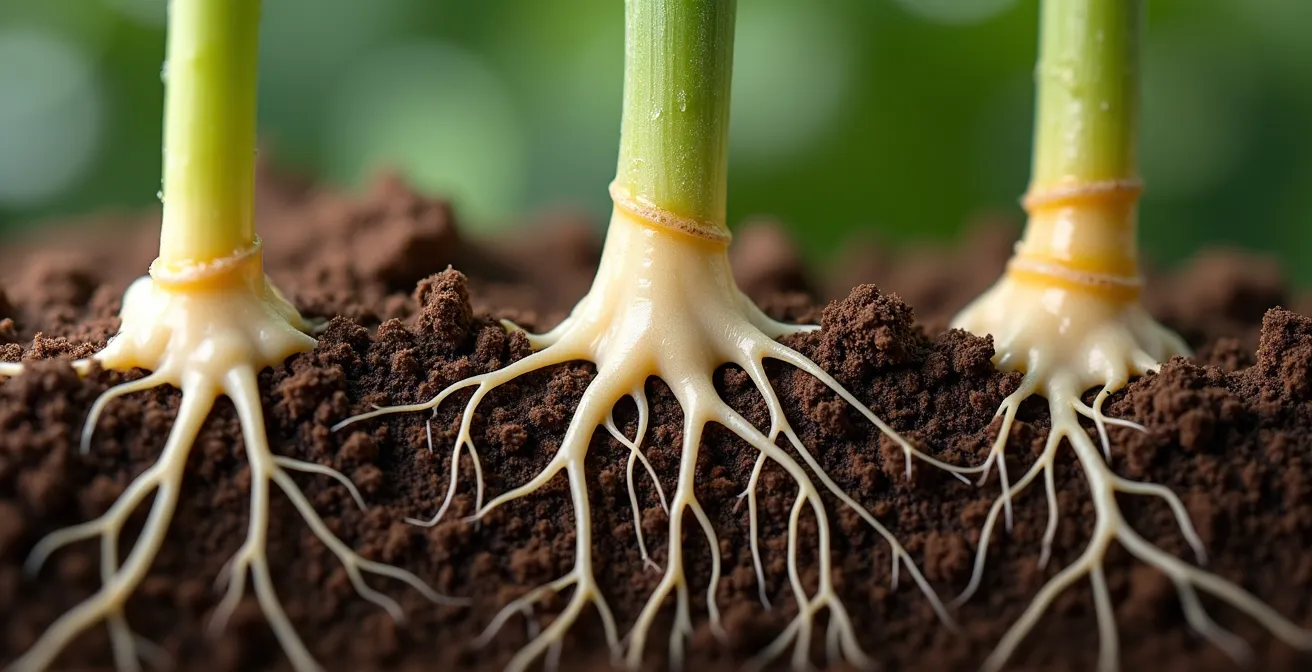
As the illustration suggests, the real magic is in the hidden connections. The roots of these plants don’t operate in isolation; they form a complex web that interacts with the soil ecosystem in profound ways.
Case Study: The Underground Network of the Three Sisters
Research reveals that all three crops in the Three Sisters system form beneficial mycorrhizal associations, creating an underground network that shares nutrients between plants. The mycorrhizal fungi optimally utilize fish fertilizer traditionally placed in mounds, extending nutrient reach far beyond what individual root systems could achieve. Over time, glomalin proteins produced by these fungi improve soil structure and quality, creating a self-sustaining ecosystem that becomes more resilient each growing season.
No-Till Gardening: Why Tilling Destroys Your Soil’s Resilience?
For generations, gardeners have been taught that the first step to a healthy garden is to till the soil, breaking it up into a fine, fluffy bed. This practice, however, is one of the most destructive things you can do to the very foundation of your garden’s resilience: the soil food web. Tilling is the equivalent of an earthquake, hurricane, and tornado combined for the billions of microorganisms that live in the soil. It shatters the delicate fungal networks, exposes protected organic matter to rapid decomposition, and destroys the soil’s natural structure.
Healthy, resilient soil is not just inert dirt; it’s a living, breathing ecosystem. It’s held together by the sticky secretions of bacteria and woven through with vast networks of mycorrhizal fungi. These fungal filaments act as a superhighway, transporting water and nutrients to plant roots far beyond their own reach. When you till, you sever this intricate web, forcing plants to rely solely on what their own roots can find. This creates dependency on external fertilizers and constant watering.
Mycorrhizal symbiosis plays an important role in ecosystems because mycorrhizae affect plant productivity and plant diversity.
– Maherali, H., PMC Research Publication on Mycorrhiza
No-till gardening, by contrast, seeks to protect and feed this underground community. Instead of digging, you build. Layers of compost and mulch are added directly to the surface. This mimics the natural process of decomposition in a forest, slowly building rich, dark, and structurally sound soil. This undisturbed soil can hold more water, resist compaction, and provide a steady stream of nutrients to your plants, making them far more resilient to drought and stress.
How to Attract Ladybugs to Control Aphids Naturally?
When an aphid outbreak occurs, the common reaction is to reach for a pesticide or to order a container of ladybugs online. While releasing ladybugs can provide a temporary fix, it doesn’t solve the underlying problem: your garden lacks the habitat to support a permanent population of beneficial insects. A truly resilient ecosystem doesn’t just import solutions; it creates the conditions for them to arise naturally. The goal is to build a self-regulating system where predators are always present to keep pest populations in check.
The key to attracting and keeping predators like ladybugs, lacewings, and parasitic wasps is to provide for their entire lifecycle. This means offering not just a food source (like aphids) but also nectar, pollen, and safe places to overwinter and lay eggs. This is where native plants excel. Co-evolved with local insect populations, they provide the precise resources that beneficial predators need to thrive year-round, something that most ornamental or non-native plants cannot offer.
As a recent comparative analysis highlights, the difference in ecosystem support between native and non-native plants is stark. Natives are the foundation of a local food web, providing the right resources at the right time.
| Plant Type | Native Plants | Non-Native Plants |
|---|---|---|
| Insect Support | Support complete lifecycles of native predators | Limited support, mainly adult feeding |
| Ecosystem Integration | Co-evolved relationships with local fauna | May lack specific pest-predator connections |
| Maintenance | Lower once established | Often higher water and fertilizer needs |
| Year-round Habitat | Provide overwintering sites naturally | May not offer suitable winter shelter |
By interplanting your garden with a diversity of native flowers and grasses—such as yarrow, asters, and goldenrod—you create a permanent, inviting habitat. These plants will draw in a standing army of beneficial insects, ensuring that when a pest like aphids appears, the predators are already there to manage the problem for you.
Mulching Strategies to Save Roots During 100°F Heatwaves
Mulch is a familiar tool for most gardeners, primarily used for retaining moisture and suppressing weeds. But in an era of extreme heatwaves, its role as a temperature regulator becomes paramount. When air temperatures soar above 100°F (38°C), the surface of bare soil can reach a scorching 140°F (60°C) or more, effectively cooking the delicate feeder roots of your plants. A thick layer of organic mulch acts as an insulator, keeping the soil beneath it dramatically cooler and protecting the vital root zone.
However, not all mulching strategies are created equal when facing extreme heat. A simple layer of bark chips is good, but a more sophisticated, multi-layered approach inspired by permaculture offers superior protection. This involves thinking of mulch not as a static covering but as a dynamic, living system.

To build a truly heat-resilient soil surface, consider these advanced techniques that mimic the layered floor of a thriving forest:
- Living Mulch Strategy: Plant creeping groundcovers like thyme or white clover around the base of larger plants. These actively cool the soil through transpiration while also providing habitat for beneficial insects.
- Chop and Drop Method: Grow robust, leafy plants like comfrey or canna lilies specifically as mulch generators. Periodically “chop” their leaves and “drop” them in place, creating a self-renewing, nutrient-rich mulch layer.
- Proper Application: While a deep layer is key, always keep mulch 3-4 inches away from the stems of your plants to prevent rot and allow for air circulation. Aim for a depth of 4-6 inches everywhere else.
- Ramial Chipped Wood: Seek out mulch made from young branches and twigs (under 3 inches or 7cm in diameter). This “ramial” wood is far richer in nutrients and supports a more robust fungal network than mulch made from heartwood.
Why You Shouldn’t Amend Soil When Planting Natives?
It feels like an act of kindness: you dig a hole for a new native plant, and before placing it in the ground, you generously mix in rich compost or peat moss to “give it a good start.” This is one of the most common and counterproductive mistakes a gardener can make. Native plants are, by definition, adapted to your region’s native soil—be it clay, sand, or loam. “Amending” the soil in the planting hole fundamentally misunderstands and disrupts this profound, evolved relationship.
When you create a pocket of rich, amended soil, you discourage the plant’s roots from exploring the surrounding native soil. Why would they venture into tough clay when they have everything they need in their cozy, amended hole? This leads to a weak, constricted root system that is poorly anchored and unable to access water and nutrients during times of stress. Furthermore, this act of kindness sabotages a critical underground partnership. As research from the Royal Horticultural Society indicates that over 90% of plant families form natural mycorrhizae, a symbiotic relationship with soil fungi.
Phosphorus-rich fertilisers are widely used in cultivated ground and not only reduce the need for mycorrhizal activity but are thought to actually suppress the mycorrhizas.
– Royal Horticultural Society, RHS Biodiversity Guidelines
Native plants and local fungi have co-evolved to work together. The fungi extend the plant’s root system, trading nutrients for sugars. When you add high-phosphorus compost or fertilizer, you essentially tell the plant it no longer needs its fungal partner. The symbiotic connection is broken, and the plant becomes dependent on your amendments for survival. The correct approach is to plant natives directly into the native soil, perhaps roughing up the sides of the hole to encourage root penetration. Trust the plant’s genetics; it knows its home better than you do.
How Permeable Pavers Prevent Basement Flooding During Heavy Rains?
A resilient landscape plan must account for the built environment, especially the vast, impermeable surfaces like driveways, patios, and walkways. In a heavy downpour, these surfaces act like funnels, collecting massive volumes of water and directing it straight towards your home’s foundation, overwhelming gutters and often leading to basement flooding. The traditional solution is to install drains to get the water off-site as fast as possible. The resilient solution is to replace impermeable surfaces with permeable ones.
Permeable pavers look and function like traditional pavers, but they are designed with wider gaps between them, which are filled with small gravel. This allows rainwater to pass through the surface and into a specially prepared, open-graded aggregate base below. This base acts as a temporary reservoir, holding the water and allowing it to slowly infiltrate into the soil beneath. Instead of a flood of runoff, you get slow, steady groundwater recharge. This not only protects your basement but also hydrates your landscape from below.
This approach transforms a liability—stormwater runoff—into an asset. By integrating hardscaping with the principles of water harvesting, you create another layer of defense against both floods and droughts.
Case Study: Massachusetts’ Two-Stage Stormwater Solution
The Massachusetts Department of Environmental Protection reports that properly designed vegetated swales and permeable surfaces can capture and treat the first inch of stormwater runoff, significantly reducing flooding risks. Properties implementing these systems alongside rain gardens create a two-stage water management system that handles even extreme weather events while recharging groundwater supplies for drought resilience.
By slowing down and sinking stormwater right where it falls, permeable pavers reduce the strain on municipal storm systems and help maintain a more balanced water cycle on your property. It’s a perfect example of designing with nature to solve a modern problem.
To remember
- Water harvesting through swales and permeable surfaces is about storing water in the landscape, not just saving it.
- Soil health is driven by the living “soil food web,” which is protected by no-till practices and advanced mulching.
- Intelligent plant relationships, like guilds and native adaptations, create a self-regulating system that manages pests and supports itself naturally.
Recirculating Stone Fountains: How to Maintain Water Clarity Without Chemicals?
Even a small water feature like a recirculating stone fountain can be a microcosm of a resilient ecosystem. The conventional approach to keeping the water clear involves a constant battle against algae using chemical treatments like algaecides. This approach creates a sterile, lifeless feature that is dependent on constant intervention. A permaculture-inspired approach, however, seeks to create a balanced aquatic ecosystem where clarity is maintained naturally by biological processes, not chemicals.
The goal is to establish a system where beneficial bacteria and aquatic plants outcompete algae for nutrients. Algae thrives on excess nutrients and stagnant, low-oxygen water. By designing your fountain to promote biological activity and oxygenation, you can eliminate the conditions algae needs to grow. This turns your fountain from a high-maintenance chore into a vibrant, living part of your garden that attracts birds, dragonflies, and other wildlife.
Maintaining this natural balance requires a few key design and maintenance considerations. It’s about fostering life, not fighting it. A chemical-free fountain is not only better for the environment but also safer for the birds and animals that will be drawn to it.
Checklist: Maintaining a Chemical-Free Fountain
- Install a bog filter section with aquatic plants like irises or rushes and gravel to naturally filter nutrients from the water.
- Add barley straw extract, which slowly releases compounds that inhibit the growth of single-celled algae.
- Design the water feature to maximize splashing and cascading, as this is crucial for optimal water oxygenation.
- Encourage the growth of a healthy biofilm on the rocks, as this community of beneficial microorganisms actively cleans the water.
- Ensure constant water movement to prevent stagnant, anaerobic conditions that can lead to foul odors and algae blooms.
Begin today by choosing one of these strategies—like a new mulching technique or adding a native plant—and observe how your backyard starts building its own resilience. Your journey to a thriving ecosystem starts with a single, thoughtful step.