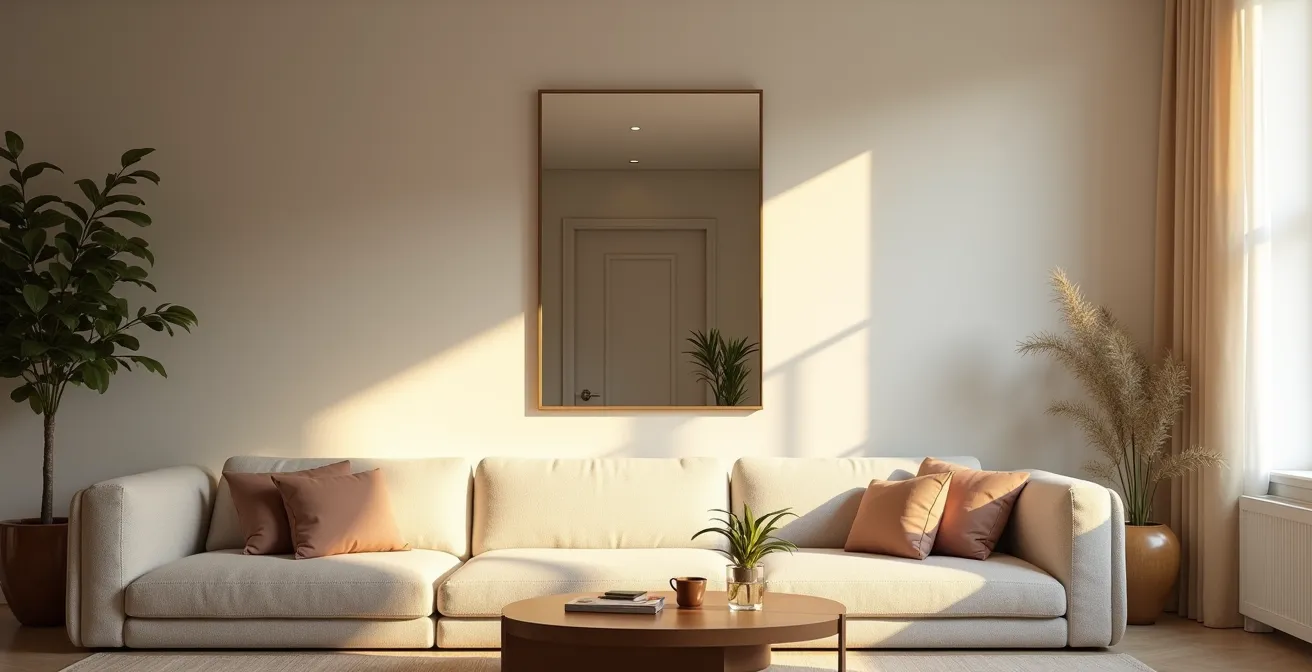
In summary:
- Forget placing mirrors directly opposite windows; placing them on adjacent walls is key for diffusing cool, northern light.
- Use specialized drywall anchors like toggle bolts or French cleats to securely hang heavy mirrors without needing a stud.
- Choose mirror shapes and frame materials intentionally to either elongate a space (rectangular) or soften it (round), while warming up cool light (brass/gold).
- Expand your strategy beyond mirrors to include other reflective surfaces like high-gloss paint and metallic decor for a complete “reflection choreography”.
Living in a space with north-facing windows often feels like a compromise. You get consistent, gentle light, but it can feel cool, flat, and leave your rooms shrouded in a perpetual twilight. The most common advice you’ll hear is to simply hang a large mirror opposite the window to bounce the light. While well-intentioned, this tactic often fails to deliver the bright, uplifting transformation you’re seeking. It can merely reflect a flat, greyish view, doing little to enhance the room’s energy or perceived brightness.
The challenge of a north-facing room isn’t just about the quantity of light, but its quality. This cool, indirect illumination requires a more nuanced approach than simply creating a single point of reflection. To truly transform these spaces, we must move beyond basic decorating tips and embrace a form of spatial light alchemy. This involves understanding how to not just reflect light, but to amplify, diffuse, and channel its energy throughout the room. It’s about creating layers of brightness and movement that make a space feel alive.
But what if the key wasn’t where you reflect light from, but how you guide its flow? This guide will deconstruct the common myths and provide a strategic framework for using mirrors. We will explore the science of reflection in the context of indirect light, the practicalities of secure installation, and the energetic impact of shape and material. By viewing mirrors as active tools for light manipulation, you can finally banish the shadows and unlock the full potential of your home’s natural light, turning a dark apartment into a bright, welcoming sanctuary.
This article provides a comprehensive roadmap, guiding you through the essential principles of mirror placement, the practicalities of installation, and the subtleties of choosing the right materials to achieve a bright and harmonious space. The following sections break down each step of this transformative process.
Summary: Mastering Light with Strategic Mirror Placement
- Why Placing a Mirror Opposite a Window Doesn’t Always Work?
- How to Anchor Heavy Mirrors on Drywall Without Finding a Stud?
- Round vs Rectangular Mirrors: Which Shape Expands a Narrow Hallway?
- The Reflection Risk: What You Should Never See in a Bathroom Mirror
- How to Create a Mirror Wall That Looks Chic, Not Like a Gym?
- How to Position Windows to Reduce Artificial Lighting Needs by 40%?
- How to Choose Between Chrome, Brass, and Glass for Maximum Light Bounce?
- How to Use Reflective Decor to Brighten Dark Corners Without Using Electricity?
Why Placing a Mirror Opposite a Window Doesn’t Always Work?
The conventional wisdom of placing a mirror opposite a window is based on the logic of direct sunlight. In a south-facing room, this works because the mirror catches a powerful beam of light and shoots it back into the space. However, north-facing rooms receive cool, diffused, and indirect light. Placing a mirror directly opposite the window often just reflects the muted tones of the sky or a neighboring building, failing to create the desired brightness. In some cases, it can even create a cold, flat glare rather than a warm, inviting glow. The goal is not simple reflection, but strategic light diffusion.
The more effective technique for north-facing rooms is adjacent mirror placement. By positioning a mirror on a wall perpendicular to the window, you catch the incoming light at an angle. This doesn’t just bounce the light back; it scatters it across multiple surfaces in the room, creating a softer, more layered effect. As one design study on light amplification notes, this method is highly effective for softening contrasts and enhancing visual comfort. It allows the light to dance around the room, illuminating different areas as the day progresses. This approach is fundamental to the concept of light alchemy—transforming the quality of light, not just doubling its source.
This understanding of light quality is critical. Improving natural light isn’t just an aesthetic choice; it has profound effects on well-being. A study cited by the Harvard Business Review found that optimizing workplace lighting led to a 51% drop in eyestrain and a 63% decrease in headaches. By thoughtfully guiding light into our homes, we are actively cultivating a healthier and more energizing environment.
How to Anchor Heavy Mirrors on Drywall Without Finding a Stud?
Once you’ve identified the perfect energetic spot for your mirror, the practical challenge of hanging it securely arises, especially when dealing with heavy pieces on stud-less drywall. Relying on a simple nail or screw is not an option; the weight of the mirror will inevitably cause it to fail, leading to damage and potential injury. The solution lies in using specialized drywall anchors designed to distribute weight effectively across the wall’s surface. Choosing the right anchor is not just a technical detail; it’s a foundational step in ensuring your design is both beautiful and safe.
For mirrors weighing over 50 pounds, a professional-grade system is non-negotiable. The most reliable options include toggle bolts, snaptoggles, and French cleat systems. A French cleat, which consists of two interlocking brackets, is often the best choice for very heavy or oversized mirrors. It distributes the weight along a horizontal line rather than at a single point, providing exceptional stability. This method is the gold standard for professional installers and ensures your statement mirror remains perfectly in place.
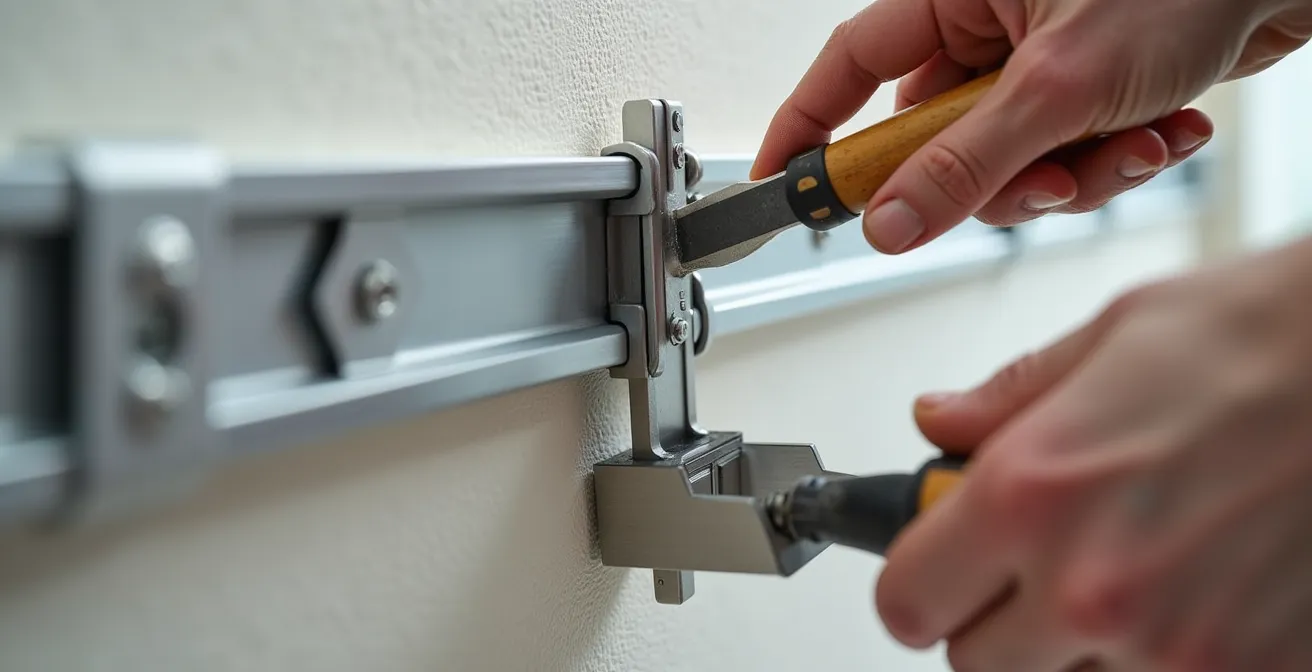
The image above illustrates the robust nature of a French cleat system. The interlocking design creates a secure hold that is far superior to single-point anchors. Before installation, it is crucial to assess not only the mirror’s weight but also the condition of your drywall. Older plaster walls may require different anchoring techniques, so a thorough evaluation is the first step toward a successful installation.
Your Action Plan: Choosing the Right Heavy-Duty Anchor
- Assess Weight: Carefully weigh your mirror. Anything over 50 pounds (22kg) requires a specialized anchoring system, not just a standard screw.
- Select the Anchor: Choose toggle bolts for mirrors up to 75 lbs (34kg) or snaptoggles for up to 150 lbs (68kg). For anything heavier or for maximum security, opt for a French cleat system.
- Distribute Weight: Favor systems like French cleats that spread the load horizontally, reducing stress on any single point in the drywall.
- Consider the Lean: For exceptionally large mirrors, consider the leaning technique. Rest the base on non-slip pads and secure the top to the wall with a discreet security strap to prevent tipping.
- Evaluate Your Wall: Check the thickness and condition of your drywall. If it’s old or crumbly, consult a professional before proceeding.
Round vs Rectangular Mirrors: Which Shape Expands a Narrow Hallway?
The shape of a mirror is not merely a stylistic choice; it’s a powerful tool for manipulating spatial perception and directing the flow of light and energy. In a narrow, tunnel-like hallway—a common feature in apartments—the right mirror can create an illusion of width and break up the monotony. The choice between a rectangular and a round mirror will produce dramatically different effects. A horizontally-oriented rectangular mirror acts as a ‘light funnel,’ pulling light along the length of the hallway and visually stretching the space. This is ideal for making a corridor feel longer and more expansive.
Conversely, a round or oval mirror creates a ‘light orb’ effect. It serves as a soft, central focal point that interrupts the hard, parallel lines of a hallway. This shape is excellent for softening the ‘tunnel effect’ and adding a gentle, organic energy to the space. It doesn’t elongate the hallway as much as a rectangle but makes it feel more balanced and less oppressive. The decision depends on your primary goal: to stretch the space or to soften it.
Some designers even advocate for a more radical approach. As noted by the Houzz design editorial team, lining two adjacent walls with mirrors can powerfully bounce light around and create the illusion of a much larger, more dynamic area. This technique is particularly effective in spaces that need a dramatic boost in both light and perceived size.
This table breaks down how different mirror shapes influence a room’s light and spatial feel.
| Mirror Shape | Visual Effect | Best Application | Light Distribution |
|---|---|---|---|
| Rectangular (Horizontal) | Creates ‘light funnel’ effect | Narrow hallways, pulling light lengthwise | Directional, extends space horizontally |
| Round/Oval | Creates ‘light orb’ effect | Breaking up tunnel effect, softening angles | Radial, creates central focal point |
| Vertical Rectangle | Draws eye upward | Low ceilings, creating height illusion | Vertical emphasis, lifts space |
| Multiple Small Shapes | Dynamic light play | Gallery walls, varied reflections | Scattered, creates movement |
The Reflection Risk: What You Should Never See in a Bathroom Mirror
In Feng Shui, a mirror is an activator and an amplifier. What it reflects, it doubles—both in terms of light and energy. While this is a powerful tool in a living area, it demands careful consideration in a personal and functional space like a bathroom. The reflection in your bathroom mirror sets a tone for your day, and certain views can create underlying stress or energetic clutter. The most important rule is to never place a mirror where it directly reflects the toilet. This doubles the visual presence of a purely functional, and often unaesthetic, element, creating a sense of discomfort and symbolically flushing away positive energy.
Another reflection to avoid is a direct view of the door. Seeing your own reflection suddenly upon entering a room can be startling and disruptive to your energetic field. The mirror should welcome you into the space, not jolt you. Instead, position the mirror so it reflects something pleasant, like a beautiful light fixture, a piece of art, or a clean, organized vanity. The goal is to create a reflection that feels calming, empowering, and positive.
Beyond Feng Shui, practical considerations are key for bathroom mirror placement. To ensure it serves its function well for most adults, the center of the mirror should be hung at an average eye-level, typically around 60 inches (152 cm) from the floor. It’s also vital to ensure the mirror is well-illuminated by vanity or overhead lighting to prevent casting shadows on your face. In high-moisture environments, slightly tilting the mirror away from the wall can promote air circulation and prevent moisture buildup behind it, prolonging its life and clarity.
How to Create a Mirror Wall That Looks Chic, Not Like a Gym?
A full mirror wall can be the ultimate solution for a light-starved room, but it walks a fine line between chic sophistication and a dated, 1980s gym aesthetic. The key to achieving an elegant look is to move away from large, seamless sheets of polished mirror. Instead, the focus should be on texture, segmentation, and framing. A chic mirror wall adds architectural interest and diffuses light in a complex, dynamic way, rather than creating a single, stark reflection.
Case Study: Sophisticated Mirror Wall Design Strategies
One of the most effective strategies is using patinated or antiqued mirrors. Their weathered, subtly aged surfaces create a sense of depth and history, reflecting light with a soft, warm glow instead of a harsh glare. Another successful approach is creating an industrial-style panelled wall. By arranging smaller mirror panels within a grid of thin metal mullions, you create the illusion of a large window, which is particularly powerful in a room that lacks them. This segmentation breaks up the reflection, making it feel more like a piece of art than a functional surface. Finally, incorporating mirrors with textured frames—like bobbin, bamboo, or rustic wood—into a gallery wall adds personality and breaks up the light in a beautifully dynamic fashion.
The choice of materials and arrangement transforms the mirror wall from a simple reflective surface into a sophisticated design feature. By using grids, antiqued finishes, or a curated gallery of smaller mirrors, you introduce visual interest and prevent the flat, monotonous look of a fitness studio. The goal is to create a “reflection choreography” where light is scattered and played with, adding layers of brightness and texture to the room.
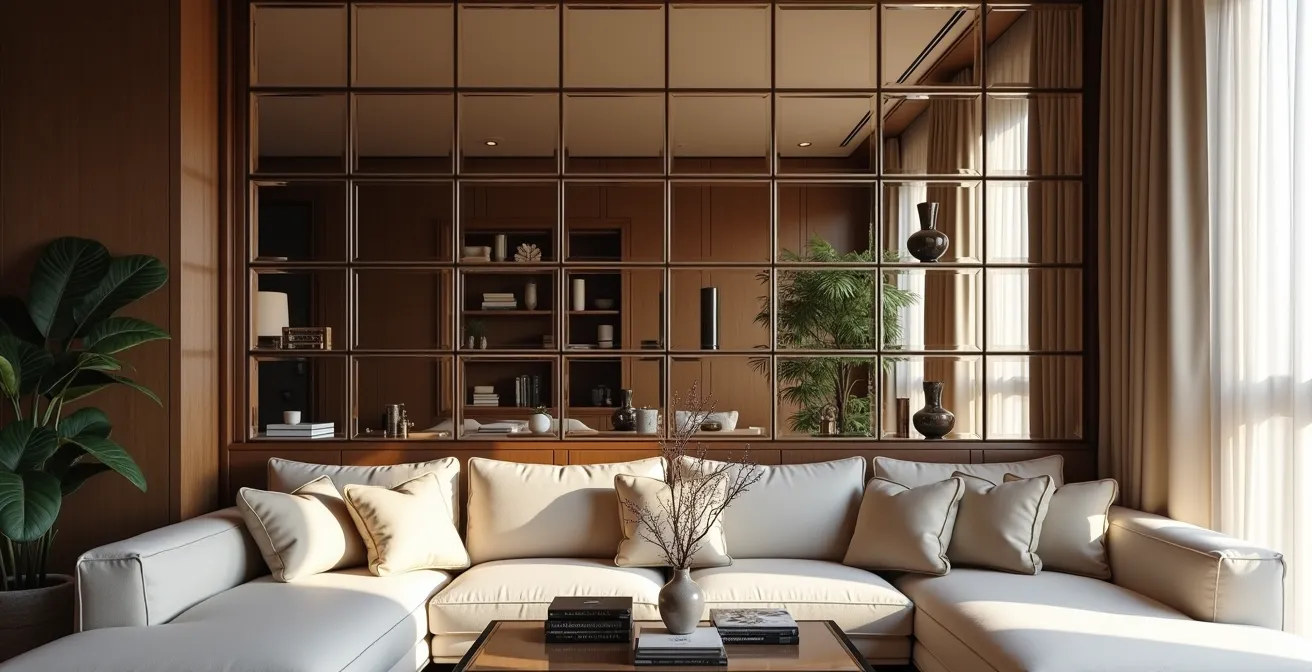
As seen in the elegant living room above, an antiqued, panelled mirror wall becomes an architectural focal point. It reflects abstract shapes and soft ambient light, enhancing the room’s atmosphere without creating a distracting, literal copy of the space. This is the essence of a successful mirror wall: it suggests space and light rather than simply mirroring it.
How to Position Windows to Reduce Artificial Lighting Needs by 40%?
While mirrors are powerful tools for manipulating light, their effectiveness is ultimately determined by the source: the window itself. The positioning, size, and type of windows are the foundation of a home’s natural light ecosystem. For those building or renovating, strategic window placement can drastically reduce the reliance on artificial lighting. A key architectural technique for deep light penetration is the use of a light shelf. This is a horizontal reflective surface installed below high windows, which bounces daylight up onto the ceiling. The ceiling then acts as a massive diffuser, scattering soft, even light deep into the core of the room, far from the window wall.
This architectural strategy is a form of large-scale light alchemy, fundamentally changing how a building interacts with daylight. The impact of maximizing natural light goes beyond aesthetics and energy savings; it has a measurable commercial benefit. A study of California retail chains, for example, found that stores retrofitted with skylights saw a 40% sales increase. This demonstrates the powerful psychological effect of bright, naturally lit environments on human behavior.
Even without a full renovation, understanding these principles helps. Knowing that light from high on a wall travels deepest into a room informs where you might focus your mirror placement. If you have a high transom window, a mirror placed to catch that specific light can be incredibly effective. The goal is to work in harmony with your home’s existing architectural features to create a cohesive and bright interior, reducing the need for artificial light and fostering a more natural, uplifting atmosphere.
How to Choose Between Chrome, Brass, and Glass for Maximum Light Bounce?
The material of a mirror’s frame is a crucial, often overlooked, element in our light alchemy toolkit. The frame doesn’t just hold the glass; it interacts with the reflected light, tinting it with a specific color temperature and affecting its overall quality. In a cool, north-facing room, the right frame material can help to warm up the light and create a cozier atmosphere. A brass or gold frame is exceptionally effective in this regard. It infuses the cool northern light with warm, yellow tones, counteracting the natural coolness and creating a more inviting, sunnier glow.
On the other hand, a chrome or silver frame will amplify the cool tones of the light. This can be perfect for a crisp, modern, or minimalist aesthetic, but it won’t help to warm up a space. It creates bright, sharp highlights, maximizing brightness but maintaining a cooler energy. The choice between warm and cool metals depends entirely on the desired atmosphere for the room.
For pure, unadulterated light maximization, a frameless or all-glass framed mirror is unbeatable. It creates no visual border, allowing the reflective surface to seamlessly blend with the wall.
– Edward Martin Design Team, What’s The Art Of Placing Mirrors To Maximize Light?
For those prioritizing pure light amplification above all else, a frameless or all-glass mirror is the ultimate choice. With no visual border, it offers the maximum reflective surface area and adds no color cast to the light. This allows for seamless integration into the wall, creating an illusion of open space and providing the most powerful light bounce possible. The table below summarizes these properties.
| Frame Material | Light Temperature Effect | Best for North-Facing Rooms | Reflection Quality |
|---|---|---|---|
| Brass/Gold | Adds warm tones | Excellent – counteracts cool light | Warm glow, cozy atmosphere |
| Chrome/Silver | Amplifies cool tones | Good for modern aesthetic | Crisp, bright highlights |
| Glass/Frameless | Neutral – no color cast | Best for pure light maximization | Maximum light bounce, seamless |
| Matte Finishes | Absorbs some light | Reduces glare | Soft, diffused effect |
Key takeaways
- Adjacent Placement is Key: In north-facing rooms, place mirrors on walls perpendicular to windows to diffuse cool light, not opposite them.
- Shape Dictates Flow: Use horizontal rectangular mirrors to create a “light funnel” that elongates a space, and round mirrors to create a “light orb” that softens hard lines.
- Frame a Warmer Light: Choose brass or gold frames to counteract the cool tones of northern light, infusing your space with a warm, inviting glow.
How to Use Reflective Decor to Brighten Dark Corners Without Using Electricity?
Mastering light alchemy means looking beyond just mirrors. To truly banish shadows, we must create a complete “reflection choreography” throughout the room, using a variety of surfaces to bounce and scatter light into the darkest corners. This holistic approach creates a layered, ambient brightness that feels natural and effortless. One of the most effective, yet often forgotten, strategies is to utilize the floor. Light-colored rugs with a subtle sheen from silk or viscose blends, or polished concrete and light wood floors with a satin finish, act as massive horizontal reflectors, bouncing light upwards and brightening the entire room from the ground up.
On vertical surfaces, the finish of your paint makes a significant difference. A high-gloss or satin-finish paint on a feature wall or, even more effectively, the ceiling, will create a subtle, diffuse reflection that brightens the entire space without the harshness of a mirror. This technique is especially useful for creating a sense of height and openness. In addition, mirrored furniture, such as a console table or cabinet, can bounce light from lower angles, illuminating areas that a wall-hung mirror might miss.
Finally, create small but powerful “sparkle points” by clustering reflective decorative objects. A collection of crystal decanters on a bar cart, a grouping of metallic vases on a shelf, or an arrangement of silver picture frames on a console table can catch and fracture light in beautiful, dynamic ways. Each small reflection contributes to the overall brightness, adding movement and life to the room. This comprehensive strategy proves that brightening your home is an investment with tangible returns; according to Zillow data, homes with ample natural light can sell for 7% more. These small, intentional choices collectively transform a dim space into a bright and valuable one.
By applying these principles of light alchemy, you are no longer just decorating a room; you are actively curating its energy and atmosphere. Embrace these strategies to transform your north-facing spaces from dim and overlooked into the bright, vibrant heart of your home.