In summary:
- Visible clutter isn’t just an eyesore; it’s a scientifically-proven source of stress. The solution isn’t just hiding items, but building ruthless, invisible systems.
- Treat every dead space—like under your bed or inside an ottoman—as a high-value asset that requires a specific strategy for dust-free, efficient use.
- Counteract the “out of sight, out of mind” trap by creating a digital inventory with QR codes to prevent duplicate purchases and wasted money.
- Implement a multi-layered labeling system (text, icons, QR codes) so every member of the household can find and put away items correctly.
- Style storage elements like baskets with intent by using them for “active” daily items and keeping them only two-thirds full to maintain visual calm.
Your minimalist apartment is supposed to be a sanctuary of calm, but a rising tide of clutter is turning it into a source of low-grade anxiety. You have no closets, no storage room, and the thought of a major renovation is out of the question. You’ve been told to buy multi-functional furniture and use bins, but these solutions often create more visual noise or become black holes where possessions go to be forgotten.
The standard advice only addresses the surface. It tells you to hide your things, but it doesn’t give you a system to manage them. This leads to the classic ‘out of sight, out of mind’ trap, where you forget what you own and buy duplicates, creating even more clutter. The cycle is vicious, and it actively works against the peace your minimalist home is supposed to provide.
But what if the key wasn’t just hiding your clutter, but engineering its complete invisibility? Effective hidden storage isn’t about buying more boxes; it’s about implementing a ruthless set of systems that manage your inventory, prevent financial waste, and reclaim every inch of dead space with strategic precision. It’s about turning chaos into an ordered, accessible, and completely unseen resource.
This guide will walk you through the exact, renovation-free strategies to build these invisible systems. We will deconstruct the psychological impact of clutter, optimize every forgotten space in your home, and give you a framework to finally win the war against stuff—not by hiding it, but by mastering it.
Summary: A Systematic Approach to Invisible Home Storage
- Why Visible Clutter Increases Cortisol Levels in the Evening?
- How to Turn the Gap Under Your Bed into a Dust-Free Wardrobe?
- Ottomans vs Coffee Tables: Which Storage Volume Is More Usable?
- The ‘Out of Sight, Out of Mind’ Trap That Leads to Duplicate Purchases
- How to Label Hidden Bins so the Whole Family Knows Where Things Go?
- How to Exploit Vertical Space to Double Your Storage Capacity?
- How to Group Baskets of Different Sizes for a Cohesive Look?
- How to Style Woven Baskets for Storage Without Making Your Home Look Cluttered?
Why Visible Clutter Increases Cortisol Levels in the Evening?
The feeling of stress that creeps in as you look at piles of clutter in your living room isn’t just in your head; it’s a physiological reality. Your brain perceives a cluttered environment as unfinished business, a constant to-do list that prevents it from fully entering a state of rest. This is especially potent in the evening, when your body is naturally supposed to wind down. Instead of producing melatonin for sleep, your system keeps pumping out cortisol, the primary stress hormone.
This isn’t just a theory. Research from UCLA’s Center on Everyday Lives of Families reveals that women living in cluttered homes show a pattern of elevated cortisol levels throughout the day, which fails to decline in the evening. This chronic stress state is linked to anxiety, poor sleep, and a sense of being overwhelmed. The visual chaos of items left on surfaces—from paperwork on the kitchen counter to clothes draped over a chair—sends a continuous signal of disorder to your brain.
To combat this, you must be ruthless. The goal is to create an end-of-day “shutdown routine” that gives your brain the all-clear signal. By systematically returning every item to its designated hidden home, you’re not just tidying up; you are actively lowering your cortisol levels and reclaiming your evening peace. This isn’t cleaning; it’s a non-negotiable mental health practice for anyone living in a small, minimalist space where every visible object has an outsized impact.
How to Turn the Gap Under Your Bed into a Dust-Free Wardrobe?
The space under your bed is one of the most valuable yet poorly utilized storage areas in an apartment. It often becomes a “clutter black hole”—a dusty, chaotic mess of forgotten items. To transform it into a functional, dust-free wardrobe, you need a multi-layer system, not just a few plastic bins. The key is to create sealed, organized zones that protect your belongings while maximizing every cubic inch.
Start by fighting dust at the source. Use vacuum-sealed bags for all soft, bulky items like seasonal duvets, sweaters, and guest bedding. This not only compresses them to a fraction of their size but also creates an airtight barrier against dust, moisture, and pests. Once sealed, place these bags inside hard-shell wheeled containers with secure-latching lids. The hard shell provides structural protection and allows for easy stacking or sliding, while the wheels are crucial for access without scratching your floors.
Next, implement a zoning strategy. Divide the under-bed space into three zones from front to back:
- Zone 1 (Front): Items you access semi-frequently, like off-season shoes or a rotation of handbags.
- Zone 2 (Middle): Seasonal linens and less-used clothing.
- Zone 3 (Back): Deep archival storage for items you need to keep but rarely access, like sentimental belongings or important documents.
This system ensures the most accessible space is used for the most relevant items, preventing you from having to pull everything out to find one thing. The choice of container material is also critical for protecting both your items and your floors.
The following table breaks down the best container base for different floor types, a detail that is crucial for long-term, damage-free use.
| Floor Type | Best Container Base | Protection Benefit |
|---|---|---|
| Carpet | Hard plastic wheels | Reduces drag and prevents fabric snags |
| Hardwood | Felt-bottom sliders | Prevents scratches and silent sliding |
| Tile/Laminate | Rubber grips | Prevents sliding and moisture damage |
Ottomans vs Coffee Tables: Which Storage Volume Is More Usable?
In the battle for living room storage, ottomans and coffee tables are the main contenders. However, judging them on total volume is a rookie mistake. The real metric is Usable Volume Efficiency—how accessible and organized the space is for your specific type of clutter. A cavernous ottoman can easily become a jumbled mess, while a smaller coffee table with drawers can offer superior organization.
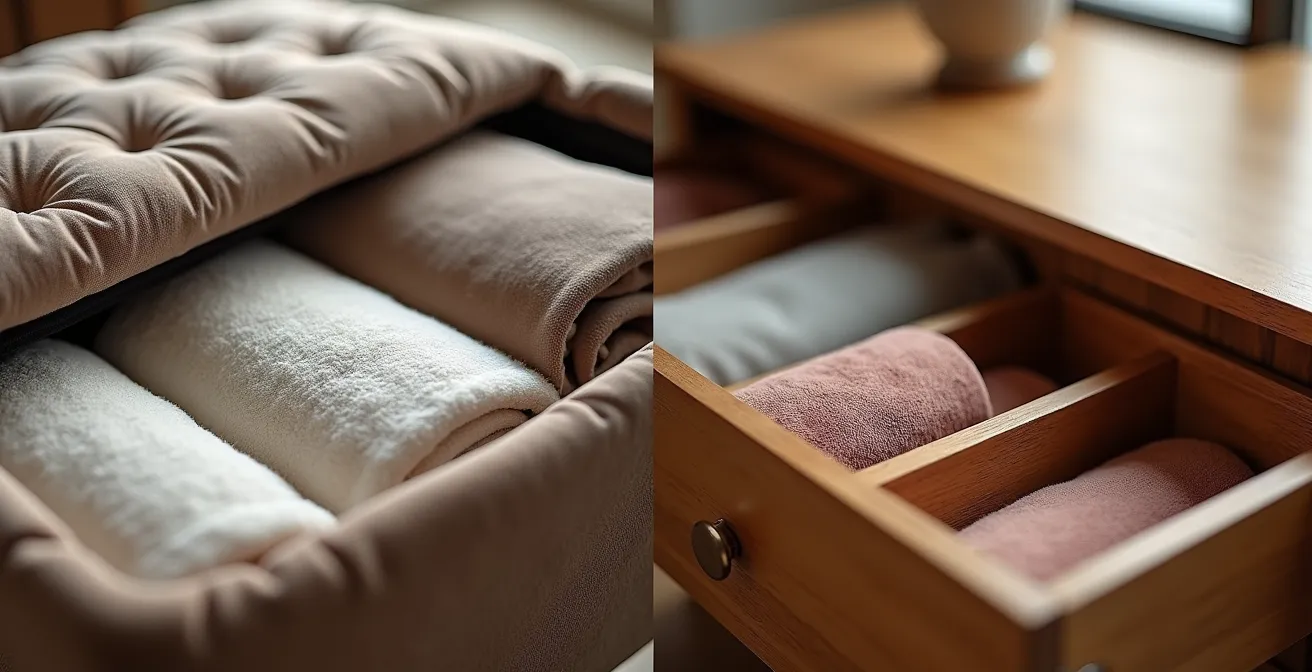
Storage ottomans excel at concealing soft, bulky items. They are the undisputed champions for stashing throw blankets, extra pillows, and kids’ soft toys. Their large, undivided cavities are perfect for things that can be compressed and don’t require careful separation. However, their weakness is their lack of structure. As one analysis notes, they are not ideal for holding drinks or small items, and their deep bins make it hard to retrieve smaller objects without digging.
This is where coffee tables with integrated storage shine. Models with drawers, shelves, or lift-tops are designed for hard, small, and frequently accessed items. Remote controls, charging cables, coasters, and magazines are perfectly managed in shallow drawers with dividers. The Spatial ROI is higher because the organization is built-in, preventing the jumble that plagues a deep ottoman. This makes them ideal for managing the daily clutter of a living room.
The image below illustrates the fundamental difference in how these two furniture types handle storage internally—one focusing on bulk capacity, the other on structured access.
Ultimately, the choice depends entirely on your primary clutter profile. You must diagnose your clutter *before* you choose your furniture. Are you drowning in blankets or tangled in cables? Answering that question is the only way to make a decision that solves your problem instead of just hiding it inefficiently.
To make the right choice, you must analyze what you need to store. This framework provides a clear guide.
| Clutter Type | Best Storage Solution | Accessibility Score |
|---|---|---|
| Soft & Bulky (blankets, pillows) | Storage Ottoman | High – lid lift access |
| Hard & Small (remotes, cables) | Coffee Table with drawers | Very High – slide access |
| Mixed Daily Use | Hybrid ottoman-table combo | Medium – tray removal needed |
The ‘Out of Sight, Out of Mind’ Trap That Leads to Duplicate Purchases
The greatest danger of hidden storage is its most obvious benefit: it makes your things disappear. This creates the “out of sight, out of mind” trap, a cognitive blind spot that leads directly to wasted money. When you can’t see your backup roll of paper towels or the extra set of batteries, you assume you’re out and buy more. These small, unnecessary purchases accumulate into a significant financial drain. In fact, studies suggest the average household could save approximately $1,500 annually by simply avoiding duplicate purchases of items they already own.
To defeat this trap, you cannot rely on memory. You must build an Invisible Inventory—a simple, external system that acts as your home’s “brain.” This system tracks the contents of your hidden storage, making them digitally “visible” even when they are physically concealed. It’s the single most powerful tool for a ruthless organizer in a small space.
Implementing this doesn’t have to be complicated. You can create a “digital twin” of your storage using free tools. This system provides a quick, visual reference of what you own, accessible from your phone while you’re at the store, effectively killing the impulse to buy duplicates. It’s the ultimate defense against the “out of sight” trap.
Your Action Plan: Implementing a Digital Twin Inventory System
- Choose Your Database: Create a simple database in an app like Notion, Trello, or even Google Keep. Make one page or card for each major storage container (e.g., “Under-Bed Box 1,” “Ottoman”).
- Photograph Contents: Before sealing any storage box or bin, lay out its contents and take a clear, well-lit photo with your phone. This visual record is faster and more effective than a written list.
- Link Your Visuals: Upload the photo to a cloud service (Google Photos, iCloud) and paste the shareable link into the corresponding card in your database.
- Implement QR Codes: For ultimate efficiency, generate a free QR code that links directly to the photo album or database card. Print it on a sticker and place it on the physical bin. Now, a quick scan tells you exactly what’s inside.
- Maintain the System: The system is only as good as its data. Get into the ruthless habit of updating the photo or list immediately whenever you add or remove a significant item.
How to Label Hidden Bins so the Whole Family Knows Where Things Go?
Your perfect invisible inventory system will fail in a week if you are the only person who knows how to use it. For hidden storage to work in a shared home, the system must be so intuitive that every family member—from pre-readers to distracted partners—can find items and, more importantly, put them back correctly. This requires a Dual-Signifier Family Labeling System that communicates information on multiple levels.
A single word on a label is not enough. An effective system combines text with visual cues. For example, a bin for “Winter Accessories” should have the text, but also a simple, minimalist icon of a snowflake or a hat. This helps young children who can’t read yet and provides a quick visual shortcut for adults. The goal is clarity and speed, removing any friction or excuse for not using the system.
For even greater detail without creating visual clutter, integrate the QR codes from your digital inventory. A small QR code on the label can link to a detailed Google Doc or photo album listing every single item inside. This is perfect for complex bins containing things like “Cables & Chargers” or “Craft Supplies.” You can find exactly what you need without pulling the bin apart.
The aesthetic of the labels is also crucial in a minimalist interior. They must be consistent and subtle. Choose a single style—like white text on a clear label for a “no-label” look, or elegant handwritten tags on matching cardstock—and apply it everywhere. The structure should be hierarchical and consistent: ROOM > CATEGORY > SPECIFIC ITEMS (e.g., LIVING ROOM > ELECTRONICS > HDMI CABLES).
How to Exploit Vertical Space to Double Your Storage Capacity?
In a small apartment, the floor is prime real estate that fills up fast. The most under-utilized dimension is vertical space. By thinking upwards, you can dramatically increase your storage capacity without adding to your footprint. The key is to use methods that are visually light or completely invisible, avoiding the bulky, oppressive feeling of heavy cabinetry.
Go beyond the obvious bookshelf. Exploit “micro-spaces” that are typically ignored. Install art ledges or slim floating shelves high up on a wall, just below the ceiling or above door frames. When painted the exact same color as the wall, they become nearly invisible. Use these for storing beautiful, uniform boxes that contain less-frequently used items. The effect is one of architectural detail rather than overt storage.
Another powerful strategy is using the backs of doors. Ultra-slim organizers, no more than two inches deep, can be mounted on the inside of closet or pantry doors to hold spices, cleaning supplies, or toiletries without impeding the door’s function. Inside deep cabinets, you can instantly double your shelving by adding tension rods. A tension rod placed halfway up a cabinet can create a new shelf for lightweight items like rolls of foil or cleaning cloths.
Case Study: The Invisible Wall Panel System
For a truly seamless look, consider a DIY wall panel system. By installing track panels at the top and bottom of a wall section and covering them with simple, flat panels cut to size, you can create a hidden storage cavity. When closed, the panels look like a modern, minimalist architectural feature or wainscoting. This provides deep storage for larger items while maintaining a completely flush, uncluttered wall surface. It offers the benefit of a built-in without the cost of renovation.
When choosing freestanding vertical storage, opt for ladder-style shelving. Its tapered design has a much smaller visual weight than a traditional rectangular bookcase, leaning against the wall and drawing the eye upward without dominating the room.
How to Group Baskets of Different Sizes for a Cohesive Look?
Baskets are a classic storage solution, but using a random assortment of different styles, materials, and sizes will make your minimalist home look more like a cluttered market stall. Achieving a cohesive, intentional look requires a strict set of grouping rules. The goal is to create a sense of unity and rhythm, not a chaotic collection.
The first and most important rule is material consistency. Whenever possible, choose baskets made of the same material (e.g., all water hyacinth, all felt, all wire) or at least with the same weave pattern. This textural unity is the single most effective way to make a group of disparate baskets look like a deliberate collection. If you must mix materials, stick to a very tight color palette of no more than three complementary shades (e.g., natural, black, and white).
Once you have your consistent set, arrange them using design principles:
- Arrange in Odd Numbers: Groups of three or five are inherently more visually appealing and dynamic than even-numbered groups.
- Create Visual Triangles: Position the baskets to form a triangle, with the largest or most prominent basket serving as an anchor point. This guides the eye and creates a sense of stability.
- Establish Functional Zones: Group baskets by purpose. Create an “entryway drop zone” with three baskets for keys, mail, and accessories, or a “cozy corner” grouping with baskets for blankets, books, and magazines.
This approach transforms a simple storage tool into a powerful design element. A well-curated group of baskets adds warmth and texture to a minimalist space while simultaneously corralling clutter in a structured, aesthetically pleasing way.
Key takeaways
- Clutter is a biological stressor; an end-of-day “shutdown routine” where everything is returned to its place is a crucial mental health practice.
- The best storage furniture is chosen based on the *type* of clutter you have (soft and bulky vs. hard and small), not just total volume.
- Implement an “Invisible Inventory” with QR codes on bins to track what you own, preventing the costly mistake of buying duplicates.
How to Style Woven Baskets for Storage Without Making Your Home Look Cluttered?
You’ve curated a beautiful, cohesive set of baskets. The final step is styling them in a way that reduces clutter, rather than adding to it. This requires a strategic philosophy that divides your belongings into two categories: Active Storage and Passive Storage. This distinction is the key to maintaining a calm, uncluttered surface.
Active Storage is for items you use daily. These are the things that create surface clutter: the remote control, the book you’re currently reading, your favorite throw blanket. These items belong in open, easily accessible baskets. The basket acts as a “home base” for these items, containing them neatly while keeping them within arm’s reach. This is a functional and beautiful solution.
Passive Storage is for items accessed weekly or less often—extra cables, seasonal decor, magazines you’ve finished. These items have no business being in an open basket. They belong in lidded baskets or tucked away in a closet. Using an open basket for passive storage is just creating a visible box of clutter.
Once you’ve sorted your items, apply two final styling rules to maintain a minimalist aesthetic:
- The Two-Thirds Full Rule: A basket should never be filled to the brim. Aim to keep it at a maximum of two-thirds capacity. This creates visual “breathing room” and prevents the basket from looking stuffed and stressful. When it’s full, it’s a signal to edit and declutter, not to get a bigger basket.
- Fold with Intention: For any textiles visible in an open basket, like a throw blanket, fold or roll them with care. The way an item is placed in the basket is part of the styling. A neatly folded blanket signals calm and order; a crumpled one signals chaos.
By treating your baskets as “functional sculptures” and being ruthless about what goes inside them, you ensure they remain a serene part of your decor, not just another source of visual noise.
Stop letting clutter dictate the emotional temperature of your home. The power to create a truly serene, minimalist space is not in having fewer things, but in having smarter, invisible systems. Start today by choosing one area—under the bed, the living room ottoman—and implement one of these ruthless strategies. The calm you will feel is immediate and profound.