A solar battery’s necessity for ROI is no longer about backup power; it’s a financial calculation dictated by grid policy and consumption timing.
- Under modern net metering policies like California’s NEM 3.0, self-consuming your solar power is vastly more valuable than exporting it, making batteries financially essential.
- Optimizing your entire home’s energy efficiency first—through upgrades like cool roofing and better insulation—can reduce the required size of your solar and battery system, saving thousands.
Recommendation: Before investing in a battery, analyze your local utility’s export credit rates and your home’s consumption patterns. A battery becomes a critical investment when the grid pays you significantly less than retail rate for your excess power.
For homeowners considering solar, the initial quote for panels is often just the beginning. The conversation quickly turns to a significant additional expense: battery storage. The common justification is simple—backup power during an outage. While valuable, this benefit alone rarely justifies a five-figure investment, leaving many homeowners wondering if a battery is an expensive luxury or a financial necessity. The answer is increasingly complex and has shifted dramatically in recent years.
The core of the issue is not just about storing energy but about optimizing its financial value. A battery’s role has evolved from a simple power bank to a sophisticated financial instrument. Its necessity hinges on two critical factors: your local utility’s net metering policies and your household’s daily energy consumption patterns. In many regions, the days of the grid acting as a generous “virtual battery,” crediting you at a 1:1 retail rate for your excess solar power, are over. This policy shift fundamentally changes the ROI calculation, often making a battery the key to unlocking a solar system’s financial potential.
Furthermore, achieving true energy independence and maximizing your return on investment goes beyond a simple “panels + battery” equation. It requires a holistic view of your home as an entire energy ecosystem. Factors like your roof’s orientation, the type of inverters you choose, and even pre-installation upgrades like roofing and insulation have a profound impact on your system’s performance and overall cost. This guide will provide the financial and technical framework to determine if battery storage is essential for your home, moving beyond the simple desire for backup to a data-driven investment strategy.
To navigate this complex decision, this article breaks down the essential components that influence a solar system’s ROI, from system design to policy impacts. The following sections provide a clear roadmap for understanding where your money is best spent to achieve energy independence.
Summary: A Homeowner’s Guide to Solar and Battery ROI
- East-West vs South Facing: Can You Go Solar with a ‘Bad’ Roof?
- Microinverters vs String Inverters: Which Handles Shade Better?
- Net Metering Explained: How Much Does the Grid Pay You Back?
- Do You Really Need to Clean Snow off Solar Panels?
- Why You Must Replace Your Roof Before Installing Solar Panels?
- How Smart Water Valves Prevent Catastrophic Flooding Damage?
- How to Stack Rebates for Energy Upgrades to Cover 30% of Costs?
- Energy-Positive Eco-Housing: How to Generate More Power Than You Consume?
East-West vs South Facing: Can You Go Solar with a ‘Bad’ Roof?
The long-standing belief in the solar industry is that a south-facing roof is the gold standard for maximum energy production. While it’s true that a southern orientation captures the most intense sunlight during midday, this narrow peak may not align with modern household consumption patterns. Most homes use the most energy in the morning (getting ready for work/school) and in the late afternoon/early evening (returning home, cooking, entertainment). A south-facing system produces a massive surplus at noon when you’re likely not home, forcing you to export that valuable energy to the grid—often for a low credit.
This is where an east-west orientation, once considered “bad” for solar, becomes a strategic advantage for self-consumption. An east-facing array catches the morning sun, while a west-facing array captures the afternoon and evening sun. This creates a broader, more consistent production curve that better matches when you actually use electricity. While the total annual energy generated might be 15-20% less than a perfect southern roof, research shows that west-facing panels can generate 50% more energy value during peak demand hours when electricity is most expensive. This alignment of production and consumption means you use more of your own power directly, drastically reducing the need to buy expensive electricity from the grid in the evening and minimizing your reliance on low-value export credits. For homeowners without a battery, an east-west system is often a more financially savvy choice than a south-facing one.
The following table illustrates the trade-offs between these orientations, highlighting how an east-west split can reduce the required battery size by improving self-consumption.
| Orientation | Peak Production Hours | Annual Energy Output | Battery Size Needed | Best For |
|---|---|---|---|---|
| South-Facing | 10am-2pm | 100% baseline | 10-15kWh typical | Maximum total production |
| East-West Split | 8am-10am & 3pm-6pm | 80-85% of south | 5-7kWh typical | Self-consumption & TOU rates |
| Southwest/Southeast | Varies by angle | 92% of south | 8-12kWh typical | Balanced approach |
Case Study: Cambridgeshire East-West Installation Success
A homeowner in Cambridgeshire with a “non-optimal” roof installed a 5kW split East-West system using microinverters. The system achieved an impressive 4,800 kWh annual generation. More importantly, its extended production hours from 7am to 8pm better matched the household’s consumption, resulting in a 35% electricity bill reduction without a battery, proving the financial viability of a well-designed system on a supposedly ‘bad’ roof.
Microinverters vs String Inverters: Which Handles Shade Better?
Once you’ve determined the best orientation for your panels, the next critical technical choice is the type of inverter. This component converts the direct current (DC) produced by your panels into the alternating current (AC) your home uses. The two primary options are string inverters and microinverters, and their architectural differences have significant implications for system performance, especially on complex or partially shaded roofs.
A traditional string inverter system connects a group of panels (a “string”) to a single, centralized inverter. The major drawback is that the entire string’s output is limited by the performance of the weakest panel. If just one panel is partially shaded by a tree, chimney, or even a bird dropping, the production of all other panels in that string is dragged down. It’s like a string of old Christmas lights—when one bulb goes out, the whole string fails. This makes them unsuitable for anything but perfectly clear, unshaded roofs.
Microinverters, on the other hand, represent a decentralized approach. A small inverter is installed on the back of each individual solar panel. This allows each panel to operate independently at its maximum potential, regardless of the performance of its neighbors. If one panel is shaded, only that single panel’s output is reduced; the rest of the system continues to produce at full power. This not only maximizes energy harvest on roofs with intermittent shade but also provides superior system resilience. The key resilience advantage shows that a single microinverter failure results in only about a 3% production loss, versus a 100% system outage if a central string inverter fails. This panel-level monitoring and resilience is critical for ensuring your investment performs as expected over its 25-year lifespan.
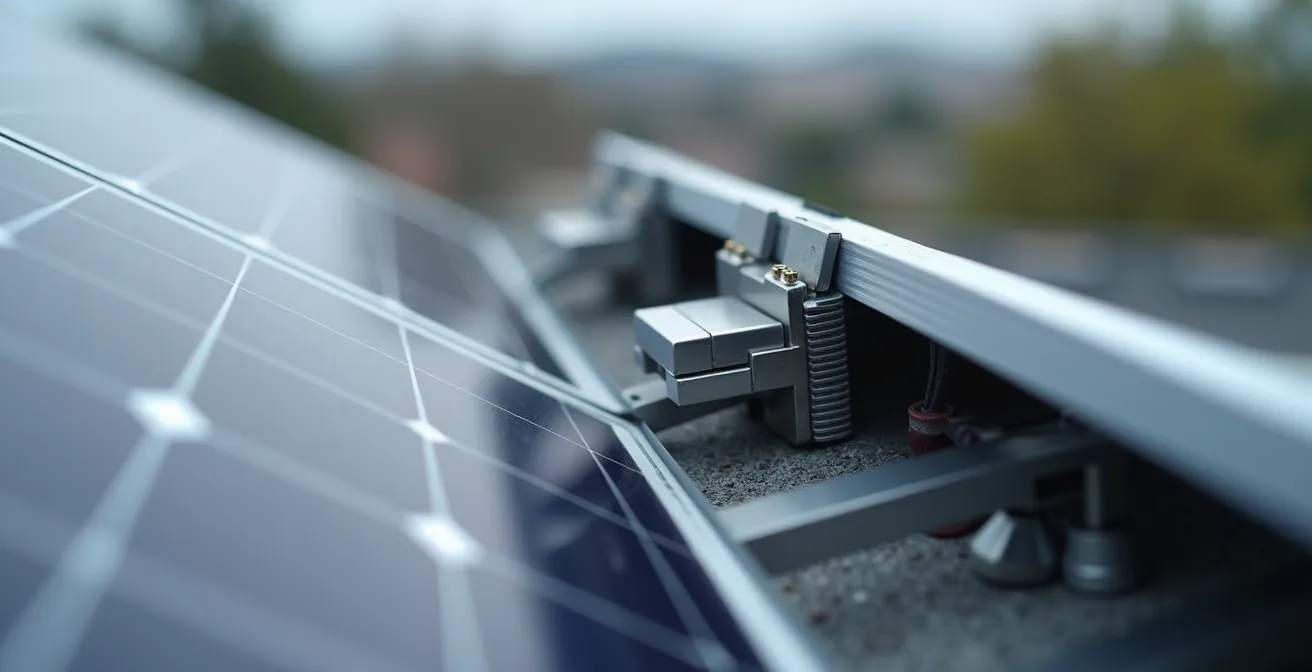
As you can see in the comparison, the decentralized architecture of microinverters offers a more robust and efficient solution for most residential rooftops. While the upfront cost may be slightly higher than a string inverter, the long-term gains in energy production and system uptime typically deliver a superior return on investment, especially for homes that aren’t blessed with a perfectly unshaded, south-facing roof.
Net Metering Explained: How Much Does the Grid Pay You Back?
Net energy metering (NEM) is the policy that dictates the financial relationship between you and your utility company. It’s the mechanism that determines the credit you receive for the excess electricity your solar panels send to the grid. Understanding your local NEM policy is the single most important factor in deciding whether a battery is a financial necessity. For years, many states offered “NEM 1.0” or “NEM 2.0” policies, which provided a 1:1 retail rate credit. For every kilowatt-hour (kWh) you exported, you received a credit equal to the price of a kWh you would have purchased. This effectively allowed homeowners to use the grid as a free, 100% efficient battery.
However, this landscape is changing rapidly. Utilities are lobbying for and implementing new policies, like California’s NEM 3.0, that drastically reduce the value of exported solar energy. Under these new rules, homeowners are compensated at a much lower “avoided cost” rate, which is based on the wholesale price of energy and can be significantly less than the retail price. For instance, under California’s NEM 3.0, homeowners experience a 75% reduction in export compensation compared to the previous policy. Suddenly, a kWh you export might only be worth 25% of a kWh you import later that evening. This policy change single-handedly makes storing your own solar energy in a battery and using it yourself (self-consumption) far more valuable than selling it to the grid for pennies on the dollar.
The impact of these policy shifts on the necessity of battery storage is not theoretical; it’s a market reality. Following California’s shift to NEM 3.0 in April 2023, battery attachment rates for new solar installations skyrocketed from around 10% to over 60% within a year, with many installers now reporting that 90% of their new systems include battery storage. This shows that when the financial incentive to export power is removed, a battery transitions from an optional add-on to an essential component for achieving a reasonable ROI.
This table clearly demonstrates how policy directly dictates the financial viability and payback period of solar and battery systems.
| Policy | Export Credit Rate | Solar-Only Payback | Solar+Battery Payback | Battery Necessity |
|---|---|---|---|---|
| NEM 2.0 (Pre-2023) | 1:1 retail rate | 5-7 years | 8-10 years | Optional |
| NEM 3.0 (Current) | ~25% of retail | 8-10 years | 4.8-7 years | Essential |
| Time-of-Use Peak | $0.52/kWh summer | N/A | 4-5 years | Critical |
Do You Really Need to Clean Snow off Solar Panels?
For homeowners in colder climates, the question of snow coverage on solar panels is a major concern for energy independence. A blanket of snow can halt energy production entirely, raising the question of whether active, and potentially risky, cleaning is necessary. The short answer is: usually not. Most solar panels are installed at an angle and have a smooth, dark surface that absorbs heat from any available sunlight. This combination often allows snow to melt and slide off naturally within a day or two after a storm. The energy lost during these few days is typically minimal over the course of an entire year and rarely justifies the risk of damaging panels or yourself by attempting to clear them with a roof rake.
However, the question changes when your goal shifts from simple bill reduction to true energy independence during winter, especially during a prolonged grid outage. In this scenario, you are entirely reliant on your solar production and battery storage. Losing several days of generation while your battery depletes is not a viable option. This is where system design and planning become more important than reactive cleaning. Installing panels at a steeper angle (often calculated as your latitude plus 15 degrees) significantly enhances this passive snow shedding. More importantly, it forces a critical calculation: sizing your battery bank for winter autonomy.
True independence requires modeling a worst-case scenario. You must calculate your home’s critical loads (heating, refrigeration, communications) and size your battery to power them for a minimum of 48-72 hours with zero solar input, assuming panels are completely covered. A telescoping snow rake specifically designed for solar panels can then become a strategic tool, not for daily cleaning, but as an emergency measure to restart generation if an outage extends beyond your battery’s autonomy window. It’s a shift in mindset from maximizing every kWh to ensuring survival and resilience.
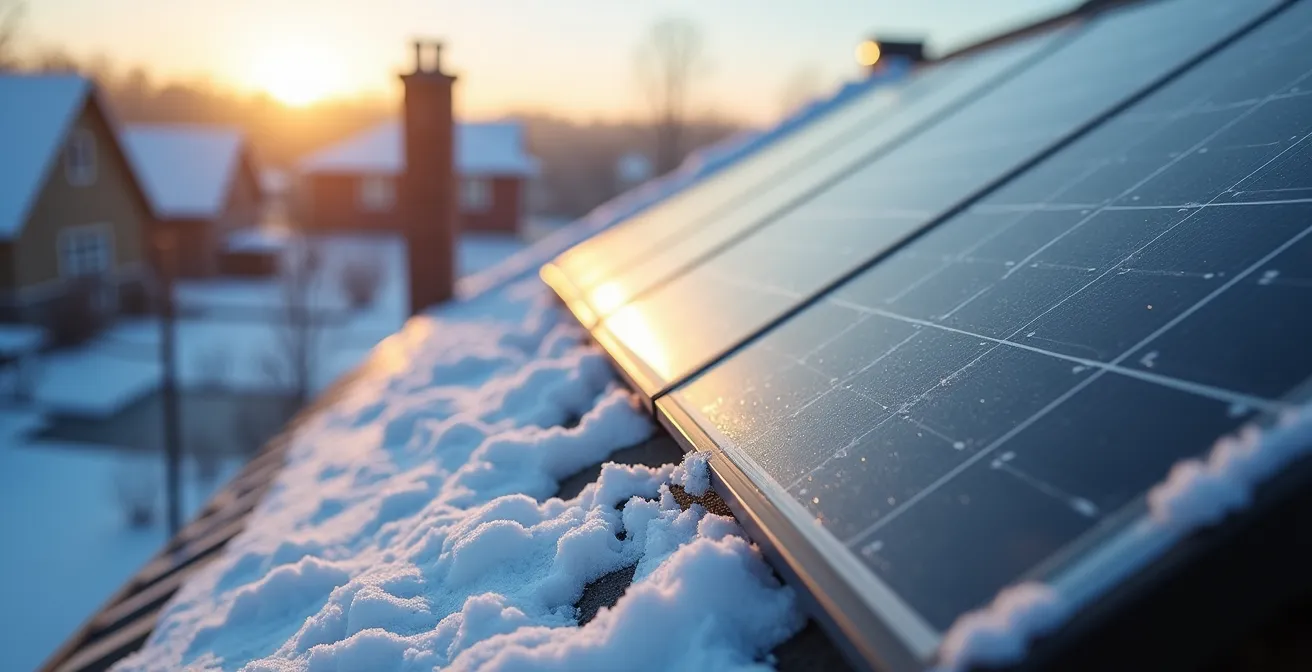
The image of partially cleared panels highlights the tension between nature’s challenges and the pursuit of self-sufficiency. Rather than fighting the snow, a resilient system is designed to work with it, combining passive shedding with sufficient battery backup to ride out the storm. This proactive approach is the cornerstone of a reliable winter energy strategy.
Why You Must Replace Your Roof Before Installing Solar Panels?
A solar panel system is a 25- to 30-year investment. Your roof, however, may have a much shorter lifespan. One of the most costly mistakes a homeowner can make is installing a brand-new solar array on an old roof. If your roof needs replacement 10 years into the life of your panels, you will have to pay a significant fee to have the entire solar system professionally removed, stored, and then re-installed after the new roof is in place. This process can cost thousands of dollars and negates a substantial portion of your energy savings. Therefore, if your roof has less than 15 years of life remaining, replacing it *before* the solar installation is a non-negotiable step in protecting your investment.
This pre-installation replacement also presents a powerful opportunity for holistic system efficiency. Instead of just replacing old shingles, you can upgrade your entire roofing system to reduce your home’s energy consumption from the top down. A “cool roof” is a prime example. By using materials with high solar reflectance, a cool roof can reduce the amount of heat absorbed into your attic and home. According to some studies, cool roof materials with high solar reflectance can achieve a 30-40% reduction in cooling load during the summer. This drastically lowers your air conditioning usage—one of the largest energy draws in a typical home.
By reducing your home’s overall energy demand *first*, you can often install a smaller, less expensive solar and battery system while still achieving your energy independence goals. The savings from downsizing the solar array can often offset a significant portion of the roof replacement cost, making it a financially astute decision.
Case Study: Holistic Home Independence Retrofit
A homeowner undertook a comprehensive energy project that perfectly illustrates this principle. They combined a roof replacement using metal roofing with an attic insulation upgrade (to R-49) and the installation of a radiant barrier. This integrated approach reduced the home’s daily energy consumption by a staggering 35%. As a result, they were able to downsize their planned system from a 10kW solar array to just 6.5kW, and from 20kWh of battery storage to 13kWh. This holistic strategy saved them approximately $15,000 on the total system cost while still meeting their original energy independence objectives.
How Smart Water Valves Prevent Catastrophic Flooding Damage?
When considering a holistic home energy system, protecting the high-value assets is as important as the energy production itself. A home battery system, often installed in a basement or garage, represents a significant investment, frequently costing $15,000 or more. While it provides energy security, it is also highly vulnerable to one of the most common and destructive household disasters: water damage from a burst pipe or failed appliance. A flooded basement can instantly destroy your battery, inverter, and other critical electrical components, leading to a total financial loss.
This is where a relatively small investment in a smart water valve provides outsized protection for your larger energy investment. A smart water valve, or water main shutoff, is an automated device installed on your home’s main water line. It connects to a network of wireless sensors placed near water heaters, washing machines, sinks, and, crucially, your battery system. The moment a sensor detects moisture, it signals the main valve to shut off the water supply to the entire house automatically, stopping a leak in seconds before it can become a catastrophic flood. This simple device acts as an insurance policy for your energy system.
The return on investment calculation is starkly clear: a $500 smart valve can protect a $15,000+ battery investment from total destruction. Furthermore, for true resilience, the valve’s controller and a few key sensors should be connected to the critical loads panel powered by your battery. This ensures that even during a grid outage—a time when you might be away from home and unaware of a leak—your home’s automated flood protection system remains fully operational, safeguarding the very battery that is keeping your lights on.
Action Plan: Battery System Flood Protection Integration
- Install a smart water valve with battery backup capability on the main water line.
- Connect the valve controller to the critical loads panel that is powered by your battery system.
- Place wireless leak sensors near the battery system, inverter, and other flood-prone areas.
- Configure automatic shutoff triggers within the device’s app for both leak detection and power outage events.
- Test the system’s operation monthly during simulated grid outages to ensure functionality.
How to Stack Rebates for Energy Upgrades to Cover 30% of Costs?
The high upfront cost of a solar-plus-storage system is often the biggest barrier for homeowners. However, a significant portion of this cost can be offset by strategically “stacking” multiple incentives, rebates, and tax credits. Viewing these programs not as individual discounts but as a cohesive financial strategy is key to maximizing your savings. The cornerstone of these incentives in the United States is the federal Residential Clean Energy Credit, commonly known as the Investment Tax Credit (ITC). This provides a tax credit equal to 30% of the total cost of the system, including panels, inverters, the battery, and even installation labor and related electrical upgrades.
Beyond the federal ITC, a wealth of state, local, and utility-specific programs exist. The key is to research and apply for all programs for which you are eligible. State-level programs, like California’s Self-Generation Incentive Program (SGIP), can provide direct cash rebates based on the size of your battery (e.g., $200 per kWh). Many local utility companies also offer their own rebates for installing solar or battery storage as it helps them manage grid load. These programs are often designed to be stackable, meaning you can apply the federal credit on top of state and local rebates.
By layering these incentives, the net cost of a system can be dramatically reduced. For example, a homeowner in a supportive state could potentially combine the 30% federal ITC with a state battery rebate and a local utility grant. This is how strategic incentive stacking in some regions can achieve up to a 55% total cost reduction on a solar-plus-storage project. It is crucial to work with an experienced installer who is knowledgeable about all available programs in your specific area and can manage the application process to ensure you capture every available dollar of savings.
The table below provides an example of how various incentives can be stacked in a state like California, illustrating the potential for significant cost reduction.
| Incentive Program | Amount/Percentage | Eligible Systems | Stackable? |
|---|---|---|---|
| Federal ITC | 30% of total cost | Solar + Battery | Yes |
| CA SGIP | $200/kWh battery | Battery Storage | Yes |
| Utility Rebates | Varies $1,000-5,000 | Solar/Battery/Both | Usually |
| Local Programs | 5-20% additional | Varies | Check locally |
Key Takeaways
- Policy Dictates ROI: The financial necessity of a battery is primarily driven by net metering rules. If export credits are low, a battery becomes essential for self-consumption.
- Think Holistically: Reducing your home’s energy demand first (with cool roofs, insulation) lowers the required size and cost of your solar and battery system.
- Stack All Incentives: The high upfront cost can be significantly reduced by layering federal, state, and local rebates. This can often cut the net price by 30-50% or more.
Energy-Positive Eco-Housing: How to Generate More Power Than You Consume?
The ultimate goal for many homeowners is not just to reach net-zero energy consumption, but to become “energy-positive”—generating more power over the course of a year than the household consumes. This transforms the home from a simple consumer of electricity into a miniature power plant that can support itself and even contribute to the stability of the wider grid. Achieving this status requires the holistic approach discussed previously: a highly efficient building envelope, optimized solar production, and robust energy storage. This is where the synergy between home energy and electric vehicles (EVs) creates a powerful new paradigm.
The battery in an electric vehicle is often far larger than a typical home storage battery. As an example of this scale, vehicle-to-home technology reveals that a standard 70kWh EV battery provides 4.5 times the capacity of a common 15kWh home battery. With the advent of bidirectional charging, known as Vehicle-to-Home (V2H) or Vehicle-to-Grid (V2G) technology, your car can become a massive, mobile battery for your house. You can charge your EV with free solar power during the day and then use that stored energy to power your home during the expensive evening peak, drastically enhancing your energy independence without the cost of a second, stationary battery.
On a larger scale, a network of energy-positive homes can form a “virtual power plant” (VPP). When the grid is under stress, a utility can pay homeowners to discharge a small amount of power from their home and EV batteries back to the grid, helping to prevent blackouts. This creates a new revenue stream for the homeowner and enhances grid stability for the entire community. This isn’t science fiction; it’s already a reality. During grid stress events in July 2025, Puerto Rico’s network of 160,000 homes with solar and storage collectively dispatched 48 megawatts from 70,000 residential batteries, preventing widespread blackouts. This powerful case study, born from the devastation of Hurricane Maria, demonstrates how a distributed network of energy-positive homes can create a more resilient and independent energy future for everyone.
Ultimately, the decision to invest in a solar and battery system is a long-term financial strategy. To ensure your investment is sound, the next logical step is to get a professional assessment of your specific property, consumption habits, and local policies. An expert analysis can provide a detailed ROI calculation and system design tailored to your unique goals for energy independence.