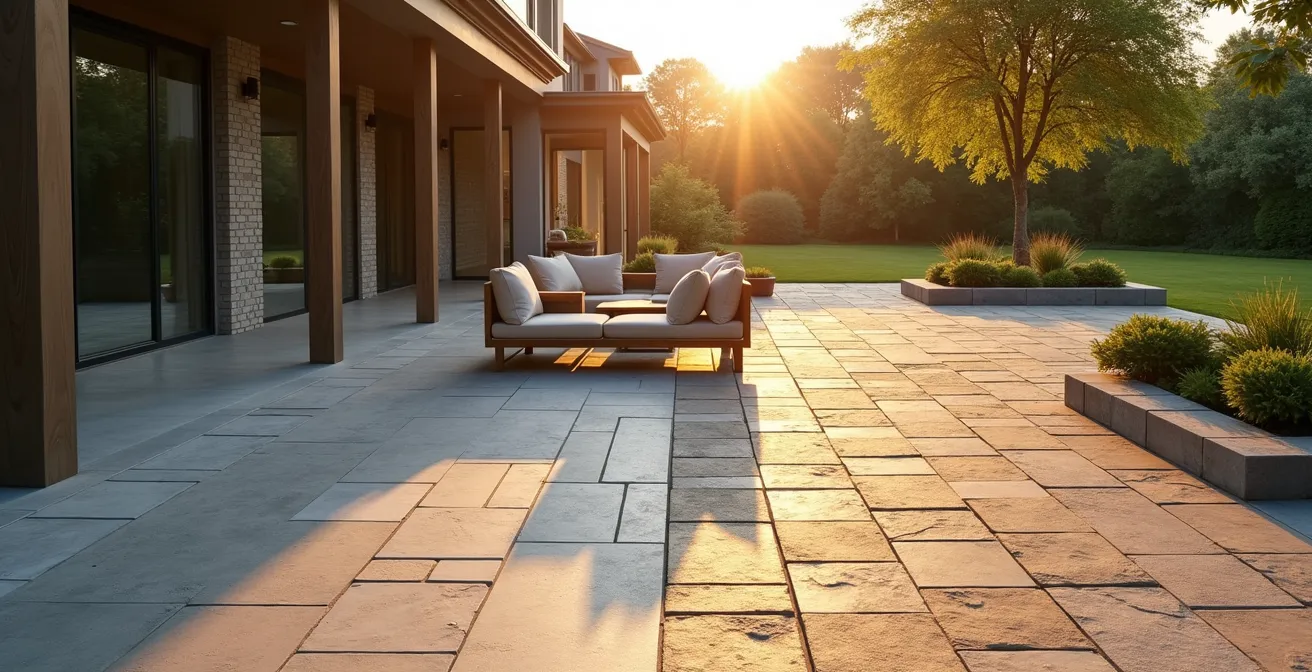
The debate over paver versus concrete longevity misses the point; the surface material is secondary to the quality of the installation system beneath it.
- A patio’s lifespan is determined by the integrity of its sub-base, not just the top layer you see.
- Proper base compaction, joint stabilization, and water management are the true indicators of whether your patio will last 5 years or 50.
Recommendation: Prioritize a hardscape contractor who emphasizes sub-base preparation and system integrity, rather than one who simply sells you on a specific surface material.
As a homeowner planning a permanent outdoor seating area, you face a foundational choice: the timeless appeal of natural stone pavers or the versatile finish of stamped concrete. The internet is filled with arguments pitting one against the other, usually focusing on upfront cost, design options, or the ease of repairing a single paver versus a cracked concrete slab. You’ve likely read that pavers are more expensive but repairable, while concrete is cheaper but prone to large, unsightly cracks. These points are valid, but they only scratch the surface of what determines a patio’s true longevity.
From a contractor’s perspective, this debate is misleading. The question isn’t “which material lasts longer?” but “which system is built to last?” A patio is not just a surface; it’s an engineered system designed to resist soil movement, water intrusion, and extreme weather. The real culprits behind a failing patio are almost always hidden from view. They are issues of poor base compaction, failed joint stabilization, and inadequate water management—problems that can doom either pavers or concrete.
This guide will shift your focus from the surface to the substance. We will dissect the critical installation factors that dictate the lifespan of any hardscape project. By understanding the ‘why’ behind common patio failures, you’ll be equipped to ask the right questions and ensure your investment creates a beautiful, durable outdoor space for decades to come, regardless of the material you choose.
This article will delve into the critical technical aspects that truly define patio durability. By exploring these eight key areas, you will gain a contractor’s insight into what makes a hardscape project a long-term success or a premature failure.
Summary: Stamped Concrete vs Natural Stone Pavers: A Contractor’s View on Longevity
- Why Your Patio Is Sinking: The Importance of Compaction
- Polymeric Sand: Does It Really Stop Weeds Between Pavers?
- Dark vs Light Pavers: Which Burns Bare Feet in Direct Sun?
- How to Size Your Patio So Chair Legs Don’t Fall Off the Edge?
- Why Certain Flagstones Crack in Winter Climates?
- Flush Thresholds: How to Eliminate Trip Hazards Between House and Patio?
- Why Smooth Tiles Are a Hazard in Kitchens and Bathrooms?
- Why Choose Permeable Stone Paving for Driveways in Flood-Prone Areas?
Why Your Patio Is Sinking: The Importance of Compaction
A sinking or uneven patio is the most visible sign of a failed installation, and the problem almost always lies beneath the surface. The longevity of your patio is built on its sub-base foundation, a layer of crushed stone that must be properly compacted. Compaction is the process of mechanically increasing the density of the soil and aggregate base to prevent future settlement. Without it, the weight of the pavers or concrete slab, combined with foot traffic and environmental factors, will inevitably cause the ground to shift and sink, creating dangerous low spots and an unstable surface.
The industry standard for a lasting installation is not arbitrary. For residential paver installations, professional guidelines require the base to be compacted to a minimum of 98% SPD (Standard Proctor Density). This specific metric comes from the Proctor compaction test, a method developed in the 1930s to establish the maximum density soil can achieve. Achieving this level of compaction requires using a heavy-duty plate compactor in multiple “lifts” (layers), ensuring the entire depth of the base is uniformly solid. A contractor who skips this step or uses inadequate equipment is not building a patio; they are simply placing materials on unstable ground, guaranteeing failure.
Think of it as the foundation of your house. You would never accept a home built on loose dirt, and the same principle applies to your hardscape. This is the single most critical factor in a patio’s lifespan. A paver system on a perfectly compacted base will outlast a concrete slab poured on a poorly prepared one every time. When interviewing contractors, their process for achieving and verifying proper compaction should be your first and most important question.
Polymeric Sand: Does It Really Stop Weeds Between Pavers?
One of the most common concerns homeowners have about pavers is the threat of weeds growing in the joints. Polymeric sand, a fine sand mixed with a polymer binding agent that hardens when wet, is often marketed as the definitive solution. While it is an essential component of a modern paver system, its effectiveness is widely misunderstood. Polymeric sand is not a magic weed barrier; it is a stabilizing agent. Its primary job is to lock the pavers together into a flexible, unified surface and to prevent the joint sand from washing out.
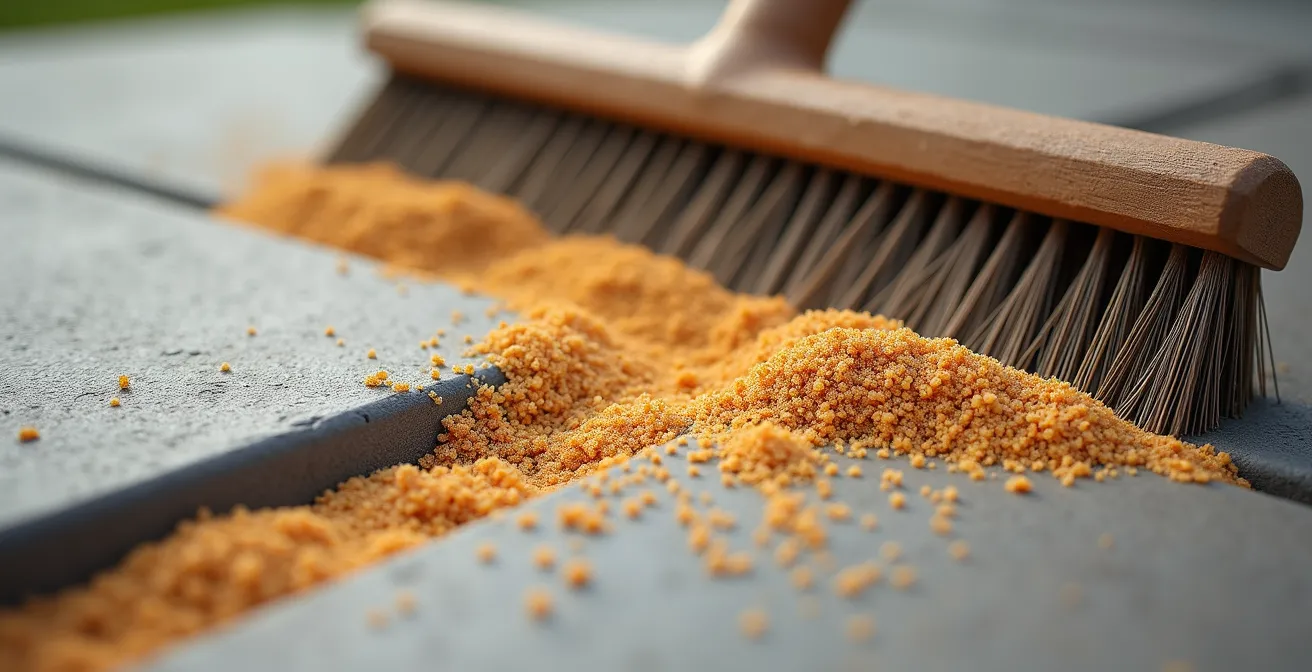
When weeds do appear, it’s rarely because they have pushed up through a properly compacted base and a solid layer of polymeric sand. Instead, it’s because the system has failed. As leading professionals from Western Interlock point out, this is a crucial distinction:
Polymeric sand failure is not the problem, but a symptom of a deeper issue. If the paver base is unstable and pavers are shifting, even minutely, the hardened sand joint will crack, creating the perfect entry point for water and weed seeds.
– Western Interlock Professionals, Joint Compound vs. Polymeric Sand Guide
These tiny cracks collect airborne seeds and organic matter, creating the perfect shallow environment for weeds to sprout. So, while polymeric sand is excellent at preventing weeds from *below*, its real value is in maintaining the system integrity that prevents weeds from establishing from *above*. It is a crucial part of the system, but it relies on a stable base to do its job effectively. Other jointing compounds exist, each with different properties and lifespans.
This comparative table, based on data from hardscape experts, illustrates the different trade-offs between common jointing materials.
| Material Type | Lifespan | Water Permeability | Installation Conditions | Cost Range |
|---|---|---|---|---|
| Polymeric Sand | 3-5 years (up to 10 with proper installation) | Non-permeable when cured | Requires dry conditions, above freezing | $20-$90 per 50-lb bag |
| Epoxy/Resin Compounds | Up to 20 years | Permeable | Can be installed wet or dry, above 37.4°F | Higher initial cost |
| Regular Silica Sand | Requires annual replenishment | Fully permeable | Any conditions | Lowest cost option |
Dark vs Light Pavers: Which Burns Bare Feet in Direct Sun?
The color of your patio surface is more than an aesthetic choice; it has significant practical implications for comfort and usability, especially in sunny climates. The simple answer is yes, dark pavers get significantly hotter than light-colored ones. This is due to a property called the Solar Reflectance Index (SRI). Materials with a low SRI (dark colors like charcoal or black) absorb a high percentage of solar radiation and convert it into heat. Light-colored surfaces have a high SRI, reflecting more sunlight and staying cooler to the touch.
However, the material itself also plays a huge role. Both concrete and stone pavers have high thermal mass, meaning they are very effective at absorbing and storing heat. This can be a benefit on a cool evening as the patio radiates warmth, but it can make the surface unbearable during a hot summer afternoon. While color is the primary driver of peak temperature, the difference in material composition between stamped concrete and pavers also matters in terms of overall durability. For instance, high-quality interlocking concrete pavers are manufactured under controlled conditions to achieve immense strength, often showing a significant advantage over poured-in-place concrete. Some analysis shows that pavers are significantly stronger than stamped concrete, with 8,000 PSI vs 3,000-4,000 PSI respectively. This superior compressive strength makes them more resistant to cracking from stress, though it doesn’t change their thermal properties.
The takeaway is that for a patio in direct sun, especially around a pool where barefoot traffic is common, choosing a light-colored paver is the best choice for comfort. While stamped concrete can also be colored light, the application of sealants—often necessary to protect the stamped pattern and color—can create a smooth, less breathable surface that may feel hotter and become extremely slippery when wet.
How to Size Your Patio So Chair Legs Don’t Fall Off the Edge?
A common design mistake that undermines a patio’s usability is making it too small. A patio that looks fine when empty can quickly become a cramped and hazardous space once furniture is added. The classic problem is a dining chair that, when pushed back, has one or more legs slip off the edge of the patio. This isn’t just an annoyance; it’s a safety issue. Professional hardscape design avoids this by using the principle of functional zoning, planning the space around its intended use, not just its dimensions.
Instead of guessing, a contractor plans for specific zones: a dining zone, a conversation/lounge zone, and circulation zones (walkways). For a dining area, the rule of thumb is to allow a minimum of 36 inches of clearance behind each chair from its position at the table. This allows someone to comfortably push their chair back and stand up without falling off the edge. Walkways should be at least 3 feet wide to allow for easy movement. By mapping out these functional zones first, the required size and shape of the patio become clear, ensuring it is both beautiful and practical.
This is another area where the paver vs. concrete debate has practical implications. While both can be formed to any size, a paver patio is a dynamic, modular system that can be easily expanded later. If you decide you need more space, a contractor can seamlessly add more pavers, extending a zone without creating an unsightly seam. With stamped concrete, adding on creates a “cold joint”—a visible line where the new slab meets the old—which is prone to cracking and is impossible to hide. Although initial costs can be higher, this flexibility is a long-term benefit of pavers. Industry data often shows that paver patios cost significantly more than stamped concrete initially at $25-$50 vs $15-$22 per square foot, but the investment can pay off in adaptability and repairability.
Action Plan: Professional Patio Sizing for Functional Zones
- Establish Dining Zones: Measure your table and chairs, then add a minimum of 36 inches of clearance behind each pulled-out chair to define the dining area footprint.
- Create Lounge Zones: Arrange your intended lounge furniture (sofas, coffee tables) with appropriate spacing for comfort and conversation, and measure the total required area.
- Design Circulation Paths: Plan clear walkways between zones, doorways, and other yard access points with a minimum width of 3 feet.
- Consider Future Expansion: Evaluate if your needs might change. Pavers allow for seamless future additions, whereas expanding a concrete slab will create visible, weak cold joints.
- Factor in Design Complexity: For intricate, multi-zone layouts, the unit-by-unit installation of pavers provides far more design flexibility than a single, monolithic concrete pour.
Why Certain Flagstones Crack in Winter Climates?
In regions with harsh winters, the freeze-thaw cycle is the ultimate test of a hardscape’s durability. Water is the primary enemy. When water penetrates a stone and freezes, it expands with immense force, a process called frost heave. If the stone has a high absorption rate, this internal pressure can cause it to flake, spall, or crack. This is why not all natural stone is suitable for cold climates. The key properties to look for are a low absorption rate and high compressive strength.
Materials like sandstone and some types of limestone have a more porous structure, allowing them to soak up water like a sponge. When a cold snap hits, they are at high risk of damage. In contrast, dense, crystalline stones like granite and quartzite have very low water absorption rates, making them virtually immune to freeze-thaw damage. This is not just a material issue; it’s a system issue. A properly installed system will also incorporate a free-draining base that prevents water from sitting against the bottom of the stones. Rigorous lab testing confirms this. For example, a case study by RDH Building Science subjected a paver system to 50 extreme freeze-thaw cycles and found no visible decay in the pavers, joints, or bedding, proving the resilience of a well-engineered system.
The choice of de-icing chemicals also plays a role. Rock salt (sodium chloride) is highly corrosive to more porous stones like limestone and can cause surface pitting. Choosing a stone with high chemical resistance is just as important as its frost resistance. Before investing in natural stone, it’s crucial to consult a hardiness guide.
This guide, based on comparative data from industry leaders like Techo-Bloc, shows how different stone types perform in demanding winter conditions.
| Stone Type | Absorption Rate | Compressive Strength | Winter Suitability | De-icing Chemical Resistance |
|---|---|---|---|---|
| Granite | Very Low | Very High | Excellent | High |
| Quartzite | Low | High | Excellent | High |
| Bluestone | Low-Medium | High | Good | Moderate |
| Limestone | Medium-High | Medium | Fair | Low |
| Sandstone | High | Low-Medium | Poor | Low |
Flush Thresholds: How to Eliminate Trip Hazards Between House and Patio?
A seamless transition from your home’s interior to your patio is not just aesthetically pleasing; it’s a matter of safety and accessibility. A step-down is a common trip hazard, especially for children and the elderly. Achieving a flush threshold, however, requires careful planning to manage water and ensure the patio surface is at the exact right height. This is an area where the installation method for pavers and concrete differs dramatically, highlighting the core nature of each material.
A stamped concrete slab is monolithic—it is poured as a single, rigid unit. The height is set by the formwork, and once the concrete is poured, it is fixed. A small mistake in elevation is extremely difficult and costly to correct. Achieving a perfect flush transition is possible, but it leaves zero room for error. Pavers, on the other hand, offer a modular, dynamic system. As hardscape professionals at Techo-Bloc explain, this offers a distinct advantage:
Pavers offer granular control, allowing for precise height adjustment paver-by-paver right up to the threshold. A concrete slab’s height is monolithic and fixed once poured, making mistakes much harder to correct.
– Techo-Bloc Installation Professionals, Stamped Concrete vs. Pavers: A Breakdown
This paver-by-paver adjustability allows a skilled contractor to fine-tune the height perfectly against the door sill. But what about water? Building a surface flush against the house requires a robust water management plan to prevent water from pooling against the foundation. Professional solutions include installing a concealed linear trench drain right against the house wall, which captures runoff while remaining invisible. Additionally, the patio must still have a subtle slope (1-2%) away from the foundation. With pavers, this slope can be precisely engineered, and permeable paver systems can be used to eliminate surface water altogether.
Why Smooth Tiles Are a Hazard in Kitchens and Bathrooms?
While the title references interior spaces, the principle it highlights is even more critical outdoors: a smooth, non-porous surface becomes a dangerous slipping hazard when wet. This is a primary concern for patios, especially around pools, hot tubs, or in rainy climates. Stamped concrete, by its nature, often requires a sealant to protect its color and stamped pattern. While these sealants enhance the look, many can dramatically lower the surface’s coefficient of friction, turning a safe patio into an ice rink when wet or frosty.
To ensure safety, outdoor walking surfaces must meet specific standards for slip resistance. The key metric is the Dynamic Coefficient of Friction (DCOF), which measures how much grip a surface provides when an object (like a shoe) is in motion. The American National Standards Institute (ANSI) specifies in standard A326.3 that surfaces expected to be walked upon when wet must have a DCOF of 0.42 or greater. Many film-forming sealants used on stamped concrete can fail this test, creating a major liability. While anti-slip additives can be mixed into the sealant, they can alter the appearance and may wear off over time.
In contrast, many natural stone and interlocking concrete pavers have a natural, textured surface that maintains excellent slip resistance even when wet, without the need for special coatings. Their inherent texture provides natural grip, making them a much safer choice for high-moisture areas. This fundamental difference in surface properties is a critical, and often overlooked, factor in the “pavers vs. concrete” decision. The focus on longevity should always include the longevity of the people using the space, and preventing slips and falls is a top priority.
Key Takeaways
- The Foundation Is Everything: A patio is only as strong and level as its compacted sub-base. 98% Proctor density is the non-negotiable standard for longevity.
- Water Is the Enemy: Longevity depends on managing water. Proper jointing, surface slope, and drainage prevent the movement, cracking, and weed growth that destroy patios.
- Systems Over Materials: A well-installed paver system will outlast a poorly poured concrete slab, and vice-versa. The integrity of the entire installation is what you are paying for.
Why Choose Permeable Stone Paving for Driveways in Flood-Prone Areas?
Moving beyond basic durability, advanced hardscape systems can actively solve environmental problems. For homes in areas with poor drainage or those subject to heavy rainfall, a permeable paver system represents the pinnacle of system integrity. Unlike a traditional, impermeable surface (like stamped concrete or standard pavers) that forces all rainwater to run off into storm drains, a permeable system is designed to let water pass straight through it.
This is achieved through two key features: the pavers themselves have larger gaps between them, and, more importantly, the sub-base is completely different. Instead of a dense, compacted base, a permeable system uses an “open-graded” base of various-sized, clean-washed stones. This creates an underground reservoir that holds rainwater and allows it to slowly percolate back into the ground. This has profound benefits: it recharges natural groundwater, dramatically reduces the strain on municipal storm sewers, and, most importantly for the homeowner, can prevent basement flooding by managing excess water right at the source.
While often used for driveways to handle heavy loads, the technology is perfectly suited for patios in flood-prone locations. Properly engineered permeable paver systems are designed to handle full vehicular loads while maintaining their drainage capacity. This is a far more sophisticated and effective solution than pervious concrete, which is a porous version of concrete that can be more prone to clogging and difficult to maintain over the long term. A permeable paver system is a proactive investment in managing water, turning your patio from a passive surface into an active part of your property’s water management solution.
Your ultimate goal is a beautiful, durable patio that serves your family for decades. The key is to shift your focus from a simple material choice to an evaluation of the contractor and their installation system. Your next step should be to find a certified professional who speaks the language of base compaction, water management, and system integrity.
Frequently Asked Questions About Patio Surfaces
How does the Solar Reflectance Index (SRI) affect patio surface temperature?
Low SRI values (dark colors) absorb more heat, making surfaces hotter and contributing to the Urban Heat Island Effect. Light-colored surfaces reflect more solar radiation but show organic stains and rust more readily.
What role does thermal mass play in paver temperature retention?
Both concrete and stone retain heat due to their thermal mass. This can be beneficial by radiating warmth into cool evenings, but problematic when radiating heat against homes during hot summer nights.
How do sealants affect the slip resistance of patio surfaces?
Sealants can dramatically lower the Dynamic Coefficient of Friction (DCOF), turning a safe patio into a liability when wet or frosty. Always verify that sealants meet ANSI A326.3 standards for outdoor surfaces.
What is pervious concrete and how does it compare to permeable pavers?
Pervious concrete is a porous version of standard concrete that allows water to pass through. While it offers permeability, permeable paver systems typically provide better long-term performance and easier maintenance because individual components can be cleaned or replaced.
How does a permeable system’s base differ from standard installation?
Permeable systems use layers of open-graded, clean-washed stone of various sizes to create an underground reservoir. This specialized base is completely different from the densely compacted base used in standard, non-permeable installations.
Can permeable systems handle vehicle traffic?
Yes, properly designed permeable paver systems can handle vehicular loads while maintaining their drainage capabilities, making them suitable for driveways and high-use areas in flood-prone regions.