The most dangerous flaw in a fixer-upper isn’t the one you can see, but the one you misinterpret.
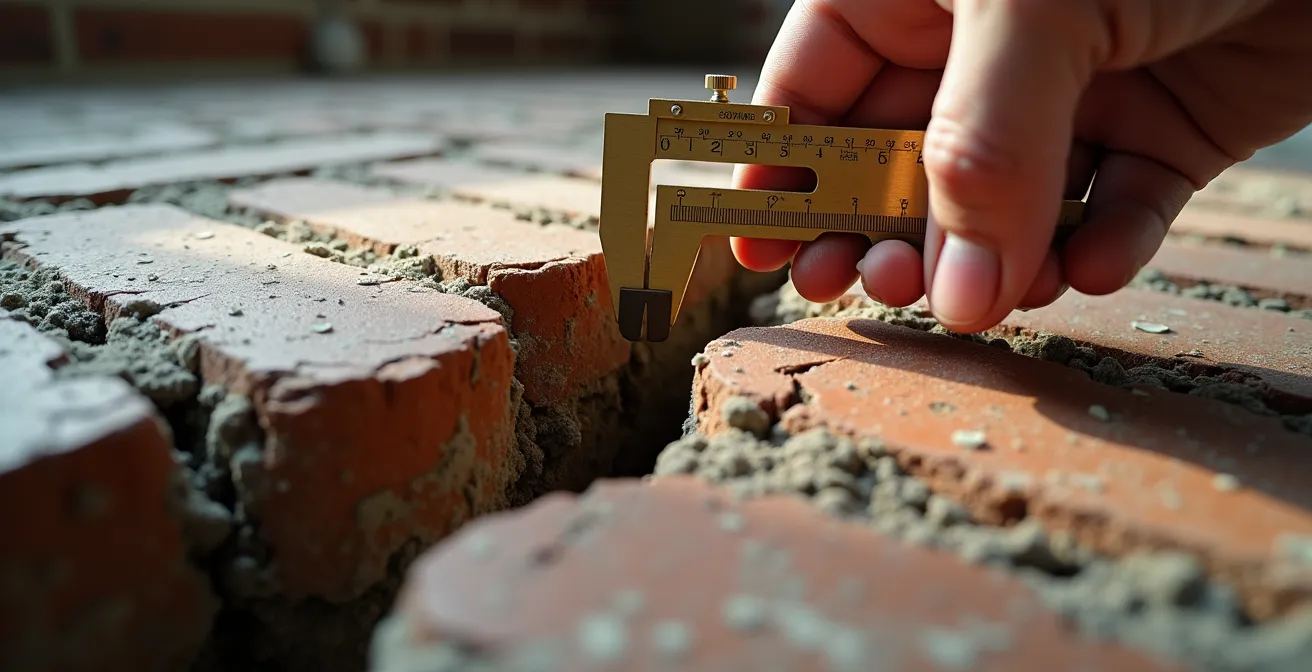
- Superficial cracks are common; stair-step cracks tracking mortar lines signal active, costly foundation movement.
- Upgrades to kitchens or baths can void ‘grandfathered’ electrical status, triggering a mandatory—and expensive—full system rewire.
Recommendation: Prioritize a pre-purchase structural assessment when any red flags are present; a $600 inspection can save you from a six-figure mistake.
For a property investor, the term “fixer-upper” represents opportunity—a calculated risk for significant reward. The calculation, however, is often dangerously oversimplified. Many investors focus on cosmetic potential and visible flaws, armed with a general home inspector’s report. Yet, the most catastrophic financial mistakes are not born from ugly wallpaper or outdated kitchens; they are rooted in the misdiagnosis of the building’s structural health. The critical question is not “Can this be fixed?” but rather, “Do I understand the underlying structural mechanism at play, and can I accurately project the cost and complexity of its remedy?”
Conventional wisdom advises looking for foundation cracks, checking for level floors, and examining the roof. While not incorrect, this advice is dangerously incomplete. It fails to provide the diagnostic framework needed to differentiate between benign, historic settling and active, progressive structural failure. An investor cannot afford to treat all symptoms equally. Is a diagonal crack by a window a sign of normal material expansion, or is it evidence of a failing header and a compromised load path? Is a bouncy floor a simple subfloor issue, or does it point to rotted joists that threaten the stability of an entire room?
This guide departs from the generic checklist. It provides a forensic engineering perspective—a systematic method for structural triage. We will not simply list problems. We will dissect the symptoms, explain the physics of failure, and establish clear thresholds to help you distinguish a cosmetic issue from a “deal-breaker.” The goal is to equip you with the knowledge to see beyond the surface crack and understand the forces acting on the structure, enabling a more precise risk assessment before you invest.
This article will guide you through the essential checkpoints of a structural assessment. We will analyze the most common and deceptive signs of trouble, from the foundation to the roof, providing you with the criteria to evaluate their severity. Follow this structured approach to transform your next property viewing from a simple walkthrough into a forensic investigation.
Summary: Structural Triage: A Forensic Engineer’s Guide to Vetting a Fixer-Upper
- Why Stair-Step Cracks in Brickwork Indicate Foundation Failure?
- How to Identify a Load-Bearing Wall Without Original Blueprints?
- Rotting Joists: The Invisible Threat Behind Your Bathroom Tiles
- Sagging Rooflines: When Is It a Quick Fix vs a Full Replacement?
- How to reinforce Floor Joists for a New Heavy Kitchen Island?
- How to Install Textured Planks to Hide Subfloor Imperfections?
- When Do You Lose ‘Grandfathered’ Status on Old Electrical Systems?
- When to Hire a Structural Engineer: A Guide for Wall Removal Projects
Why Stair-Step Cracks in Brickwork Indicate Foundation Failure?
Of all the potential defects in a fixer-upper, cracks in masonry are the most visually alarming. However, not all cracks are created equal. The key to proper diagnosis lies in their pattern, location, and width. Hairline vertical or jagged cracks that do not follow a pattern may be due to simple material shrinkage, a non-structural concern. The unambiguous red flag is the stair-step crack. This pattern, which follows the mortar joints in brick or blockwork, is a classic indicator of differential settlement—the upward or downward movement of a portion of the foundation relative to the rest.
This movement is often caused by changing soil conditions, such as expansion and contraction due to moisture. In fact, an analysis from the American Society of Civil Engineers found that 25% of all homes in the US have experienced damage due to expansive soils. When soil swells or shrinks unevenly beneath the footing, it creates immense pressure, forcing the rigid foundation to bend and crack. The rigid brick veneer above cannot accommodate this movement and fails in shear along its weakest plane: the mortar joints. A stair-step crack is the visible telegraph of this subterranean battle.
The investor’s primary task is to determine if the movement is historic or active. A historic crack, while evidence of a past event, may have stabilized. An active crack signifies an ongoing problem that will worsen and require immediate, and often expensive, intervention like underpinning or pier installation. Any crack wide enough to fit a nickel (approximately 1/16 inch or wider) warrants immediate professional evaluation, as it suggests significant movement.
How to Identify a Load-Bearing Wall Without Original Blueprints?
In older properties, original blueprints are a luxury. For an investor planning to create an open-concept living space, the inability to definitively identify load-bearing walls presents a significant risk. Removing or altering such a wall without providing an adequate new support system (like a properly sized header or beam) can lead to catastrophic failure, including sagging floors, cracked drywall on upper levels, and in the worst-case scenario, partial collapse. Your investigation must focus on understanding the home’s load path—the structural skeleton that transfers weight from the roof down to the foundation.
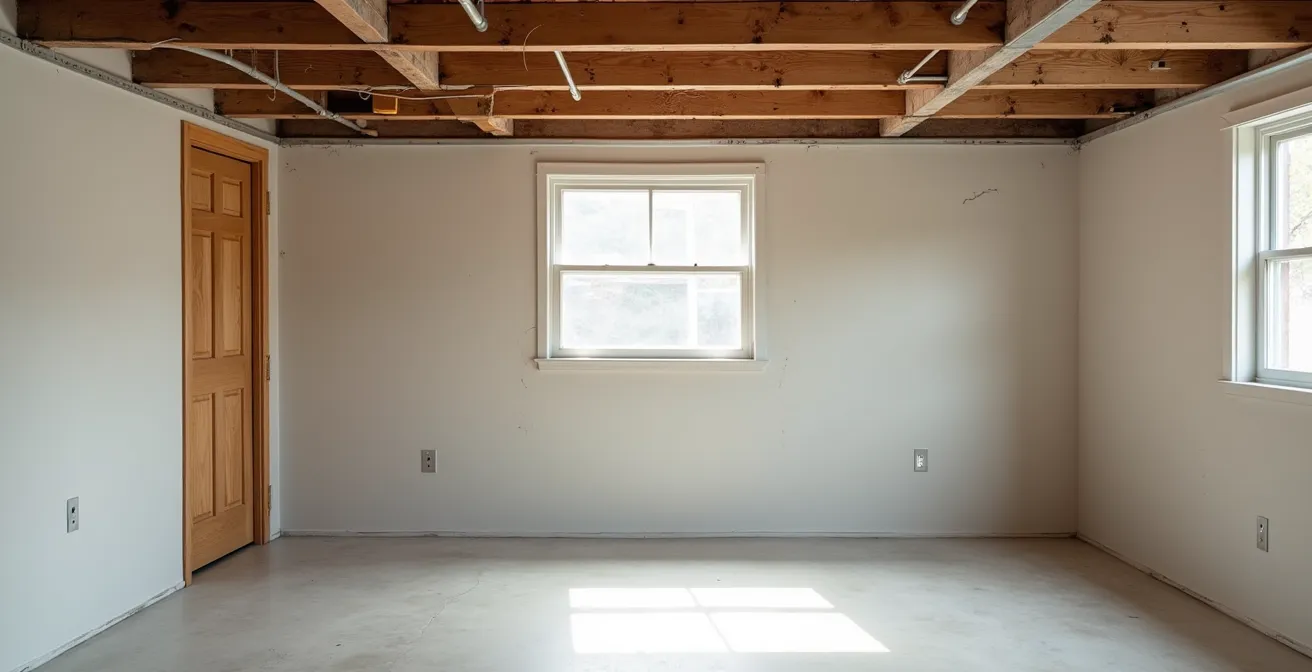
The most reliable method, absent plans, is to apply the “stacking principle.” Look for walls that are positioned directly on top of other walls or support beams on the floor below, all the way down to the basement or crawlspace. Exterior walls are almost always load-bearing. For interior walls, go to the basement or crawlspace and examine the ceiling. Identify the direction of the floor joists. Any wall running perpendicular to the joists is very likely load-bearing, as the joists are resting on it for support. Conversely, a wall running parallel to the joists is typically a non-load-bearing partition wall.
The image below shows an exposed basement ceiling, illustrating how beams and joists form the primary support structure. A wall on the floor above running perpendicular to these joists would be carrying their load.
Look for clues: walls that are thicker than others, or walls that contain plumbing stacks or HVAC ductwork, are often structural. Additionally, any wall situated near the center of the house is a prime candidate, as it likely supports the midpoint of long joist spans. Never rely on a single indicator. A confluence of these signs is necessary for a confident, preliminary assessment. However, the final determination before any demolition must always be made by a structural engineer.
Rotting Joists: The Invisible Threat Behind Your Bathroom Tiles
While foundation issues are dramatic, some of the most destructive problems are insidious and hidden. Floor joist rot, particularly in bathrooms and kitchens, is a prime example. Persistent, low-level water leaks from toilets, shower pans, or supply lines can saturate the subfloor and joists over years. The wood, trapped in a dark, damp environment, becomes a breeding ground for fungi, leading to rot that silently compromises the floor’s structural capacity. By the time symptoms like a “spongy” floor or cracked tiles become obvious, the damage is often extensive.
A savvy investor must employ a multi-sensory diagnostic approach. Trust your nose: a persistent musty, earthy smell is a tell-tale sign of mold and rot, even if no water is visible. Use your ears: tap the floor around the toilet and tub with a hard object, listening for a dull, hollow thud compared to a solid sound elsewhere. Use your sense of touch: walk slowly and deliberately across the floor, feeling for soft or bouncy spots. A simple but effective tool is a marble; place it on the floor and see if it consistently rolls toward a potential leak source, indicating significant sagging of the floor structure.
For a more technical assessment, moisture meters are invaluable. They can detect elevated moisture levels in the subfloor or joists that are not yet visible. Below is a comparison of common moisture detection tools an investor might consider using during an inspection.
| Tool Type | How It Works | Best For | Drawback |
|---|---|---|---|
| Pin-Type Meter | Measures electrical resistance between pins | Accurate readings in rough lumber | Leaves tiny holes in finished surfaces |
| Pinless Meter | Uses electromagnetic fields | Finished surfaces like hardwood floors | Less precise than pin-type |
| Relative Mode | Compares moisture between areas | Detecting problem zones | No absolute measurement |
Repairing rotted joists is an invasive and costly process. It often involves removing fixtures, flooring, and the subfloor to gain access. The joists may need to be “sistered” (reinforced with new lumber) or replaced entirely. More importantly, the source of the moisture must be permanently fixed to prevent recurrence. Ignoring a soft spot in a bathroom floor is a direct path to a full-gut renovation.
Sagging Rooflines: When Is It a Quick Fix vs a Full Replacement?
A sagging roofline is a defect that can stop a potential buyer in their tracks. It can indicate a range of issues, from minor to catastrophic. The structural triage here depends on identifying the cause, location, and severity of the sag. A slight, uniform dip along the ridge may simply be the result of age and long-term load, known as “creep.” Structural guidelines suggest a deflection of 1-2 inches over a 20-foot span might be acceptable historic settling in an older, conventionally-framed roof. This may not require immediate action, though it should be monitored.
The real danger lies in localized, pronounced sags or sags in modern truss roofs. A “stick-built” or conventionally-framed roof is built on-site with individual rafters and collar ties. It has some redundancy. A modern truss roof, however, is a pre-engineered system of interconnected members where each piece is critical. The failure of a single web member can compromise the entire truss and lead to a localized collapse. A significant sag in a single area often points to a broken rafter or failed truss, potentially caused by water damage, rot at the bearing points, or simply an inadequate original design.
Your inspection should start from the outside, sighting down the ridgeline and eaves from the ground. Look for a “swayback” appearance. Then, if safe to do so, enter the attic. Look for cracked or broken rafters. In a truss system, inspect the metal connector plates; if they are pulling away from the wood, the truss is failing. Check for evidence of water intrusion, especially around roof penetrations like chimneys and vents, as this is a primary cause of rot that weakens structural members. A “quick fix” might involve sistering a single broken rafter, but widespread sagging, multiple failed trusses, or extensive rot points to a full—and very expensive—roof structure replacement.
How to reinforce Floor Joists for a New Heavy Kitchen Island?
A common goal for investors renovating a fixer-upper is to install a modern kitchen, often featuring a large island with a heavy stone countertop. This introduces a significant point load concentration that the original floor structure was likely never designed to handle. A typical floor is designed for a uniform live load of around 40 pounds per square foot (psf). A granite-topped island can concentrate over 1,000 pounds into a small area, potentially exceeding the capacity of the existing joists and leading to excessive deflection, bouncy floors, and even structural failure.
Before proceeding, the existing floor system must be assessed and reinforced. The first step is to determine the span and spacing of the joists. Longer spans and wider spacing mean a weaker floor. The solution must then match the required load capacity. For minor reinforcement, installing “blocking” or “bridging”—perpendicular wood pieces between the joists—can prevent them from twisting under load and helps distribute the weight to adjacent joists.
For moderate loads, the most common solution is “sistering,” which involves attaching a new joist of the same size alongside one or more of the existing joists. This is often done with a combination of construction adhesive and structural bolts or screws, as shown in the image, effectively doubling the joist’s strength.

For extreme loads, more robust solutions are necessary. This might involve sistering with steel plates (“flitch plates”) for maximum strength in a minimal profile, or installing a new “drop-beam” underneath the joists, supported by posts that carry the load directly to the foundation. Crucially, any reinforcement plan must consider the entire load path. It is useless to strengthen the joists if the new, concentrated load is transferred to a beam or foundation footing that cannot support it.
How to Install Textured Planks to Hide Subfloor Imperfections?
Not every floor issue is a sign of impending doom. In many older homes, floors may be uneven or sloped due to historic settling that has long since stabilized. While this rules out certain sensitive flooring types, it doesn’t necessarily condemn the property. The key is to understand the tolerance of modern flooring materials and use them strategically. Attempting to hide a significant structural problem with a cosmetic fix is a recipe for disaster. However, covering minor, stable imperfections is a valid and cost-effective renovation strategy.
The first step is to quantify the problem. Use a long, straight edge (6-10 feet) or a laser level to measure the dips and high spots in the subfloor. Different flooring materials have different thresholds for what they can tolerate before their integrity is compromised. A floating plank floor, for instance, might show gaps at the seams with only a 1/8-inch dip over 10 feet, whereas ceramic tile can sometimes handle more variation before the grout begins to crack. The table below outlines typical tolerance thresholds.
| Flooring Type | Maximum Acceptable Dip | Warning Signs | Required Action |
|---|---|---|---|
| Floating Plank | 1/8 inch over 10 feet | Visible gaps at seams | Level subfloor first |
| Hardwood | 3/16 inch over 10 feet | Squeaking, separation | Address joist issues |
| Luxury Vinyl | 3/16 inch over 10 feet | Clicking sounds, lifting edges | Self-leveling compound needed |
If the subfloor’s unevenness is within an acceptable range, installing a textured or hand-scraped plank flooring can be an excellent camouflage. The inherent variations in the surface of these materials—whether luxury vinyl, laminate, or engineered wood—are masterful at hiding minor dips and waves in the subfloor. Their textures disrupt the light, making it difficult for the eye to perceive the underlying imperfections. Choosing a floating floor system with a thick, high-quality underlayment can further help to smooth out small irregularities. This approach allows an investor to achieve a beautiful, modern look without embarking on a costly and potentially unnecessary mission to perfectly level an old, settled subfloor.
When Do You Lose ‘Grandfathered’ Status on Old Electrical Systems?
Many fixer-uppers contain outdated electrical systems, such as knob-and-tube or ungrounded two-wire systems. While functional, they lack the safety features and capacity of modern wiring. As long as the system remains untouched, it is often “grandfathered,” meaning it is not legally required to be brought up to current code. For an investor, this grandfathered status is a critical budgetary consideration. The moment that status is voided, a full and expensive electrical upgrade is often triggered.
The triggers that void this status are tied to the scope of the renovation. It’s a common misconception that you can renovate around an old system indefinitely. Most building codes stipulate that if you alter or extend existing circuits, or if your renovation project exceeds a certain threshold, the grandfathered protection is lost. A simple rule of thumb is that any project requiring an electrical permit will likely open the door to a mandated upgrade. In some jurisdictions, renovating more than 50% of a home’s square footage automatically requires the entire electrical system to be brought up to code, a cost that can be substantial. Indeed, it’s not uncommon for the cost of updating a house’s electrical system to be $30,000 or more.
Investors must be acutely aware of these renovation triggers. The following actions are common events that can void grandfathered status and force a complete rewire:
- Moving or opening any wall, even non-load-bearing ones, that contains wiring.
- Adding a new bathroom or significantly remodeling a kitchen, as these require new dedicated circuits for GFCIs and appliances.
- Renovating more than 50% of the home’s total square footage.
- Pulling any new electrical permit for additions or significant upgrades.
- Changing the home’s occupancy classification (e.g., converting a single-family to a multi-family dwelling).
Understanding these tripwires is essential. The budget for a “cosmetic” kitchen remodel can easily double if it triggers a mandatory $30,000 electrical system overhaul. Always consult local building codes before planning a renovation on a home with an older system.
Key takeaways
- Differentiate Active vs. Historic Movement: Use crack monitors or dated photos to determine if a crack is growing. A stable, historic crack is a past problem; an active crack is an ongoing expense.
- Always Trace the Load Path: Before altering any wall, trace its support system down to the foundation. A wall’s position relative to the joists below is the most reliable indicator of its function.
- Understand Renovation Triggers: Be aware that modernizing kitchens or moving walls can void the ‘grandfathered’ status of old electrical and plumbing systems, triggering mandatory and costly full-system upgrades.
When to Hire a Structural Engineer: A Guide for Wall Removal Projects
While this guide provides a framework for preliminary structural triage, it is not a substitute for professional expertise. The role of the investor is to be an educated first-responder, capable of identifying red flags that warrant escalation. The decision to hire a structural engineer is not a sign of failure but the final, critical step in a sound due diligence process. The cost is negligible compared to the financial devastation of a misdiagnosed structural flaw. A pre-purchase inspection from an engineer provides a definitive assessment of the home’s condition.
According to home improvement experts, the $600 average for a home foundation inspection is a small price to pay for certainty. This assessment gives you a clear report on the home’s structural integrity and, most importantly, a professional opinion on the cause and required remedy for any issues. This report becomes a powerful tool for negotiation, allowing you to request concessions from the seller or, if the problems are too severe, to walk away from the deal with confidence.
For investors planning significant renovations like wall removal, an engineer is not optional; they are essential. They perform the necessary calculations to determine if a wall is load-bearing and design the correct size and type of beam or header to replace it, ensuring the load path remains unbroken. Proceeding without this stamped plan is a gamble against the laws of physics.
Your Action Plan: Red Flag Checklist for Calling an Engineer
- Any horizontal foundation crack (immediate concern for structural integrity).
- Any crack wider than 1/4 inch that can fit your pinky tip.
- Basement wall visibly bowing inward from external pressure.
- Door frames significantly out of square (doors won’t close properly).
- Multiple diagonal cracks originating from the corners of windows and doors.
Ultimately, a structural engineer provides the one thing an investor needs most: a clear boundary between manageable risk and a catastrophic liability. They transform unknowns into knowns, allowing for accurate budgeting and confident decision-making.
To put these principles into practice, the next logical step is to engage a qualified structural engineer for an impartial, expert assessment of any property exhibiting one or more of these red flags.