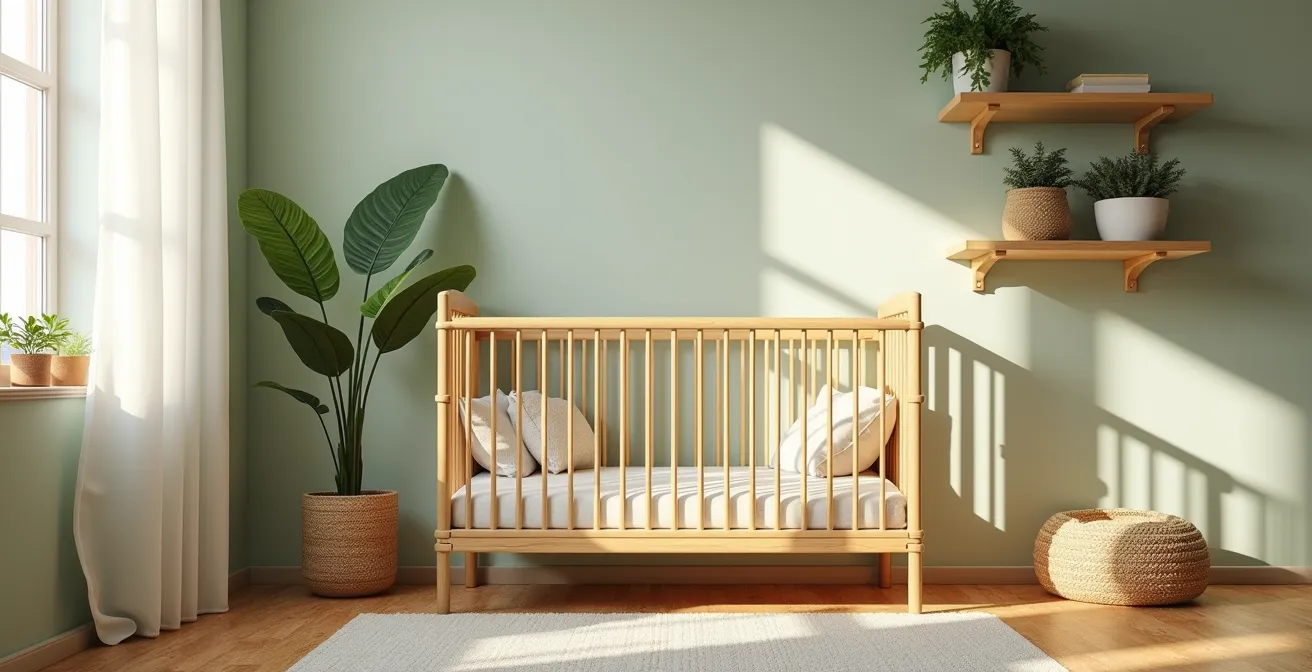
Relying on ‘low-VOC’ labels is not enough to guarantee a non-toxic nursery; many contain hidden chemical triggers that can impact your baby’s health.
- Paints marketed as ‘low-VOC’ can still release harmful compounds like propylene glycol ethers (PGEs), which are linked to asthma.
- The true environmental impact of a material depends on its entire lifecycle, from sourcing and shipping carbon costs to its disposal.
Recommendation: Adopt a ‘chemical detective’ mindset. Scrutinize material data sheets, prioritize third-party certifications (like FloorScore), and consider the full lifecycle of every product you bring into your nursery.
Preparing a nursery is one of the most exciting projects for expecting parents. You envision a peaceful, beautiful, and, above all, safe sanctuary for your new arrival. In your quest for a healthy environment, you’ve likely come across the primary piece of advice: choose ‘low-VOC’ or ‘zero-VOC’ paints and natural materials. This has become the standard recommendation, a seemingly simple box to check for conscientious parents wanting to protect their baby from harmful fumes and off-gassing.
While well-intentioned, this surface-level advice often falls short. The reality is that the world of ‘eco-friendly’ materials is complex and fraught with misleading labels. A ‘low-VOC’ sticker doesn’t automatically mean a product is free from all harmful substances. Many conventional ‘safe’ products still contain hidden chemical triggers that can compromise indoor air quality. Creating a truly healthy space requires moving beyond marketing claims and becoming a discerning chemical detective for your baby’s first environment.
This guide is designed to empower you with that deeper knowledge. We will go beyond the platitudes and explore the science behind non-toxic finishes. We’ll uncover why some ‘safe’ paints might still be problematic, compare the real-world durability of popular renewable flooring, and analyze the full lifecycle of materials, from the carbon cost of their journey to your home to their ultimate fate at disposal. By understanding these critical factors, you can make informed choices that create a genuinely healthy, nurturing, and sustainable nursery.
This article provides a comprehensive breakdown of the key decisions you’ll face when selecting materials for your nursery. The following summary outlines the critical areas we will explore to help you build a truly non-toxic and healthy space.
Summary: A Guide to Choosing Genuinely Healthy Nursery Materials
- Why ‘Low VOC’ Paint Can Still Trigger Asthma Symptoms?
- Bamboo vs Cork: Which Renewable Floor Is More Durable for Kids?
- How Recycled Glass Countertops Compare to Granite for Stain Resistance?
- The Carbon Cost of Shipping Italian Marble vs Local Stone
- Biodegradable vs Recyclable: Which Material Is truly Greener at Disposal?
- Why Seagrass Baskets Are a Better Eco-Choice Than Plastic Bins?
- The Venting Mistake That Causes Sewer Gas Smells in New Bathrooms
- Energy-Positive Eco-Housing: How to Generate More Power Than You Consume?
Why ‘Low VOC’ Paint Can Still Trigger Asthma Symptoms?
Volatile Organic Compounds (VOCs) are chemicals that turn into gas at room temperature, a process known as off-gassing. They are found in thousands of products, but paint is one of the most significant sources in a home renovation. The push for “low-VOC” and “zero-VOC” paints was a major step forward for indoor air quality. However, the label can be dangerously misleading. Regulations often only cover specific VOCs, allowing other potentially harmful, unregulated compounds to remain. One such group of chemicals is propylene glycol ethers (PGEs), common additives used in water-based paints to improve their application and finish.
The problem is that these compounds are not benign. In fact, research from Harvard and Kalstad University reveals that children exposed to PGEs are 2 to 4 times more likely to suffer from allergies, asthma, or rhinitis. This means that while you are diligently avoiding traditional VOCs, the “safer” alternative you chose could still be releasing chemical triggers into your baby’s environment. This highlights the critical need to look beyond the label and scrutinize the full list of ingredients or choose paints from brands that are transparent about being completely free of all glycols and plasticizers.
The clinical evidence supports this distinction. A double-blind study involving asthmatic patients found that exposure to conventional paint caused a significant increase in wheezing and breathlessness. In contrast, patients exposed to a truly VOC-free paint showed no such adverse reactions. For expecting parents, the takeaway is clear: the safest choice is not “low-VOC,” but truly zero-VOC paint that is also free from glycols, fungicides, and other synthetic additives.
Bamboo vs Cork: Which Renewable Floor Is More Durable for Kids?
When it comes to sustainable flooring, bamboo and cork are two of the most popular choices for a nursery. Both are rapidly renewable resources, but they offer very different performance characteristics, especially in a room designed for children. Cork is harvested from the bark of cork oak trees, which regenerates every nine years. It’s naturally antimicrobial, fire-resistant, and provides excellent thermal and acoustic insulation. Its soft, yielding surface is gentle on little knees and can cushion falls, but this softness is also its biggest weakness: it is susceptible to dents and scratches from sharp toys or furniture legs.
Bamboo, on the other hand, is a type of grass that matures in just 3-5 years. Strand-woven bamboo is incredibly hard and durable, often ranking higher than traditional hardwoods on the Janka hardness scale, making it highly resistant to the wear and tear of a playroom. However, the primary health concern with bamboo flooring has historically been the adhesives used to bond the grass strands together, which could off-gas formaldehyde, a known carcinogen. Fortunately, the industry has made significant progress. Today, leading manufacturers now achieve less than 0.005 ppm formaldehyde in their products, meeting stringent standards like FloorScore certification. This makes it a much safer option than in the past.
To help visualize the difference in their core structure, consider the textures of the raw materials.

As the image shows, bamboo’s dense, fibrous composition contributes to its hardness, while cork’s cellular structure gives it its unique compressibility and softness. The choice ultimately depends on your priorities. For maximum durability in a high-traffic area, a high-quality, FloorScore-certified strand-woven bamboo is superior. If comfort, warmth, and sound insulation are your top concerns and you can accept a lower level of scratch resistance, cork is an excellent, healthy choice.
How Recycled Glass Countertops Compare to Granite for Stain Resistance?
While countertops are less common in a nursery, they are a key feature in an adjoining bathroom or on a changing table unit. Granite has long been a popular choice for its durability and natural beauty. However, for years, concerns have been raised about its potential to emit radon, a radioactive gas. This has led many health-conscious homeowners to seek alternatives like recycled glass countertops. These surfaces are made from post-consumer glass set in a cement or resin binder, making them an excellent eco-friendly option. They are non-porous, meaning they resist stains and don’t require the periodic sealing that granite does.
However, the fear surrounding granite and radon may be largely overstated. The U.S. Environmental Protection Agency (EPA) has investigated this issue and found that while granite does contain naturally occurring radioactive elements, the levels are typically very low. In fact, comprehensive Environmental Health & Engineering research shows radon from granite is 300 times lower than outdoor air levels. The contribution to indoor radon levels is far less than that from soil, water, and other common sources.
The EPA’s official position solidifies this, providing reassurance to parents who love the look of natural stone. As the agency states:
At this time the EPA believes that the existing data is insufficient to conclude that the types of granite commonly used in countertops are significantly increasing indoor radon levels.
– U.S. Environmental Protection Agency, EPA Official Position on Granite Countertops and Radon
Therefore, the choice between recycled glass and granite should not be driven by radon fears. Instead, it should be based on other factors. Recycled glass offers superior stain resistance and a unique, modern aesthetic, with the binder (choose a zero-VOC resin) being the key health consideration. Granite offers a classic, natural look but is more porous and can stain if not properly sealed. Both can be healthy choices when sourced and installed correctly.
The Carbon Cost of Shipping Italian Marble vs Local Stone
The concept of a healthy nursery extends beyond the chemicals inside the room; it also includes the broader environmental impact of your choices. A material’s journey from its source to your home carries a significant, often invisible, cost: its embodied carbon. This refers to the total greenhouse gas emissions generated during its extraction, manufacturing, and transportation. When you choose a material like classic Italian Carrara marble for a countertop or decorative element, you are also choosing the carbon emissions associated with shipping that heavy stone thousands of miles across the ocean.
Long-distance transportation, typically by cargo ship and truck, burns fossil fuels and releases pollutants into the atmosphere. Crucially, environmental studies demonstrate that this long-distance shipping contributes particulates and NOx/SOx that directly impact children’s respiratory health, often in communities located near ports and shipping lanes. The impact is both global (climate change) and local (air pollution).
Opting for a locally sourced stone, such as Vermont slate or Georgia marble if you live in the United States, can dramatically reduce this transportation footprint. By choosing materials extracted and processed within a few hundred miles of your home, you minimize “food miles” for your building materials. This not only supports local economies but also directly reduces your project’s contribution to air pollution. This lifecycle thinking is a core principle of sustainable and health-conscious design. It requires asking not just “What is it made of?” but also “Where did it come from?”
Biodegradable vs Recyclable: Which Material Is truly Greener at Disposal?
In the search for green materials, “biodegradable” and “recyclable” are two terms that are often used interchangeably, but they represent vastly different end-of-life scenarios. A recyclable material, like a plastic storage bin or a metal component, can be reprocessed into a new product, saving raw materials and often energy. However, the recycling process itself consumes energy and is dependent on the availability of local facilities and a market for the recycled content. If a “recyclable” item isn’t properly sorted or if there’s no local capability to process it, it ends up in a landfill anyway.
A biodegradable material, such as a bioplastic or certain natural fibers, is designed to be broken down by microorganisms. This sounds like the perfect natural solution, but the context is critical. In a landfill, which is an anaerobic environment (lacking oxygen), these materials don’t decompose cleanly. Instead, they break down and produce methane, a greenhouse gas that is over 25 times more potent than carbon dioxide. For a material to biodegrade beneficially, it typically requires a commercial composting facility with the right balance of heat, moisture, and oxygen—facilities that are not available everywhere.
Furthermore, many “natural” products may have synthetic dyes or finishes that can leach harmful chemicals as the product degrades. This complexity means that neither label is an automatic winner. A truly greener choice often lies in prioritizing longevity and durability first, minimizing the need for disposal altogether. When disposal is inevitable, the better choice depends entirely on your local waste management infrastructure.
Your Action Plan: Assessing a Material’s End-of-Life Impact
- Evaluate anaerobic decomposition potential: Will the material produce methane if it ends up in a landfill?
- Assess chemical leaching risks: Are the dyes and finishes on this ‘natural’ product also non-toxic and stable?
- Calculate energy requirements for recycling: How energy-intensive is it to reprocess this synthetic material?
- Consider modular design: Can different materials in the product be easily separated for proper disposal or recycling?
- Prioritize longevity and lifetime value: Is this material durable enough to last for years, avoiding the disposal question entirely?
Why Seagrass Baskets Are a Better Eco-Choice Than Plastic Bins?
Storage is essential in a nursery, and the choice between ubiquitous plastic bins and natural alternatives like seagrass baskets is a perfect example of a small decision with a big impact. Plastic bins are derived from petroleum, a non-renewable fossil fuel. Their production is energy-intensive and creates significant pollution. While many plastics are technically recyclable, a huge percentage still ends up in landfills or, worse, in our oceans, where they break down into microplastics that persist for centuries and contaminate ecosystems.
Seagrass, by contrast, is a shining example of a rapidly renewable resource. It’s an aquatic plant that grows quickly in coastal waters and can be harvested by hand without damaging the root system, allowing it to regrow. The harvested grass is then dried in the sun and woven into baskets, a process with a very low carbon footprint. Unlike plastic, seagrass is fully biodegradable. At the end of its long life, a seagrass basket will break down naturally and return to the earth without releasing harmful toxins or synthetic compounds.
Beyond the lifecycle analysis, there is a tangible, sensory benefit to choosing natural materials for a child’s environment. The tactile experience of a woven seagrass basket offers a connection to nature that a sterile plastic surface cannot.
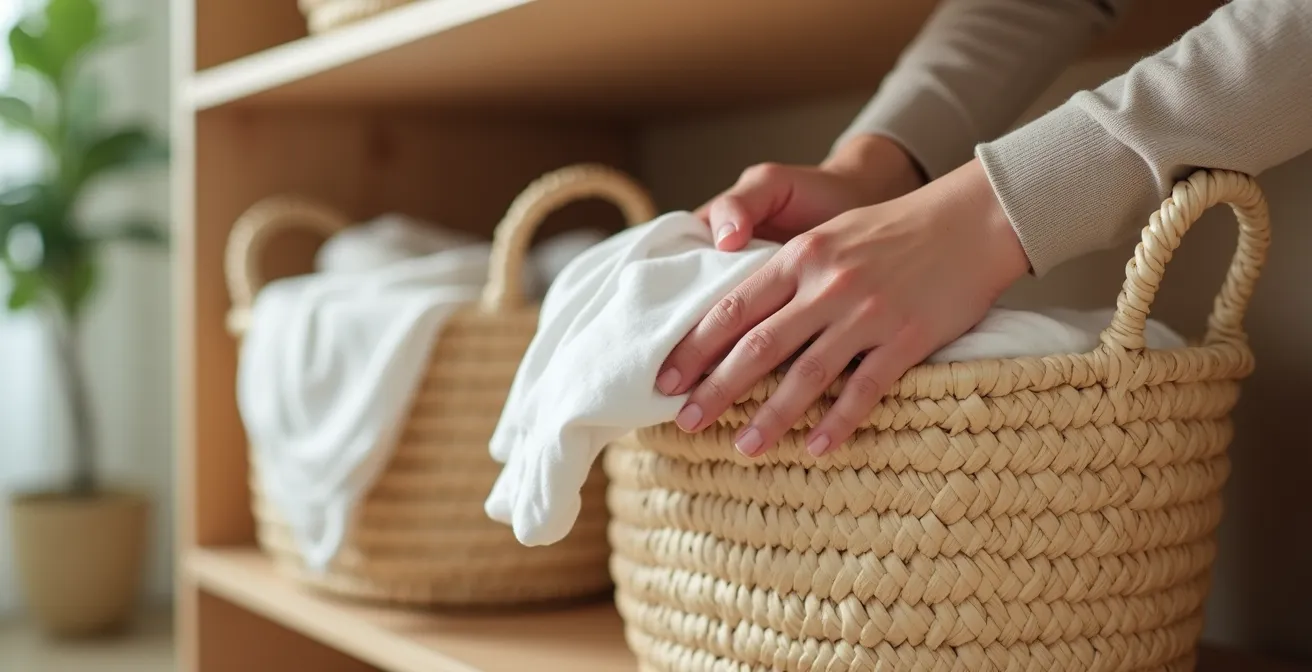
As you curate your nursery, surrounding your child with natural, non-toxic materials like seagrass, wood, and organic cotton helps create a calming and grounding atmosphere. This choice supports not only the planet’s health but also fosters an early appreciation for the beauty and texture of the natural world.
The Venting Mistake That Causes Sewer Gas Smells in New Bathrooms
A healthy home is a system, and sometimes issues in one area can have surprising effects elsewhere, including the nursery. One of the most common—and alarming—problems in new or renovated bathrooms is the intermittent smell of sewer gas. This is almost always caused by a simple plumbing ventilation error. Every drain in your home, from sinks to showers, has a U-shaped pipe called a p-trap. Its job is to hold a small amount of water that acts as a seal, preventing gases from the sewer line from entering your home.
For this system to work, your plumbing needs a vent stack (a pipe that usually runs up through the roof) to equalize pressure. If the venting is inadequate, improperly installed, or blocked, a phenomenon called negative pressure can occur. When you flush a toilet or drain a tub, it can create a suction effect that siphons the water right out of a nearby p-trap. Once that water seal is gone, there is a direct, open path for sewer gas—a mixture of hydrogen sulfide, methane, and other unpleasant gases—to flow into your bathroom and adjacent rooms.
This isn’t just a matter of an unpleasant odor. This negative pressure can compromise the air quality of the entire home. If a poorly vented bathroom fan is running, it can pull air from other rooms, including the nursery, to make up for the pressure imbalance. This can accelerate the off-gassing of VOCs from new furniture, carpets, and finishes in the nursery, concentrating them in the air your baby breathes. For infants, whose respiratory and neurological systems are still developing, even low-level exposure to sewer gas and increased VOC levels can pose health risks. Ensuring your home’s plumbing and mechanical ventilation are working correctly is a critical, though often overlooked, aspect of creating a healthy indoor environment.
Key Takeaways
- ‘Low-VOC’ is not a guarantee: Prioritize paints and finishes that are fully transparent about being free of all harmful compounds, including glycols and plasticizers.
- Think in lifecycles: A material’s true impact includes its origin (embodied carbon from shipping) and its end-of-life (disposal), not just its composition.
- A healthy home is a system: Proper ventilation, airtight construction, and material choices all work together to create safe indoor air quality.
Energy-Positive Eco-Housing: How to Generate More Power Than You Consume?
While choosing individual non-toxic materials is crucial, the ultimate goal in healthy and sustainable design is to create a home that functions as a holistic, high-performance system. The pinnacle of this approach is the concept of “energy-positive” or “plus-energy” housing. These are buildings designed and constructed so efficiently that, over the course of a year, they generate more energy (typically from renewable sources like solar panels) than they consume from the grid. This might seem like a futuristic or complex goal, but its core principles can be applied even at the scale of a nursery renovation to create a more stable, healthy, and efficient environment.
The foundation of this concept lies in the principles of Passive House design. This is a rigorous, voluntary standard for energy efficiency that dramatically reduces a building’s ecological footprint. It focuses on several key strategies:
- Airtight Construction: Creating a completely sealed building envelope prevents uncontrolled air leaks. This stops outdoor pollutants, allergens, and drafts from infiltrating the nursery, giving you full control over the indoor air quality through a dedicated ventilation system.
- High R-value Insulation: Super-insulating the walls, roof, and floor creates a thermal barrier that keeps the indoor temperature incredibly stable, reducing the need for heating or cooling and thus saving energy.
- Thermal Mass Flooring: Using materials like concrete or tile that can absorb and store heat helps to passively regulate the room’s temperature, keeping it comfortable year-round.
Applying Passive House Principles to a Nursery
Implementing these passive design strategies creates a nursery that is not only ultra-efficient but inherently healthier. The stable temperatures and airtight construction prevent outdoor pollutants from entering the space. By combining this approach with the use of materials certified for low emissions, such as the FloorScore certified materials discussed in flooring choices, you create a multi-layered defense against both external and internal sources of air pollution, ensuring the safest possible environment for a developing child.
While achieving a fully energy-positive home is a large undertaking, adopting its principles—focusing on airtightness, maximizing insulation, and choosing certified healthy materials—is the most effective strategy for building a truly resilient and healthy nursery from the ground up.
Frequently Asked Questions About Healthy Nursery Design
How does improper bathroom venting affect nursery air quality?
Negative pressure from poor venting can pull air from the nursery, accelerating VOC off-gassing from furniture and finishes.
What are the health risks of sewer gas exposure to infants?
Low-level exposure to hydrogen sulfide and methane can impact developing neurological and respiratory systems.
How can parents test their home’s ventilation?
Use the incense stick test near doors to check for air pull patterns and pressure imbalances. If the smoke is drawn strongly under a closed door, it indicates your home may have a negative pressure issue that needs to be addressed by a professional.