The key to saving 20% on renovation labor isn’t working faster; it’s making smarter, front-loaded decisions about contracts, infrastructure, and logistics before the first wall comes down.
- Prioritizing “invisible infrastructure” like electrical and plumbing prevents costly rework and future-proofs your home.
- Choosing the right contract type (Fixed Price vs. T&M) is your primary tool for de-risking the project budget.
Recommendation: Treat your renovation like a manufacturing process. Optimize the sequence and manage risks upfront to control the timeline and budget, rather than reacting to problems as they arise.
Most home renovation advice centers on budgets, contractors, and contingency funds. While important, these are reactive measures. The true discipline of a successful, on-budget renovation lies in the mindset of a project manager, not a decorator. It’s an obsession with process, sequence, and risk mitigation. The biggest savings aren’t found in haggling over material costs, but in orchestrating the project to eliminate wasted time, rework, and delays—the primary drivers of inflated labor costs.
This approach requires shifting your focus from the visible finishes to the unseen systems that enable them. It means treating your contract as a strategic tool, not a formality, and understanding how logistical choices directly impact project velocity. The common wisdom tells you to expect the unexpected; a project manager’s goal is to systematically eliminate as many “unexpected” variables as possible through rigorous upfront planning. This isn’t about creating a simple to-do list; it’s about designing an efficient production line.
This guide will walk you through the critical, front-loaded decisions that define a professionally managed renovation. We will dissect the strategic allocation of funds, the legal frameworks that protect you, the logistical choices that accelerate your timeline, and the technical standards that ensure safety and value. By adopting this efficiency-obsessed mindset, you can navigate your renovation with clarity and control.
Summary: A Project Manager’s Blueprint for Renovation Efficiency
- Why You Should Allocate 15% of Your Budget to ‘Invisible’ Infrastructure?
- Fixed Price vs Time and Materials: Which Contract Protects You Better?
- How to Navigate Zoning Laws for Additions Without Project Delays?
- Living In vs Moving Out: The True Cost of Renting During Renovation
- How to Run Conduit for Future Tech Needs Before Closing Walls?
- The Hidden Costs of Building with Oak Frames Compared to Softwood
- Full-Size vs Apartment-Size Furniture: Which Is Better for Resale Value?
- Building Standards 101: What DIY Enthusiasts Must Know to Avoid Fines?
Why You Should Allocate 15% of Your Budget to ‘Invisible’ Infrastructure?
In any renovation, the temptation is to focus the budget on what you can see: countertops, flooring, and paint. However, a project manager knows that the most critical investment is in the “invisible infrastructure.” This includes your electrical, plumbing, HVAC, and structural systems. Neglecting these can lead to catastrophic failures, budget-crushing rework, and the inability to support modern amenities. Allocating a dedicated portion of your budget—often around 15%—to this layer is the ultimate act of project de-risking.
This isn’t just about replacement; it’s about capacity. An original 100-amp electrical panel might technically work, but it won’t safely support an EV charger, an induction cooktop, and a new heat pump. Upgrading it is a classic front-loaded decision. According to recent cost analysis, upgrading to a 200-amp service can cost between $1,200 and $2,000, a predictable expense when planned, but a costly emergency mid-project. The same logic applies to replacing old galvanized plumbing before it fails behind a newly tiled wall.
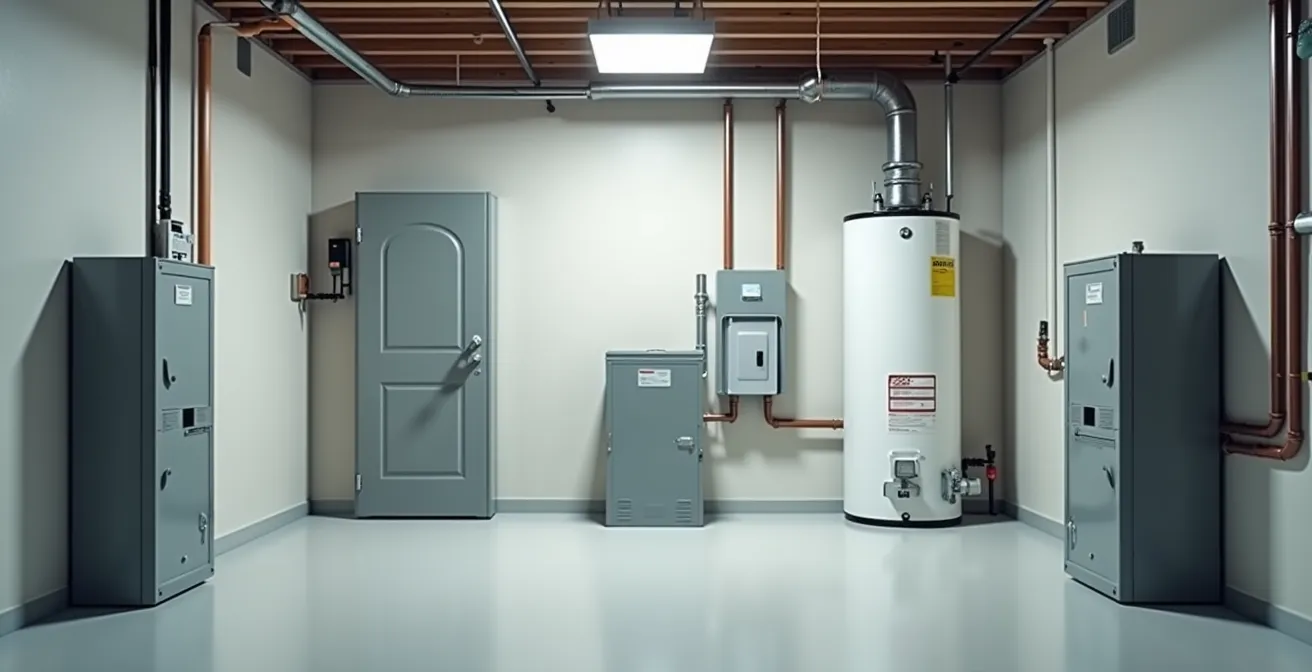
As the illustration shows, these systems are the lifeblood of your home. Before any aesthetic work begins, a thorough audit is non-negotiable. This process identifies critical failure points and capacity shortfalls that must be addressed while the walls are open and access is cheap. Ignoring a sagging floor joist or undersized ductwork to save money upfront almost guarantees you will pay double to fix it later.
Action Plan: Your Infrastructure Pre-Mortem
- Electrical Panel & Wiring: Check panel capacity against planned appliances. Identify any outdated wiring (e.g., knob-and-tube) that needs full replacement.
- Structural Integrity: Inspect the foundation, joists, and beams for cracks, water damage, or signs of stress, especially under areas planned for heavy additions like bathtubs.
- Plumbing & HVAC Systems: Evaluate the age, material (e.g., lead, galvanized steel), and performance of pipes and ductwork. Assess if the current HVAC can handle any new square footage.
- Insulation & Envelope: Review insulation levels in walls and attic. Check for air leaks around windows and doors that compromise energy efficiency.
- Document Everything: Photograph all findings. This visual record is crucial for getting accurate quotes from contractors and serves as a baseline for inspections.
Fixed Price vs Time and Materials: Which Contract Protects You Better?
The single most important document in your renovation is the contract. It’s not a formality; it is your primary risk management tool. The choice between a Fixed Price (or “Lump Sum”) contract and a Time and Materials (T&M, or “Cost Plus”) contract dictates where the financial risk of the project lies. Neither is universally “better”—the superior choice depends entirely on the clarity and predictability of the work being performed.
A Fixed Price contract is ideal for scopes of work that are meticulously defined. Think cabinet installation, flooring, or painting, where every detail can be specified upfront. The contractor agrees to a set price, and they absorb the cost of any inefficiencies. This gives you budget certainty. Conversely, a T&M contract is suited for work with many unknowns, such as demolition or foundation repairs, where unexpected issues are likely. You pay for the actual hours and materials used, which offers flexibility but places the risk of overruns squarely on you.
A sophisticated project manager rarely uses one type exclusively. The most effective strategy is often a hybrid approach, applying fixed pricing to predictable phases and T&M to unpredictable ones. This blended model optimizes for both budget control and flexibility.
Case Study: The Hybrid Contract Success
A Massachusetts homeowner undertaking a major 2024 renovation provides a perfect example. They negotiated a hybrid contract, securing a fixed price of $45,000 for the well-defined cabinet installation and flooring. For the initial demolition, where the condition of 100-year-old framing was unknown, they used a T&M contract with a “not-to-exceed” cap. This strategy allowed them to manage discoveries without contentious change orders and ultimately saved an estimated 15% compared to what a contractor would have built in for contingency on a fully fixed-price bid.
How to Navigate Zoning Laws for Additions Without Project Delays?
A renovation timeline can be instantly derailed by zoning and permitting issues. These are not mere suggestions; they are legal requirements enforced by your local municipality. As a project manager, your job is to treat zoning research as part of the critical path, addressing it before a single architectural drawing is finalized. Waiting until you have a full set of plans to discover your project violates setback or lot coverage limits is a recipe for costly redesigns and months of delays.
Key areas to investigate include:
- Setbacks: The minimum distance your structure must be from property lines.
- Lot Coverage: The maximum percentage of your lot that can be covered by structures.
- Height Restrictions: The maximum allowable height of your home.
- Historical Overlays: Special restrictions if your home is in a designated historic district.
These regulations can be complex and are subject to change. For example, to address housing shortages, some regions are actively easing rules. A prime illustration is how, as of February 2025, new Massachusetts regulations permit Accessory Dwelling Units (ADUs) up to 900 square feet by right in many cases, removing previous barriers. Staying informed of such changes can unlock new possibilities for your project.
The most efficient first step is often a pre-design consultation with a local permit expediter or a zoning attorney. For a small fee, they can identify potential red flags in minutes, saving you thousands in architectural fees for a non-compliant design. If your project does require a variance (permission to break a rule), a proactive neighbor communication plan can be invaluable. Presenting your immediate neighbors with a simple, clear one-pager on your project can preempt opposition at public hearings, a common source of significant delays.
Living In vs Moving Out: The True Cost of Renting During Renovation
The decision to live in your home during a renovation or move out is often seen through a simple lens: rent is an extra cost. A project manager, however, analyzes this through the metric of project velocity. While moving out adds a temporary housing line item, it can dramatically accelerate the construction timeline, leading to significant savings in labor, financing costs, and stress.
Living on-site means contractors must work around your family’s schedule, spend time each day setting up and cleaning up to create a “livable” space, and navigate furnished rooms. This friction slows down every single trade. When a house is empty, it becomes a pure worksite. Crews can operate at maximum efficiency, with unimpeded access and the ability to run multiple trades in different areas simultaneously. This increased velocity is not a minor benefit.
Analysis: The Impact of an Empty Worksite
Industry analysis shows that for major renovations (e.g., kitchen and multiple bathrooms), moving out can reduce the project timeline by 20-30%. On a $100,000 project, this acceleration can directly offset 40-60% of temporary housing expenses through reduced labor charges and lower carrying costs on any construction loans. The net cost of moving out becomes far less than the initial rental figures suggest.
Furthermore, the non-financial costs must be weighed. The constant dust, noise, and lack of privacy take a significant psychological toll. A recent survey reveals that 26% of homeowners identify managing stress as their second biggest renovation challenge, surpassed only by budgeting. Shielding your family from this environment has a tangible, if unquantifiable, value.
Ultimately, the decision is a strategic calculation. For a single-room cosmetic update, living in is manageable. For a multi-room gut renovation, moving out is often the more efficient and financially sound decision when all costs—direct and indirect—are considered.
How to Run Conduit for Future Tech Needs Before Closing Walls?
One of the most valuable and inexpensive forms of future-proofing is running empty conduit before the drywall goes up. The walls of your home are filled with opportunity, and for a few hundred dollars in plastic tubing, you can save yourself thousands in retrofit costs later. A project manager thinks not just about the home’s needs today, but what they might be in five or ten years. Adding a new speaker system, an EV charger, or a hardwired internet connection is simple when a pathway already exists. It’s messy and expensive when it requires cutting into finished walls.
The core strategy is to install a “Digital Spine“—an oversized conduit (e.g., 2-inch diameter) running vertically from your basement or utility room to the attic. This main channel allows you to easily pull almost any future low-voltage cabling through the core of the house. From there, smaller conduits can branch off to key locations.
Case Study: The $2,500 Investment That Saved $15,000
During a 2024 renovation in Toronto, a homeowner invested $2,500 in materials and labor to have an electrician run a comprehensive network of conduits. This included the “Digital Spine,” dedicated conduits to the garage for future EV chargers, and smaller runs to each window for powered smart shades. Two years later, they decided to add a whole-home integrated audio system and a second EV charger. The installation was completed in one day with no drywall damage, saving an estimated $15,000 in retrofit costs that would have involved extensive cutting, patching, and painting.
Key areas to pre-wire with conduit include:
- Home Entertainment: To every location where a TV or projector might be mounted. Include blocking in the wall for the mount itself.
- Integrated Audio: To ceiling or in-wall speaker locations in main living areas.
- Smart Home Devices: To windows for powered shades and to entryways for smart locks or cameras.
- Electric Vehicle Charging: A dedicated, large-diameter conduit to the garage or driveway.
Before the walls are closed, take meticulous photos and videos documenting the location of every conduit run and junction box. This documentation is as valuable as the conduit itself.
Key Takeaways
- Renovation efficiency is driven by proactive, front-loaded decisions on infrastructure, contracts, and logistics, not reactive problem-solving.
- Your primary tools for budget control are not spreadsheets, but a hybrid contract strategy and a deep understanding of your local zoning laws.
- The “invisible” elements—electrical, plumbing, conduit, and framing choices—have the greatest long-term impact on your home’s value and your project’s final cost.
The Hidden Costs of Building with Oak Frames Compared to Softwood
The choice between an oak frame and a standard softwood (e.g., pine, spruce) frame seems aesthetic, but it carries profound and often hidden cost implications that extend far beyond the material itself. While the beauty of exposed oak is undeniable, a project manager must quantify the downstream financial impacts. The material cost is just the beginning; oak’s density, weight, and temperament create a ripple effect through the entire construction process.
First, the raw material cost for structural oak can be 3x to 4x higher than for an equivalent softwood frame. This is the obvious part. The hidden costs begin with the foundation, which may need to be engineered to be 15-20% stronger to support the additional weight. Then comes labor. Oak is significantly harder and heavier, which slows down every trade that interacts with it. Drilling for plumbing and electrical wiring takes longer and wears out tools faster. Industry analysis shows this density can increase the labor costs for rough-in trades by a multiplier of 1.2x to 1.5x.
This table breaks down the compounding cost factors when choosing between these two framing materials.
| Cost Factor | Oak Frame | Softwood Frame |
|---|---|---|
| Material Cost | 3x-4x higher | Baseline |
| Foundation Requirements | 15-20% stronger needed | Standard design |
| Trade Labor Premium | 20-50% increase | Standard rates |
| Long-term Maintenance | Higher – checking/movement | Lower – more stable |
Finally, there’s the long-term behavior of the wood. Oak is prone to “checking” (cracking) and movement as it dries over many years. This is part of its rustic charm but can create issues with drywall finishes and trim that abut the frame, requiring more flexible detailing and potential future maintenance. Softwood, being more stable, presents fewer long-term finishing challenges.
Full-Size vs Apartment-Size Furniture: Which Is Better for Resale Value?
When designing a renovated space, the choice between full-size and apartment-scale furniture feels like a personal preference. However, from a project manager’s perspective focused on maximizing resale value, it’s a strategic decision about market appeal. The goal is to create a flexible space that can be convincingly staged for the broadest possible range of potential buyers, whose needs and lifestyles will vary.
A room designed exclusively for oversized, deep-seated sofas may feel luxurious to you but can appear cramped or unusable to a young family or a downsizing couple who own smaller furniture. Conversely, a room that only works with diminutive pieces might fail to impress buyers accustomed to more substantial furnishings. The key to maximizing resale value isn’t choosing one scale over the other, but designing for ambiguity. This means strategic placement of outlets, lighting, and doorways to allow the room to be logically and attractively furnished with both full-size and apartment-scale layouts.
This flexible design approach has a direct impact on how your home is perceived by the market, which is a crucial component of its ultimate sale price.
Case Study: The Power of the “Digital Staging Portfolio”
Top real estate professionals now advise clients to think beyond physical staging. One agent’s client, after a renovation, created a “digital staging portfolio.” They commissioned renderings showing their primary living space furnished in three different ways: one with large, family-friendly sectionals; one with sleek, apartment-scale modern pieces; and one set up as a spacious home office. This portfolio was included in the online listing, allowing diverse buyers to visualize themselves in the space. The strategy was credited with attracting a wider buyer pool and ultimately securing multiple offers above the asking price.
This strategy demonstrates that the marketability of a renovated space is not just about the quality of the finishes, but about the perceived flexibility and potential of the space itself. Planning for multiple furniture scales is a low-cost way to significantly broaden your home’s appeal.
Building Standards 101: What DIY Enthusiasts Must Know to Avoid Fines?
For the project-managing homeowner, taking on some of the work (the “DIY” portion) can be a great way to save money. However, it’s critical to understand where the line is between acceptable DIY tasks (like painting or tiling) and work that, if done incorrectly, poses a serious safety risk and legal liability. Building codes are not guidelines; they are the law. Failure to comply can result in fines, the forced removal of completed work, and a voided homeowner’s insurance policy. The stakes are particularly high with electrical work, as the Electrical Safety Foundation reports that electrical issues cause over 51,000 fires in U.S. homes annually.
A smart project manager knows their limits and respects the “mandatory professional touchpoints.” These are specific jobs that, in almost all jurisdictions, must be performed and signed off on by a licensed professional. Attempting to DIY this work is not just foolish; it’s dangerous and illegal. While you can manage the project, you cannot legally perform these specific installations.
The following tasks should always be considered non-negotiable professional work:
- Main Electrical Service: Any work on the electrical panel, the meter, or the main service line from the utility.
- Structural Modifications: Any alteration to a load-bearing wall, beam, or foundation element.
- Gas Lines: All work involving natural gas or propane lines, without exception.
- Major Plumbing: Modifications to main drain stacks, sewer lines, or main water supply lines.
- HVAC Systems: Full installation or major modification of furnaces, air conditioners, or heat pumps, especially involving refrigerant lines.
Managing a renovation means knowing what to delegate. Your role is to hire, schedule, and verify the work of these licensed trades, not to replace them. The savings you might achieve by illegally doing this work yourself are dwarfed by the potential cost of a fire, flood, or structural collapse.
By adopting a project manager’s mindset and focusing on these strategic, front-loaded decisions, you transform your renovation from a stressful ordeal into a controlled, efficient, and financially sound investment. Start today by applying these principles to your own project planning.