
Permeable paving transforms your driveway from a source of water problems into a powerful tool for flood prevention and landscape health.
- It actively absorbs rainwater on-site, drastically reducing runoff that can flood basements and overwhelm municipal sewers.
- The deep aggregate base acts as an underground reservoir, slowly releasing water into the soil and passively irrigating surrounding plants.
Recommendation: Treat your driveway project not as simple paving, but as an investment in your property’s hydrological resilience and ecological value.
For homeowners in areas plagued by heavy rains, a standard driveway often becomes a liability. Water sheets off the impervious surface, creating persistent puddles, eroding landscaping, and worst of all, contributing to saturated ground that can lead to a damp or flooded basement. Many look for solutions by installing complex and costly French drains or regrading their entire property. This approach, however, only redirects the problem elsewhere.
The conventional wisdom focuses on getting water *away* from the house as quickly as possible. But what if the most effective strategy was not to fight the water, but to manage it intelligently on-site? This is where the concept of permeable paving shifts the paradigm. We must stop thinking of a driveway as just a hard surface for cars and start seeing it as a dynamic, functioning part of our landscape’s ecosystem. It’s not just about choosing different stones; it’s about implementing an integrated water management system that mimics natural ground functions.
This guide moves beyond the simple fact that permeable pavers let water through. We will explore the hydrology-aware principles that make this technology a robust solution against flooding. We’ll delve into the critical role of the sub-base, the maintenance required to ensure long-term performance, and how this single installation can become the heart of a resilient, low-water garden. By the end, you will understand how to turn a flood-prone problem area into a functional, beautiful, and ecologically beneficial asset.
text
This article will walk you through the essential considerations for adopting a permeable paving system. From the science of its flood prevention capabilities to the practicalities of maintenance and financial incentives, you will gain a comprehensive understanding of this sustainable drainage solution.
Summary: A Complete Guide to Permeable Driveways as a Flood Solution
- How Permeable Pavers Prevent Basement Flooding During Heavy Rains?
- How to Keep Permeable Paving from Clogging with Silt?
- The Aggregate Base Layer: How It Differs from Standard Patio Prep?
- Grid Systems vs Porous Concrete: Which Looks Less Industrial?
- Why Your Patio Is Sinking: The Importance of Compaction
- Digging Swales: How to Capture Rainwater Passive for Trees?
- Native Plant Selection: How to Design a Beautiful Garden That Needs Zero Watering?
- Are There Tax Credits for Installing Permeable Surfaces in Your City?
How Permeable Pavers Prevent Basement Flooding During Heavy Rains?
The primary function of a permeable driveway during a downpour is to act like a massive, flat sponge rather than a slide. Instead of directing torrents of water toward your home’s foundation or the street’s storm drain, it captures rainfall exactly where it lands. The water percolates through the small gaps between the pavers, which are filled with tiny, angular stones. This immediate capture is the first line of defense against the hydrostatic pressure that builds up in saturated soil next to your basement walls—a primary cause of leaks and flooding.
Once through the surface, the water enters the system’s most critical component: the deep aggregate base. This isn’t just gravel; it’s an engineered sub-base reservoir with significant storage capacity. During a sudden, intense storm, this reservoir can hold thousands of gallons of water, releasing it slowly and safely into the subsoil over several hours or days. This dramatically reduces the peak flow of water your property has to manage, giving the ground time to absorb it naturally.
By effectively detaining and infiltrating stormwater, the system maintains a drier perimeter around your foundation. It prevents the supersaturation of soil that leads to water seeping through foundation cracks or overwhelming a sump pump. This principle of hydrologic mimicry—emulating how a natural forest floor absorbs rain—is what makes permeable paving a proactive flood prevention tool, not just a reactive drainage fix. It addresses the root cause of surface water overload, offering peace of mind when the weather turns severe.
How to Keep Permeable Paving from Clogging with Silt?
The long-term effectiveness of any permeable system hinges on its ability to remain, well, permeable. The primary threat to this function is clogging. Over time, fine particles like silt, organic debris from leaves, and dirt can wash into the joints between pavers, filling the crucial void spaces and turning your permeable surface into an impervious one. This is the single most common point of failure for poorly maintained systems.
Preventative maintenance is straightforward but essential. Regular sweeping with a stiff-bristled broom, especially after windy days or in the fall, removes most surface-level organic matter before it can break down and migrate into the joints. Using a leaf blower is also highly effective. For a deeper clean, a pressure washer can be used, but it must be handled with care: use a fan-tip nozzle and spray at an angle to avoid dislodging the joint aggregate. The goal is to wash the surface, not excavate the joints.
The image below shows the fine-textured aggregate in the joints that must be kept clean to allow water to pass through effectively.
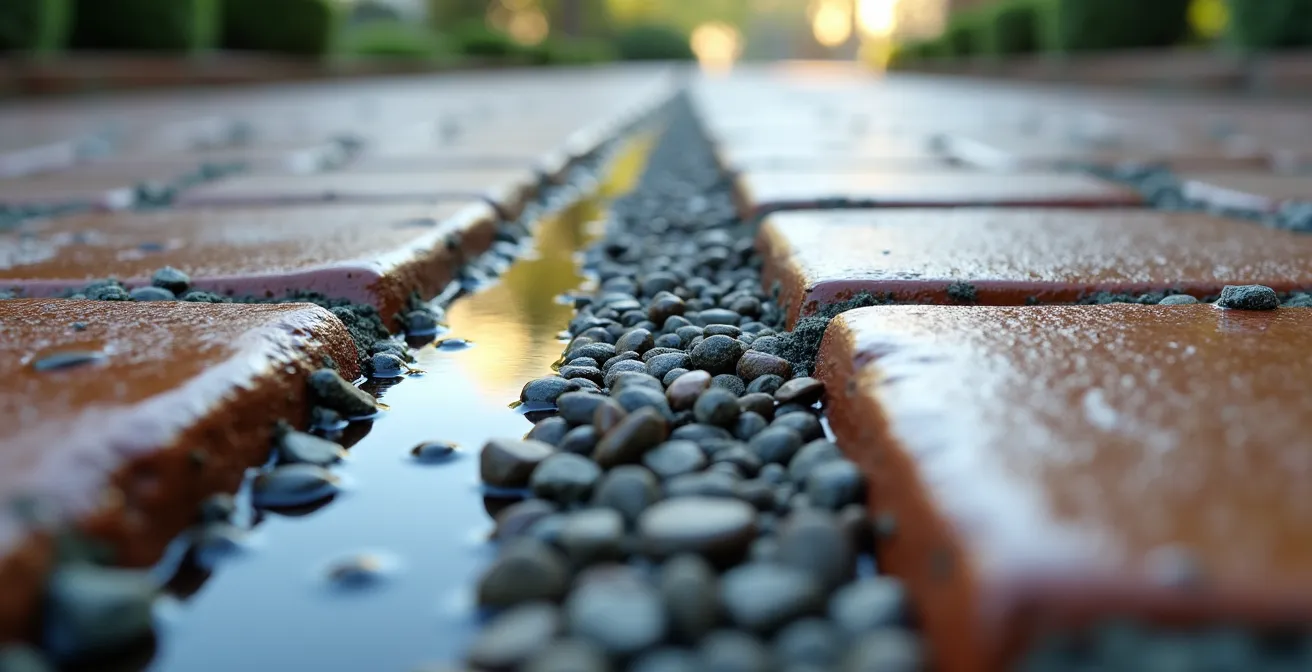
In cases of significant clogging, specialized vacuum-sweeping equipment can restore percolation rates by removing the top layer of contaminated aggregate, which is then replaced with fresh material. Research on long-term performance confirms the importance of this upkeep. One study found that infiltration rates have generally reduced to below 1000 mm/h for sites with no maintenance after just four years, while maintained sites retain functionality for decades. A simple, consistent cleaning schedule is the best insurance for your investment.
The Aggregate Base Layer: How It Differs from Standard Patio Prep?
The secret to a permeable paver system’s success lies hidden beneath the surface. While a standard patio requires a 4 to 6-inch base of compacted gravel, a permeable driveway demands a much more substantial and specialized foundation. This base is not merely for support; it is an engineered reservoir designed to store and manage water. The depth can range from 15 to 18 inches or more, depending on soil conditions and local rainfall intensity. This profound difference in depth is the most significant departure from traditional hardscaping.
The material itself is also fundamentally different. Standard base material often includes “fines”—small particles of sand and dust—which help it compact to a dense, solid mass. For a permeable system, this would be a disaster. The base must be built with “open-graded” or “clean-washed” stone, which means all the fines have been removed. This creates a network of interconnected voids, known as void space, that allows water to flow freely and be stored. Typically, this void space should account for about 40% of the base’s volume.
As Troy Johnson, an expert from Outdoor Escapes, details in the This Old House Installation Guide, the layering is meticulous:
Start with a 6-inch layer of 3/4-inch to 2-inch washed crushed stone. This larger stone creates a stable base and allows for excellent water flow. After the initial layer, add a 4-inch layer of 1/4- to 1-1/2-inch washed crushed stone. Use a plate compactor to compact each layer thoroughly, making two passes in different directions to ensure proper settling. This compaction is crucial for preventing future settling and maintaining the driveway’s level surface.
– Troy Johnson, Outdoor Escapes, This Old House Installation Guide
The following table clearly illustrates the critical distinctions between the two preparation methods, highlighting why a permeable installation is a specialized hydrological construction, not just a paving job. The data is based on a comprehensive installation analysis.
| Specification | Standard Patio Base | Permeable Paver Base |
|---|---|---|
| Minimum Depth | 4-6 inches | 15-18 inches |
| Base Material | Compacted gravel with fines | Open-graded stone (no fines) |
| First Layer | Dense-graded aggregate | 6″ of 3/4″ to 2″ washed stone |
| Second Layer | Sand bedding | 4″ of 1/4″ to 1.5″ washed stone |
| Compaction Method | Maximum density | Maintain void space (40% porosity) |
Grid Systems vs Porous Concrete: Which Looks Less Industrial?
A common concern for homeowners considering permeable options is aesthetics. Many fear that a functional, eco-friendly driveway will inevitably have a sterile, commercial, or “industrial” appearance. Fortunately, modern permeable solutions offer a wide range of styles that can complement or even enhance a home’s curb appeal. The two main alternatives to traditional-looking pavers are grass grid systems and porous concrete, each with a distinct look.
Plastic or concrete grid systems are laid on the aggregate base and filled with either grass or small gravel. When filled with grass, they create a “living driveway” that seamlessly blends into the landscape, offering a soft, green aesthetic that is the antithesis of industrial. This is ideal for properties aiming for a natural, park-like setting. The grid provides the structural stability to support vehicles while protecting the grass roots from compaction. The visual effect is that of a reinforced lawn, not a paved surface.
On the other hand, porous concrete offers a more modern, minimalist look. Unlike the rough, grey finish of municipal porous pavements, residential versions can incorporate decorative aggregates and colorants. This allows for a smooth, uniform surface that can range from light tan to dark charcoal, mimicking the appearance of high-end architectural concrete or fine gravel. It provides a clean, solid look without the harsh lines of individual pavers.

Beyond visual appeal, these surfaces offer other environmental benefits. Because they retain less heat than dark, solid asphalt, they contribute to a cooler microclimate around your home. Studies show that permeable pavers help mitigate urban heat islands with a potential 30% reduction in surface temperature compared to non-permeable counterparts. Ultimately, the choice between grids, porous concrete, or interlocking pavers depends on the desired architectural style, but none of them require a compromise on beauty for the sake of function.
Why Your Patio Is Sinking: The Importance of Compaction
One of the most frustrating sights for a homeowner is a paver patio or driveway that has developed dips, ruts, or begun to sink. This failure is almost always attributable to an improperly prepared or compacted base. For a permeable system, which bears the load of vehicles and manages significant water flow, proper compaction is non-negotiable. It’s a delicate balance: the goal is to settle the aggregate layers to prevent future movement, but not to over-compact them to the point where the crucial void space is eliminated.
The load from a vehicle on the surface is not borne by the pavers themselves, but is transferred down through the layers of aggregate. If the base is loose, the stones will shift and settle under this weight over time, creating an uneven surface. This is why installers use a heavy plate compactor on each layer of the base. The vibrations lock the angular stones together, creating a stable, interlocking matrix. This process must be done methodically, usually with multiple passes in different directions.
Another critical, and often overlooked, component for preventing sinking and shifting is the edge restraint. Without a robust border made of concrete, plastic, or metal, the pavers at the edge of the driveway have nothing to push against. Under the lateral force of a turning car tire, they can be pushed outwards, breaking the interlock pattern and leading to displacement and rutting. A proper edge restraint acts as a permanent frame, holding the entire paver field together as a single, stable unit.
Digging Swales: How to Capture Rainwater Passive for Trees?
A permeable driveway is a powerful tool on its own, but its true potential is unlocked when it’s integrated into the broader landscape. Instead of viewing it as a self-contained unit, think of it as the collection point for an integrated water management system. One of the most effective ways to do this is by connecting the driveway’s overflow to a system of swales and rain gardens, turning excess stormwater into a free source of irrigation for your trees and plants.
A swale is a shallow, vegetated channel designed to slow and spread the flow of water, allowing it to soak into the ground. By installing a perforated drainpipe near the top of your driveway’s aggregate base, you can direct overflow during an extreme storm event into a strategically placed swale. This swale can meander through your garden, passively irrigating the root zones of trees and shrubs along its path. This technique is particularly valuable for establishing new trees, which require consistent moisture.
The sheer volume of water that can be captured is significant. The deep aggregate base acts as a primary reservoir, but the swale system provides secondary storage and distribution. Engineering calculations show that a base of 3/4 inch gravel holds about 48% of its volume in water, which translates to hundreds of gallons for a typical driveway. By channeling the overflow from this reservoir, you are essentially creating a passive irrigation network that reduces your reliance on municipal water, lowers your water bill, and creates a more resilient and drought-tolerant landscape. It’s the ultimate expression of working with nature, not against it.
Native Plant Selection: How to Design a Beautiful Garden That Needs Zero Watering?
The logical conclusion of an integrated water management system is a landscape that largely takes care of itself. Once you have a system in place to capture, store, and distribute rainwater via your permeable driveway and swales, the final step is to select plants that can thrive on this natural irrigation cycle. This is where native plants become the perfect partners for your permeable hardscape. They are adapted to your region’s specific climate and rainfall patterns, meaning that once established, they require little to no supplemental watering.
By situating a rain garden or planting bed at the terminus of your swale system, you create a dedicated zone that receives concentrated moisture after a storm. This is the ideal location for moisture-loving native perennials and shrubs, such as Joe Pye weed, cardinal flower, or winterberry in many parts of North America. These plants not only provide beautiful blooms and foliage but also develop deep root systems that further improve soil infiltration and structure. Their presence completes the hydrologic mimicry, creating a miniature ecosystem on your property.
Further away from the swale, along drier banks or upland areas, you can plant more drought-tolerant natives. This practice, known as xeriscaping, leverages the natural moisture gradients you’ve created. The result is a lush, diverse, and beautiful garden that supports local pollinators and wildlife, all while drastically reducing your maintenance workload and water consumption. Your driveway is no longer just a place to park; it has become the engine of a self-sustaining landscape.
Key takeaways
- A permeable driveway is a hydrological system, not just a surface. Its deep, open-graded base is the key component, acting as an underground reservoir.
- Long-term performance depends on regular maintenance to prevent silt from clogging the joints. Sweeping is non-negotiable.
- Proper installation is critical. Insufficient base depth and poor compaction are the primary causes of sinking and failure.
Are There Tax Credits for Installing Permeable Surfaces in Your City?
Beyond the direct benefits to your property, installing a permeable driveway can also come with financial perks. Many municipalities are struggling with aging stormwater infrastructure that is easily overwhelmed by runoff from impervious surfaces. To encourage homeowners to become part of the solution, many cities and water districts offer incentives, rebates, or tax credits for installing green infrastructure like permeable paving. These programs recognize the public benefit of reducing strain on municipal systems.
These incentives can take several forms. Some cities offer a reduction in your monthly stormwater utility fee, as your property is now managing a larger portion of its own runoff. Others provide direct rebates that can cover a percentage of the installation cost. A prime example is found in Virginia, where the Virginia Conservation Assistance Program offers reimbursement up to 75 percent for qualifying projects that solve stormwater challenges. These programs can significantly offset the higher initial cost of a permeable installation compared to traditional asphalt or concrete.
Finding these programs requires a bit of local research, as they are highly specific to your municipality or state. The process is often more straightforward than homeowners assume. By proactively managing stormwater on your property, you are providing a valuable service to your community, and these financial incentives are a way for your local government to acknowledge and reward that contribution.
Action Plan: How to Find and Apply for Permeable Paver Incentives
- Initial Search: Contact your local stormwater utility department. Use search terms like “stormwater utility fee credit [your city]” or “[your county] water conservation rebate” to find program pages.
- Broaden Inquiry: Search for “LID incentives” or “green infrastructure grants” on your municipality’s website. LID stands for Low-Impact Development, the category these projects fall under.
- Document Everything: Before, during, and after your project, take photos. Keep all receipts for materials and labor, and have a clear calculation of the total square footage of the permeable surface installed.
- Explore State-Level Programs: Look beyond your city. Check your state’s Department of Environmental Quality or equivalent agency for statewide conservation programs that may offer grants or technical assistance.
- Check for Certifications: If your project contributes to heat reduction or uses sustainable materials, investigate if it helps you qualify for points under programs like LEED for Homes, which can have its own financial benefits.
Frequently Asked Questions About Why Choose Permeable Stone Paving for Driveways in Flood-Prone Areas?
Can I use de-icing salt on permeable pavers in the winter?
It is strongly discouraged. De-icing salts can accelerate the deterioration of concrete pavers and, more importantly, the salts and chemicals will be washed directly into the subsoil and groundwater with the meltwater, causing environmental harm. It’s better to use sand for traction or a de-icer that is specifically rated as safe for concrete pavers and groundwater.
What’s the difference between compaction for standard vs permeable pavers?
Standard pavers use maximum compaction with aggregate containing ‘fines’ (small particles) to create a dense, impervious base. For permeable systems, the goal is to settle the open-graded aggregate to create an interlocking, stable base while preserving approximately 40% void space for water storage. The compaction is therefore carefully controlled, not maximized.
Can permeable pavers handle heavy vehicle loads without sinking?
Yes, when installed correctly. The structural strength comes from the deep, properly compacted aggregate base, which is designed to absorb and distribute the load from vehicles like cars and SUVs. The pavers on the surface primarily provide a durable, interlocking wear layer.