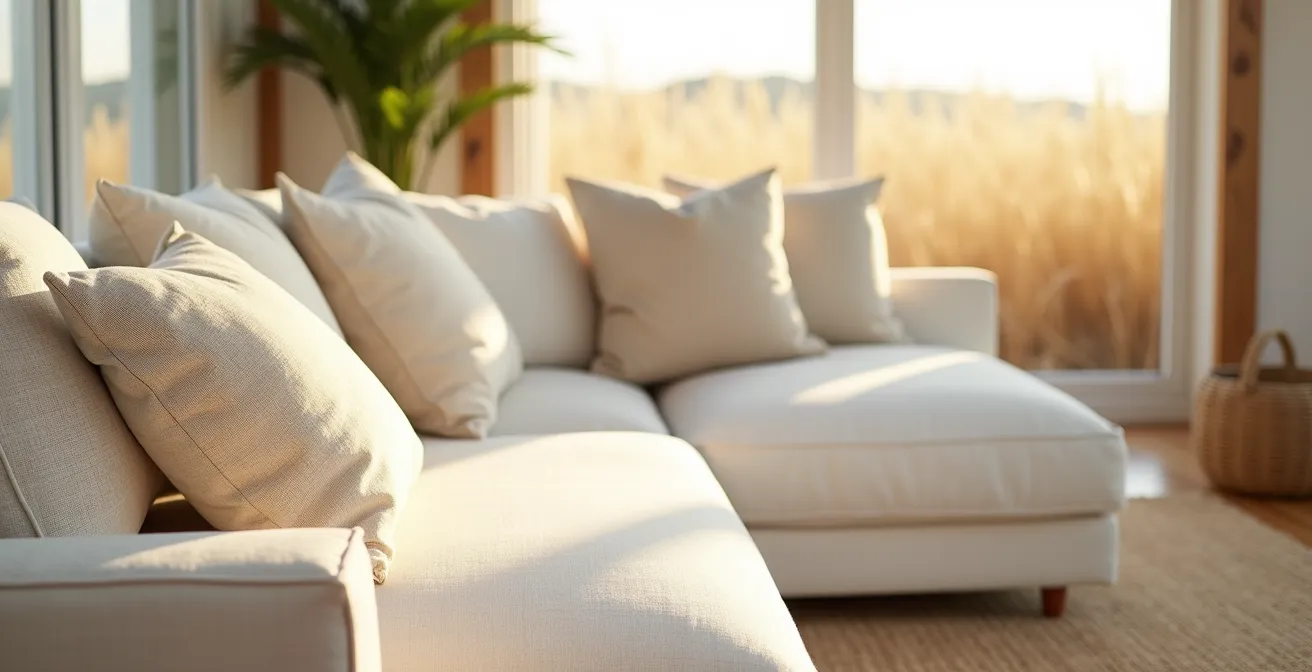
Choosing premium linen upholstery for a seasonal residence is less about aesthetics and more about investing in superior material science for unparalleled comfort in warm climates.
- Linen’s unique hollow-fiber structure actively manages heat and moisture, providing a tangible cooling effect that synthetics cannot replicate.
- What is often perceived as “wrinkling” is actually the development of a soft, desirable patina that signals the authenticity and quality of the fabric.
Recommendation: Prioritize linen for its proven thermo-regulating performance and graceful aging, viewing it as a long-term upgrade to your home’s sensory environment, not just its look.
For owners of vacation homes in sun-drenched locales, the choice of upholstery fabric is a critical decision that extends far beyond color palettes and design trends. The ambient heat and humidity demand a material that not only endures but actively enhances the living experience. While countless options exist, the conversation often circles back to a timeless classic: linen. However, the common perception of linen as merely a component of a ‘coastal chic’ aesthetic vastly undersells its technical capabilities.
Many discussions stall on superficial points—its breathability is noted, its tendency to wrinkle is lamented, and its natural origin is praised. But these are just headlines. The true value of high-quality linen, particularly for a summer residence, lies in its fundamental material science. Understanding the ‘why’ behind its performance is key to appreciating it not as a simple decorating choice, but as a strategic, long-term investment in comfort and quality of life. This is not about following a style; it’s about making an informed choice based on tangible, sensory benefits.
This article moves beyond the surface to deconstruct the properties that make linen a superior performance fabric. We will explore the physics of its cooling effect, provide a sensory toolkit to distinguish true quality from cheap imitations, and reframe its aging process as a mark of distinction. By comparing its performance against other popular textiles, you will gain a clear understanding of why investing in premium linen is one of the smartest decisions for a home designed for warm-weather relaxation.
Table of Contents: A Buyer’s Guide to Investing in Linen Upholstery
- Why Linen Keeps You Cool in Summer and Warm in Winter?
- How to Distinguish Belgian Linen from Cheap Blends instantly?
- Loose vs Tight Weave: Which Linen Resists Cat Claws Better?
- The ‘Wrinkle Anxiety’: Why You Should Embrace the Patina of Linen
- When to Reupholster vs Replace: Is Your Frame Worth the Linen Cost?
- Silk vs Cotton: Which Fabric Retains Dye Vibrancy Longer?
- Why Performance Velvet Is Actually Easier to Clean Than Linen for Dog Owners?
- Are Velvet Sectional Sofas Practical for Households with Pets and Children?
Why Linen Keeps You Cool in Summer and Warm in Winter?
The exceptional comfort of linen in fluctuating temperatures is not a matter of opinion but a result of its inherent physical structure. Unlike cotton, which can feel damp and heavy in humidity, linen possesses remarkable thermo-regulating and hygroscopic properties. The flax fibers from which it is made are hollow, allowing air to circulate freely. This natural ventilation system wicks moisture away from the body and allows it to evaporate quickly, creating a tangible cooling sensation in the summer heat. In fact, lab tests show that while cotton and linen absorb similar amounts of moisture, linen’s structure allows it to dry significantly faster, a crucial advantage in humid environments.
This moisture management is scientifically quantifiable. According to research from textile experts, linen can absorb up to 20% of its weight in moisture before it even begins to feel damp to the touch. As Dr. Sundaresan Jayaraman, a textile expert at Georgia Tech, notes, “The moisture vapor transport rate for linen is much greater than that for cotton or polyester.” This rapid transport prevents the sticky, clammy feeling common with less breathable fabrics on a hot day. Conversely, in cooler weather, the air trapped within the hollow fibers acts as a natural insulator, helping to retain body heat. This dual-action performance makes linen a uniquely intelligent choice for environments with wide temperature swings.
Ultimately, the reason linen feels so comfortable is its active partnership with the body and its environment. It’s not a passive covering but a dynamic system that constantly works to maintain thermal equilibrium. This is the core of its material integrity and why it has been prized for centuries in the warmest climates on earth, with 2024 lab tests confirming its superior performance in heat and humidity.
How to Distinguish Belgian Linen from Cheap Blends instantly?
In a market saturated with “linen-look” fabrics, identifying genuine, high-quality linen is a skill that relies on sensory feedback. Cheap polyester blends are engineered to mimic the appearance of linen but can never replicate its feel or performance. A true luxury textile buyer trusts their hands and eyes. The most reliable method is a series of simple sensory tests that instantly reveal a fabric’s authenticity and material integrity.
First is the touch and temperature test. Genuine linen feels cool and crisp to the touch initially. When held, it will quickly warm and soften with your body heat. A synthetic blend, by contrast, will feel warmer from the start and its temperature will remain uniform. Second, the light test reveals the fabric’s natural character. When you hold a piece of authentic linen up to a light source, you will notice subtle variations in the yarn thickness, known as ‘slubs’. These irregularities are a hallmark of the natural flax fiber and are absent in machine-made blends, which appear perfectly uniform.
The most definitive test, however, is the water drop test. It directly exposes the fabric’s hygroscopic nature. This is a clear, visual confirmation of the material’s performance capabilities.
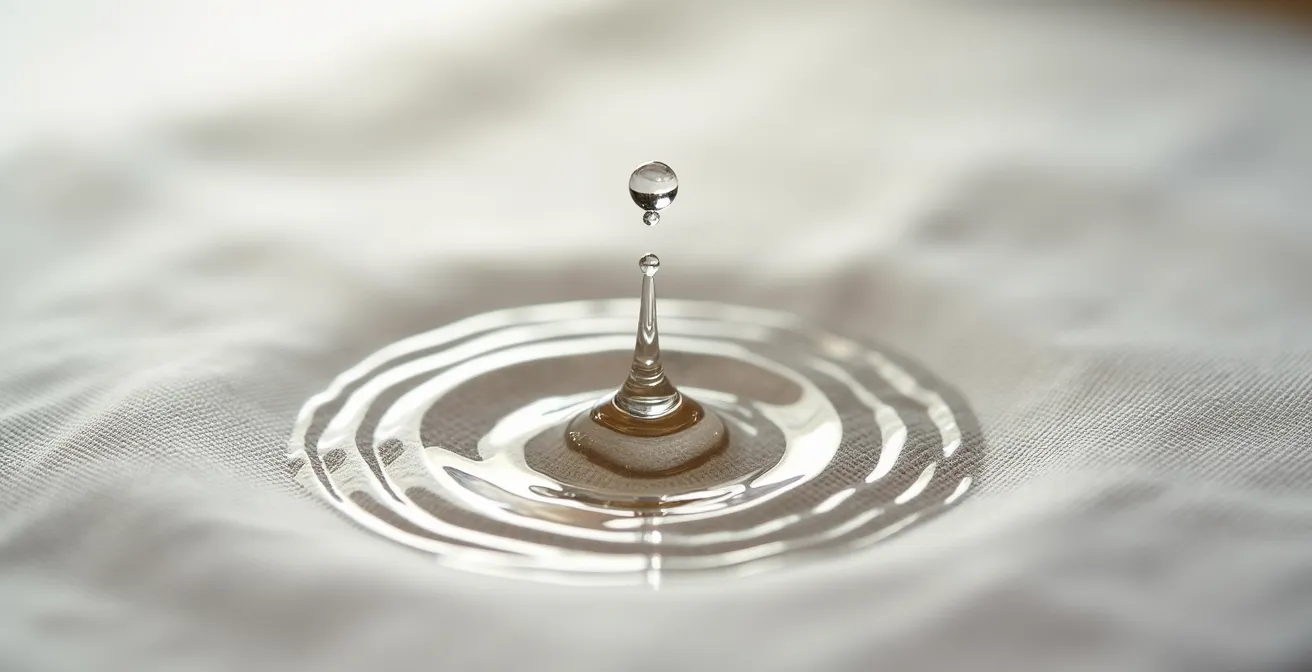
As the image demonstrates, when a single drop of water is placed on pure linen, it is absorbed almost instantly and spreads outwards as the hollow fibers wick it away. On a polyester or poly-blend fabric, the water will bead up on the surface, revealing its non-absorbent, synthetic nature. Finally, don’t neglect the sound test. Bunching a piece of genuine linen in your hand produces a distinct, crisp rustle—a sensory signature that silent synthetics cannot imitate. These tests combined provide an immediate and reliable assessment of quality.
Loose vs Tight Weave: Which Linen Resists Cat Claws Better?
For pet owners, the question of durability is paramount, and a common concern is how linen upholstery stands up to the occasional snag from a cat’s claws. The answer lies not in the linen itself, but in its weave architecture. The resistance of the fabric is determined by the interplay between the tightness of the weave and the thickness of the threads. Intuitively, one might assume a tighter weave is always better, but the reality is more nuanced, especially when considering damage visibility and repairability.
A tightly woven linen does offer higher initial snag resistance because there are fewer gaps for a claw to catch. However, if a thread is pulled, the damage is often more conspicuous and permanent. The pull disrupts the smooth, uniform surface and is very difficult to work back into place. Conversely, a looser weave may be more susceptible to an initial snag, but the damage is often far less visible, blending into the fabric’s naturally textured landscape. Furthermore, the looser structure allows for easier repairs, as a snagged thread can often be gently manipulated back into the weave.
After 23 years in the upholstery business, we’ve found that our Whernside Herringbone linen-blend fabrics with a looser weave but heavier weight threads actually perform better in homes with cats. The ‘self-healing’ quality of the looser weave means minor snags can often be gently worked back into the fabric, while tight weaves show every little pull permanently.
– Professional Upholsterer, Sofas and Stuff
The thickness of the threads is another crucial factor. A loose weave made from thick, robust threads (often indicated by a higher GSM or grams per square meter) can be surprisingly resilient. The choice ultimately depends on your priorities, as this comparative table illustrates.
| Characteristic | Tight Weave Linen | Loose Weave Linen |
|---|---|---|
| Initial Snag Resistance | High – fewer gaps for claws to catch | Moderate – more space between threads |
| Damage Visibility | Very visible – pulls show clearly on smooth surface | Less visible – blends into natural texture |
| Repair Potential | Difficult – permanent pulls in tight structure | Easier – threads can be worked back into place |
| Thread Thickness Impact | Fine threads can still snag easily | Thick, robust threads offer resilience |
| Recommended GSM | 280-350 GSM for durability | 400+ GSM with heavy threads |
| Best Use Case | Low-pet-traffic formal areas | Active households with pets |
The ‘Wrinkle Anxiety’: Why You Should Embrace the Patina of Linen
Perhaps the most misunderstood characteristic of linen is its tendency to wrinkle. For those accustomed to the static perfection of synthetic fabrics, the natural rumpling of linen can cause “wrinkle anxiety.” However, from the perspective of a luxury textile expert, this is not a flaw but a defining feature—a sign of authenticity and quality. The key is to reframe the concept from “wrinkling” to “developing a patina.” Much like fine leather or solid wood, high-quality linen ages gracefully, and its creases tell the story of its use.
This phenomenon is rooted in the fabric’s molecular structure. The long fibers of the flax plant are rigid, causing them to hold a crease. But in a high-quality textile, these are not the sharp, messy creases of a cheap cotton shirt. Instead, the fabric develops a ‘wrinkle signature’—a series of soft, organic rumples and drapes that conform to the patterns of use. This is the essence of concepts like the Japanese aesthetic of *wabi-sabi*: finding beauty in imperfection and authenticity. A linen sofa that shows a gentle patina looks inviting, comfortable, and lived-in, not unkempt.
The way linen ages is a primary indicator of its quality. Premium linen will soften with each use, developing a supple hand and a gentle luster. Cheap blends, on the other hand, tend to hold sharp, unsightly creases and can look permanently messy rather than elegantly relaxed.
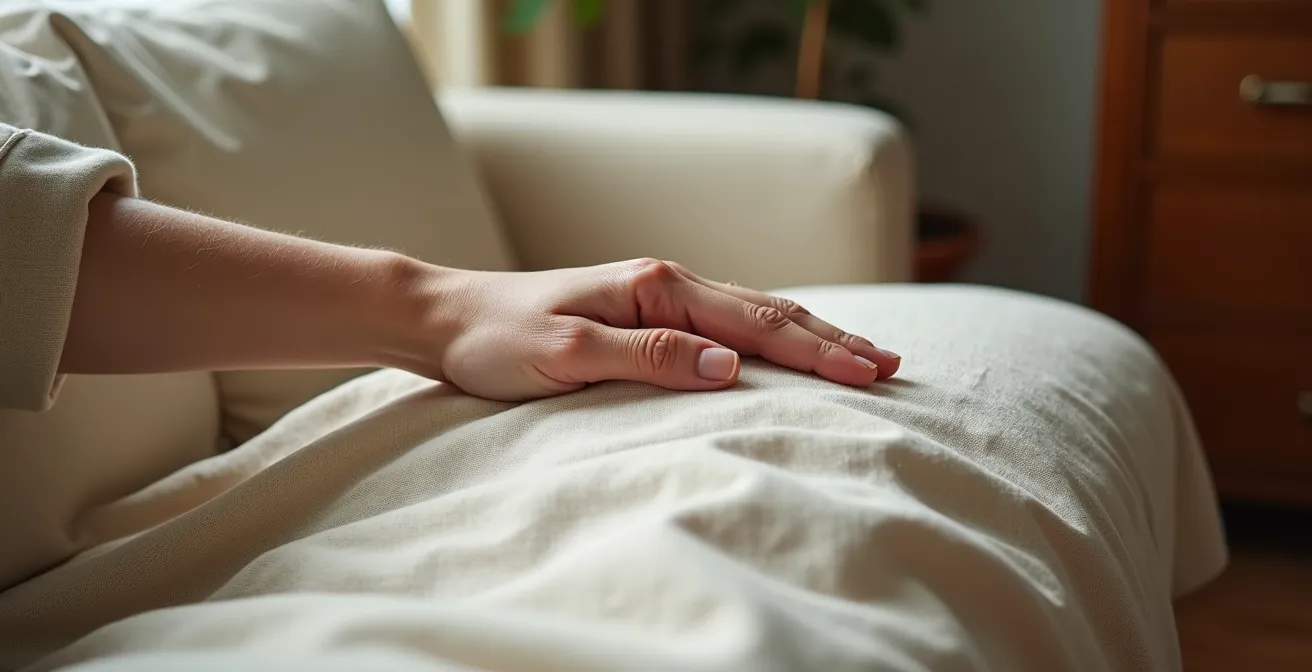
Embracing this natural evolution is a shift in mindset. It’s an appreciation for a material that lives and breathes with you, rather than a static object that resists all signs of life. The soft patina of a well-loved linen chair is a mark of sophisticated comfort, a sensory signature that signals a relaxed and confident approach to interior design.
When to Reupholster vs Replace: Is Your Frame Worth the Linen Cost?
Investing in high-quality linen upholstery is a significant decision, and its cost is best justified when paired with a piece of furniture that has equally good “bones.” Reupholstering a poorly made sofa with premium fabric is a false economy. Before committing, it is crucial to evaluate the structural integrity of the furniture frame to determine if it is worthy of the investment. A well-built frame can last for decades, making it the perfect candidate for a new life with luxurious linen.
The first point of inspection is the frame’s material and construction. A quality frame is made from kiln-dried hardwood, which prevents warping and cracking. You can often identify this by the weight of the piece—hardwood frames are significantly heavier than those made from particleboard or softwood. Next, examine the joinery. The best frames use traditional methods like dowels, screws, and corner blocks for strength. If the frame is held together primarily by staples, it’s a clear sign of low-quality construction and is not a good candidate for reupholstery.
The spring system is another critical component. An 8-way hand-tied spring system is the gold standard, offering superior comfort and durability. Sinuous springs (S-shaped wires) are a more common and adequate alternative, but if the springs are broken or sagging significantly, the repair costs may be prohibitive. Finally, consider the piece’s heritage. A sofa from a respected heritage brand or a unique vintage find often possesses a level of craftsmanship that is difficult and expensive to replicate today, making it an excellent investment for reupholstery. The potential savings from reupholstering a quality piece versus buying a new one of comparable quality can be substantial.
Your 5-Point Checklist to Evaluate Reupholstery ROI
- Frame Construction: Lift a corner of the piece. If it feels heavy and solid, check for visible kiln-dried hardwood. Light-weight frames are often particleboard and not worth the investment.
- Joinery Quality: Inspect the joints, especially on the underside. Look for dowels, screws, and reinforcing corner blocks. A frame held together only by staples is a poor candidate.
- Spring System Health: Push down firmly on the seating deck. Do you feel resilient, individual springs (good) or a sagging, uniform give (poor)? An 8-way hand-tied system is a sign of high quality worth preserving.
- Original Maker’s Mark: Research the brand or maker’s label on the furniture. Is it from a quality heritage manufacturer? This can signal underlying craftsmanship that justifies the cost.
- Personal & Aesthetic Value: Assess its sentimental worth. An irreplaceable family heirloom or a unique vintage find has value beyond its materials that makes reupholstery a worthy endeavor.
Silk vs Cotton: Which Fabric Retains Dye Vibrancy Longer?
When selecting a luxury fabric for a sun-drenched summer home, color fastness is a primary concern. Both silk and high-quality cotton can offer stunningly vibrant colors, but their ability to retain that vibrancy under prolonged UV exposure differs dramatically. Silk, renowned for its natural luminosity, is surprisingly vulnerable in this regard. Its brilliance comes from the triangular, prism-like structure of its protein fibers, which refract light and create a deep sense of color. However, these same protein fibers are notoriously susceptible to damage from ultraviolet rays.
In a room that receives abundant natural light, a silk-upholstered piece can begin to fade and even degrade noticeably over a single season. The UV radiation breaks down the protein structure, weakening the fabric and causing colors to lose their depth. While silk typically employs acid dyes that form strong chemical bonds with the fibers, this bond is not enough to protect it from the relentless effects of the sun. This makes it a high-maintenance and often impractical choice for the main living areas of a summer home.
High-quality cotton and linen, on the other hand, offer superior performance in this context. These cellulosic fibers are typically colored using fiber-reactive dyes. These dyes form a covalent bond with the fabric’s molecules, becoming a part of the fiber itself. This creates a much more stable and permanent coloration that is far more resistant to fading from sun exposure and washing. While a premium cotton or linen may not have the same initial light-refracting shimmer as silk, its color will remain true and vibrant for far longer, making it a more practical and durable investment for sunny environments.
Why Performance Velvet Is Actually Easier to Clean Than Linen for Dog Owners?
In the debate over pet-friendly fabrics, performance velvet has emerged as a strong contender, often presenting a more practical solution than natural fibers like linen, especially concerning ease of cleaning. For dog owners, who contend with everything from muddy paws to shedding, the fundamental properties of performance velvet offer a distinct advantage. Unlike traditional velvets made from silk or cotton, modern performance velvets are typically 100% polyester, and their synthetic nature is key to their resilience.
The primary difference lies in how the fabrics interact with moisture and dirt. Linen is hygroscopic, meaning its natural fibers absorb water. While this is the source of its breathability, it also means that spills can quickly soak into the fiber, potentially leading to stains if not treated immediately. Performance velvet is the opposite; it is hydrophobic. Its synthetic fibers repel water, causing liquids to bead up on the surface. This gives you a crucial window of time to wipe away a spill before it has a chance to penetrate the fabric, making cleanup significantly easier and less stressful.
This principle also applies to pet hair and dirt. The tight, low pile of performance velvet allows pet hair and dust to sit on the surface, where it can be easily removed with a vacuum or a lint brush. With linen, the more open weave and textured surface can trap hair and dirt within the fibers, requiring more effort to clean. While linen has undeniable benefits in comfort, it’s important to acknowledge that for sheer wipe-and-go convenience in a household with pets, performance velvet often has the upper hand.
| Cleaning Factor | Performance Velvet | Linen |
|---|---|---|
| Water Behavior | Hydrophobic – repels water, spills bead on surface | Hygroscopic – absorbs water into fiber (up to 20%) |
| Immediate Spill Response | Wipe away immediately with cloth | Requires blotting and spot treatment |
| Pet Hair Management | Sits on surface, easy vacuum/brush | Gets woven into texture, harder removal |
| Stain Resistance | High – synthetic fibers resist staining | Moderate – natural absorption can set stains |
| Summer Comfort Trade-off | Poor breathability, can feel sweaty | Excellent breathability and cooling |
Key Takeaways
- Linen’s value is in its scientific performance (thermo-regulation) and aesthetic aging (patina), not just its style.
- Identifying quality linen is a sensory skill based on touch, sight (slubs), and water absorption.
- For pet durability, a looser weave with heavier threads is often better for hiding and repairing snags than a tight weave.
- Despite performance velvet’s cleaning advantages, its lack of breathability makes it a poor choice for summer home comfort.
Are Velvet Sectional Sofas Practical for Households with Pets and Children?
The practicality of a velvet sofa in an active household hinges almost entirely on one crucial distinction: traditional velvet versus modern performance velvet. Traditional velvets, made from delicate natural fibers like silk, are notoriously impractical. They are susceptible to crushing, staining, and water damage, making them wholly unsuitable for a home with pets and children. However, the advent of performance fabrics has completely changed the equation. As the manufacturer Revolution Fabrics points out, these modern textiles are not just a variation but a different category altogether.
Performance velvets are specifically engineered for durability and stain resistance, unlike traditional silk or cotton velvet which is extremely impractical and delicate
– Revolution Fabrics, PFAS-Free Performance Fabric Manufacturer
These engineered velvets are designed from the ground up to withstand the rigors of daily life. Their synthetic fibers are stain-resistant and easy to clean, making them a surprisingly practical choice. Yet, for the specific context of a summer home, practicality must be weighed against comfort. Here, the advantages of performance velvet begin to wane when compared to a high-quality linen. The core trade-off is breathability. Synthetic velvets do not breathe; on a hot, humid day, they can feel sweaty and uncomfortable, trapping heat against the skin. This directly contradicts the primary goal of creating a cool, relaxing environment in a summer residence.
Furthermore, while durable, performance velvets have their own aesthetic drawbacks over time. They are prone to ‘crushing,’ where the pile flattens in high-use areas, creating shiny spots. They can also pill, developing small balls of fiber that make the surface look worn rather than distinguished. Linen, in contrast, develops a soft patina that enhances its character over time. For a seasonal home where cool comfort is the ultimate luxury, linen’s superior breathability and graceful aging process make it the more intelligent long-term investment, even if it requires more mindful care than its synthetic counterpart.
Now that you are equipped to assess fabric performance beyond surface aesthetics, the logical next step is to apply this knowledge. Begin by evaluating your existing furniture to determine if its quality warrants the investment in a premium textile like linen.