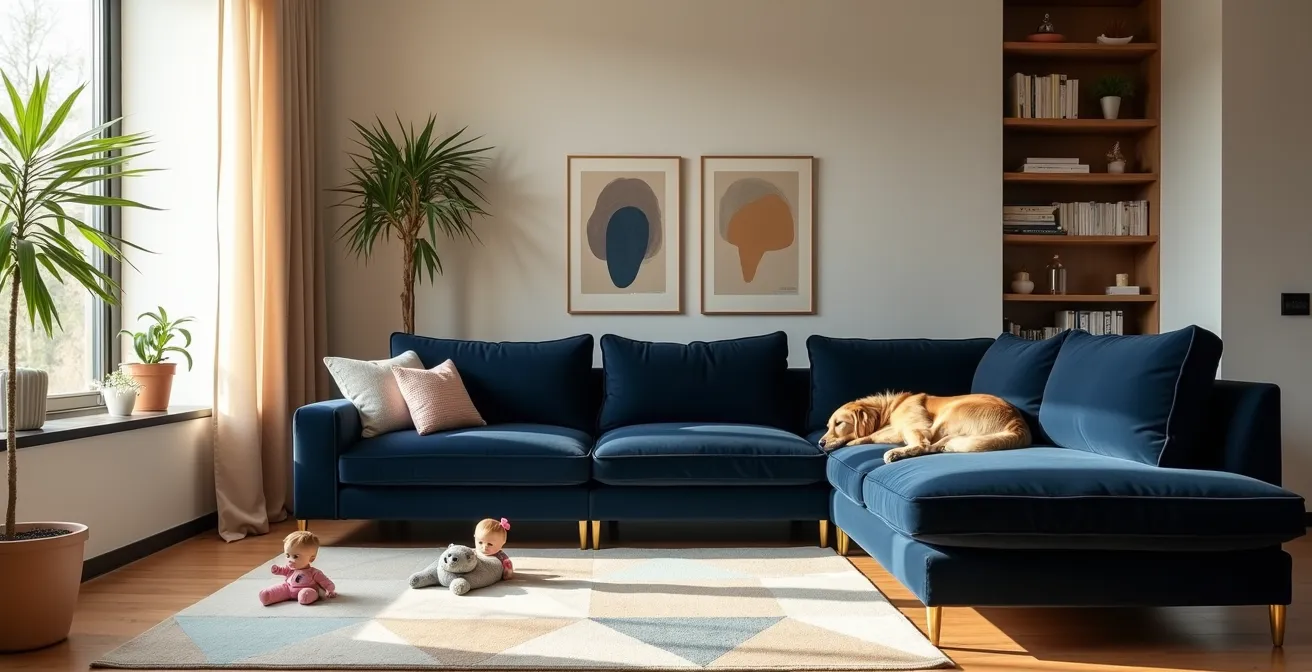
Contrary to popular belief, a velvet sofa is not a liability in a home with pets and children; it’s a strategic choice, thanks to its unique material science.
- The tight, loop-free weave resists pet claws and makes fur easy to remove, as it sits on the surface instead of getting embedded.
- Its dense pile creates surface tension that repels initial spills, buying you precious time for cleanup compared to absorbent fabrics like linen.
Recommendation: Opt for a high-rub-count “performance velvet” and understand its properties to enjoy luxury without the stress.
The image is a familiar one for many parents and pet owners: a stunning, jewel-toned velvet sectional that seems to beckon from a design magazine, followed by the immediate, sinking feeling of picturing it covered in muddy paw prints, sticky fingerprints, or the aftermath of a spilled juice box. The desire for a luxurious, stylish living space often crashes against the reality of an active household. For years, the conventional wisdom has been to steer clear, opting for “safer” materials like leather or simply resigning oneself to hiding furniture under a fortress of protective throws.
This approach assumes that velvet is inherently fragile and impractical. But what if this assumption is fundamentally flawed? What if the very nature of velvet—its dense pile and tightly woven structure—is precisely what makes it a surprisingly resilient and manageable choice for a family home? The key to living beautifully with velvet isn’t about avoiding life’s messes, but about understanding the engineered properties of the fabric itself. It’s not magic; it’s material science.
This guide will move beyond the myths to give you a fabric expert’s realistic perspective. We will deconstruct the composition of performance velvet, explain why it handles pet hair and spills better than you think, and provide a clear, actionable maintenance plan. By understanding how velvet works on a microscopic level, you can make an informed decision and finally bring that dream sofa home with confidence, not fear.
To help you navigate this topic, we have structured this guide to address the most pressing concerns, from cleaning and color choice to long-term care and smart pairings within your home.
Summary: Are Velvet Sectional Sofas Practical for Households with Pets and Children?
- Why Performance Velvet Is Actually Easier to Clean Than Linen for Dog Owners?
- How to Remove Red Wine from Velvet Without Leaving a Water Ring?
- Dark Navy vs Emerald Green: Which Hide Stains Better?
- The ‘Velvet Crush’ Phenomenon: Is It a Defect or Patina?
- How to Brush Your Velvet Sofa to Maintain Its Sheen Monthly?
- Why Modular Sofas Are the Best Choice for Renters Who Move Often?
- Hand-Scraped vs Wire-Brushed: Which Texture Hides Scratches Better?
- Why Is High-Quality Linen Upholstery Worth the Investment for Summer Homes?
Why Performance Velvet Is Actually Easier to Clean Than Linen for Dog Owners?
The idea that velvet is easier to clean than a seemingly simple fabric like linen sounds counterintuitive, but the answer lies in the weave. Linen and other fabrics like tweed have an open, looped weave. When a dog sheds, its hair gets trapped and woven into these loops, making it incredibly difficult to remove completely. Velvet, on the other hand, has a short, dense pile with no loops. This creates a “frictionless” surface where pet hair and dander sit on top, rather than getting embedded. As a result, cleaning experts find that regular vacuuming with an upholstery attachment can remove over 90% of pet hair and airborne particles.
Beyond pet hair, performance velvet’s construction offers superior durability. The industry standard for measuring fabric resilience is the Martindale test, which simulates natural wear and tear. A fabric for general domestic use typically passes with 15,000 to 20,000 “rubs.” However, high-quality performance velvets are engineered for much more. Many can withstand a Martindale rub count of over 40,000 cycles, putting them in the “heavy-duty” commercial-grade category. This is why fabric durability experts recommend a 40,000 or above rub count for spaces with frequent use, a standard that many performance velvets meet or exceed. This robust construction means the fabric resists thinning and wear from constant lounging, pet claws, and active kids.
How to Remove Red Wine from Velvet Without Leaving a Water Ring?
The dreaded spill—especially a dark liquid like red wine—is a primary source of anxiety for any sofa owner. With velvet, the fear is often compounded by the risk of creating a “water ring,” a visible mark left after a spot-cleaning attempt dries. This ring isn’t from the stain itself but from minerals in the water and displaced dirt settling into a new perimeter. The key to avoiding this is a methodical approach that cleans beyond the initial spot.
First, act quickly. Velvet’s dense pile creates surface tension that can hold a liquid on the surface for a few moments, giving you a crucial window to intervene before it soaks deep into the fibers. The technique below focuses on blotting absorption and feathering the cleaning area to ensure an even, mark-free finish.
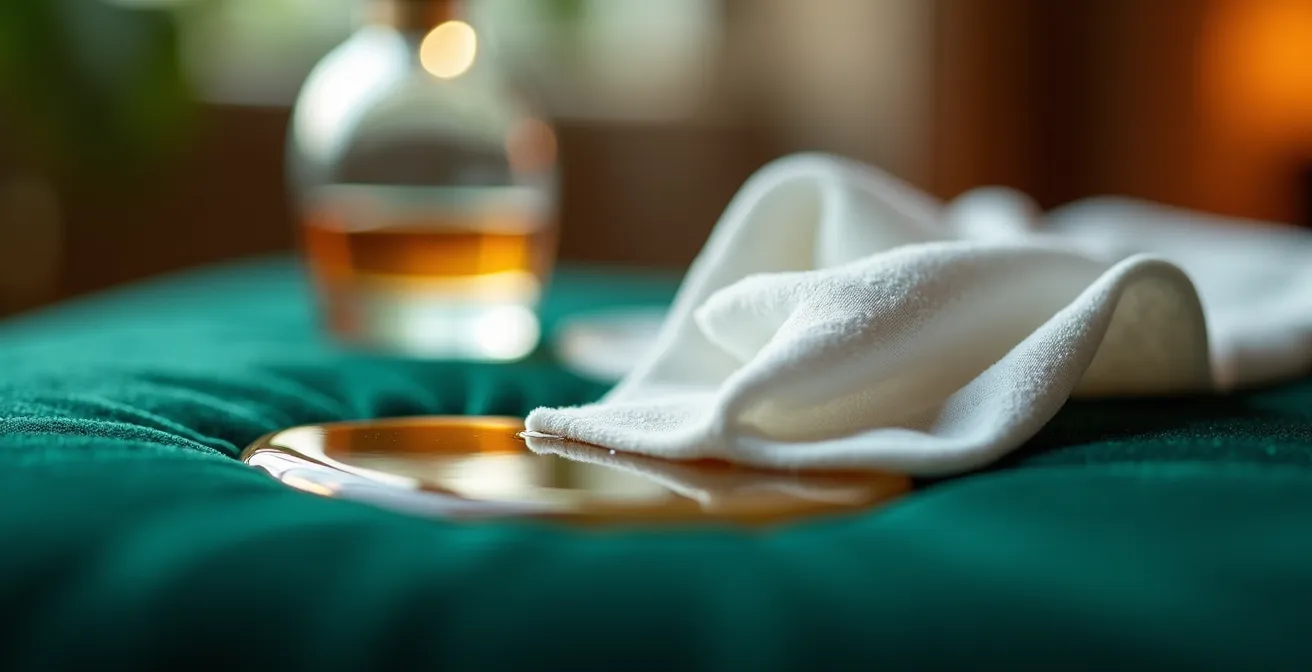
As shown in this close-up, the goal is to lift the spill, not rub it in. For a dark stain like red wine, a specialized upholstery cleaner is often necessary, but the application technique is what truly prevents lasting marks. According to professional cleaners at HGTV, you should clean a 10-inch radius around the targeted spot. This blending action prevents the creation of an obvious “clean spot” or water ring by feathering the moisture and allowing the entire area to dry uniformly. After cleaning, gently brushing the pile back into its natural direction will restore the velvet’s uniform sheen.
Dark Navy vs Emerald Green: Which Hide Stains Better?
The common advice to “just choose a dark color” to hide stains is an oversimplification. While darker shades are generally more forgiving, the type of stain and the specific hue of the velvet matter immensely. The best color for your family depends on the kind of messes you anticipate most. A household with toddlers and pets will face a different spectrum of stains than one with only adults. For example, a navy sofa is excellent at camouflaging ink from a broken pen or mud tracked in from the garden, but it might not be the best for lighter-colored pet fur.
To make a strategic choice, it’s helpful to consider which stains are most common in your home and match them to a color that will naturally absorb them. The following comparison breaks down the performance of popular velvet colors against specific types of spills and wear.
This table, based on insights from designers who frequently work with families, provides a more nuanced approach to color selection. It shows that an emerald green might be superior for hiding the yellowish tones of pet bile or food spills, while a medium gray is a versatile champion for masking general dust and the fur from multi-pet households.
| Color | Best For Hiding | Considerations |
|---|---|---|
| Dark Navy | Blue/black ink, mud, denim transfer | May fade to purple/gray in direct sunlight |
| Emerald Green | Pet bile, grass stains, yellow food spills | More stable color retention over time |
| Medium Gray | General pet hair, dust | Most versatile for multi-pet households |
Real-world experience often confirms this durability. As one long-term velvet sofa owner shared in a review on Style by Emily Henderson:
I have both cats and kids (both boys!) and velvet has been super durable and not attractive to the cats, unlike another non-velvet sofa I own that has become a very expensive scratching post. It does fade in direct sunlight though, which is a bummer, but I employ throws to keep the fading to a minimum.
– Long-term Velvet Sofa Owner
This testimony highlights both the impressive durability against pets and the critical consideration of sunlight. If your sofa will be in a bright room, choosing a more color-stable option like green or employing throws becomes a vital part of your long-term strategy.
The ‘Velvet Crush’ Phenomenon: Is It a Defect or Patina?
One of the most misunderstood characteristics of velvet is “crushing” or “bruising.” After sitting in one spot for a while, you might stand up to see a visible imprint where the fibers are pressed down, reflecting light differently and appearing as a darker or shinier patch. Many new velvet owners mistake this for a permanent flaw or a sign of poor quality. In reality, this is an inherent and expected characteristic of the fabric. It is not a defect, but rather a form of patina—a sign of use that adds character over time, much like the softening of leather.
Velvet’s signature sheen comes from the way light refracts off its millions of upright fibers. When you sit on the sofa, you are simply bending these fibers. The “crushed” area is just the pile lying in a different direction, causing the light to hit it at a new angle. This phenomenon is completely normal and, in most cases, reversible. It’s a feature of the fabric’s life, not a flaw in its construction. In fact, some velvets, known as “crushed velvet,” are manufactured with this effect intentionally created for a uniquely textured look.
Furthermore, the quality of the cushions beneath the fabric plays a significant role. According to fabric specialists, high-resiliency foam provides consistent support, which allows the velvet to develop a more even and gentle patina over time. Lower-density foam can collapse unevenly, leading to harsher, more permanent-looking creases in the fabric. Therefore, a well-made sofa will not only have durable fabric but also a supportive foundation that helps the velvet wear gracefully.
How to Brush Your Velvet Sofa to Maintain Its Sheen Monthly?
As Homes & Gardens Global Editor in Chief Lucy Searle emphasizes, proper maintenance is about gentle, consistent care rather than harsh, reactive cleaning. Her advice encapsulates the expert approach:
I blot blot blot on anything wet, but you mustn’t push too hard. If I’m going to clean my velvet sofa, I always brush in the direction of the pile. Afterwards, I always use a dry cloth on it to brush the velvet back into shape. I never, ever rub it. I get it professionally cleaned annually, too.
– Lucy Searle, Homes & Gardens Global Editor in Chief
This wisdom highlights the importance of regular brushing to revive the pile and maintain the sofa’s luxurious sheen. A monthly brushing routine can lift crushed fibers, remove surface dust, and restore the velvet’s uniform appearance. This simple act is preventative maintenance that keeps the fabric looking its best and prevents dust from settling deep into the pile. For areas that have become crushed from heavy use, a handheld steamer can be a powerful tool to relax and lift the fibers before brushing.
Your Monthly Velvet Restoration Plan
- Dry Brush First: Using a soft-bristled upholstery brush or a specialized velvet brush, gently stroke the fabric in the direction of the nap. This lifts surface dirt and begins to restore the plush appearance.
- Apply Gentle Steam (If Needed): For stubborn crushed areas, use a handheld steamer on its lowest setting. Hold it a few inches above the fabric, never directly on it, while using the soft brush to gently lift the fibers as they relax from the steam.
- Perform a Final Brush: After steaming, brush the entire surface carefully in the same direction as the pile. Use gentle, even motions. This final step “sets” the fibers and is what makes the velvet sofa look almost brand new.
- Vacuum Thoroughly: Use the soft brush attachment on your vacuum cleaner to go over the entire sofa. This removes any loosened dust and debris from the brushing and steaming process.
- Assess and Rotate Cushions: Finally, check all cushions for even wear. If possible, flip and rotate them to ensure that pressure points are distributed evenly over time, which will help the velvet develop a consistent patina.
Why Modular Sofas Are the Best Choice for Renters Who Move Often?
For those who desire the luxury of velvet but also require the practicality of adaptable furniture—especially renters or homeowners who anticipate future moves—the modular velvet sectional is an unparalleled solution. This design combines the resilience of performance velvet with the ultimate flexibility, solving multiple problems at once. Moving a traditional large sectional can be a logistical nightmare, often requiring professional movers and risking damage to both the sofa and the home. A modular design, however, breaks down into manageable, easy-to-carry pieces that can fit through tight doorways and be transported in a smaller vehicle.
This adaptability extends beyond moving day. A modular sofa can be reconfigured to fit different room layouts. A three-piece sectional with a chaise can become a long sofa and a separate ottoman, or it can be split into a loveseat and an armchair. This ensures your investment continues to serve you, even if your living space changes dramatically. It’s a sustainable approach to furniture, designed to evolve with your life.

Furthermore, combining this flexibility with performance velvet creates a powerhouse of practicality for pet owners. As one durability test noted, the very structure of performance velvet can deter destructive behavior. A review of a modular velvet sectional on Addicted 2 Decorating confirmed that high-performance velvet is such a tightly woven fabric that cats have a very hard time getting their claws into it. When they try to scratch and can’t get any satisfying resistance or pull, they typically lose interest. This makes the fabric an actively pet-deterrent choice, not just a pet-tolerant one.
Hand-Scraped vs Wire-Brushed: Which Texture Hides Scratches Better?
A truly pet-friendly living room thinks beyond just the sofa. The flooring beneath it plays a crucial role in the room’s overall durability and aesthetic. If you’re investing in a beautiful velvet sofa, pairing it with the right type of flooring can complete the durable, stylish environment you’re creating. When it comes to hardwood floors, texture is your best ally against the inevitable scratches from pet claws. Two popular texturing techniques, hand-scraping and wire-brushing, offer distinct advantages.
Hand-scraped flooring features long, flowing grooves and a rustic, inconsistent surface. This pronounced texture is exceptionally good at camouflaging the deeper, more significant scratches that a larger dog’s claws might create. The new scratches simply blend in with the existing distressed look of the wood. Wire-brushed flooring, by contrast, has a more subtle texture where the soft grain of the wood is brushed away, leaving the harder grain exposed. This is excellent for hiding the lighter, surface-level scuffs and scratches common in a busy household. It offers a more modern and uniform appearance than hand-scraping.
The choice between them often comes down to your aesthetic preference and the type of pets you have. A household with a 70-pound Labrador might benefit more from a hand-scraped finish, while one with cats or small dogs may find a wire-brushed floor is sufficient.
| Flooring Type | Scratch Resistance | Best Sofa Leg Pairing | Acoustic Benefits |
|---|---|---|---|
| Hand-Scraped | Superior for deep claw scratches | Rustic wood legs | Excellent sound diffusion |
| Wire-Brushed | Good for light surface scratches | Modern metal legs | Moderate sound absorption |
Key Takeaways
- Performance velvet’s durability comes from its tight, loop-free weave and high rub count (often 40,000+), making it resistant to pet claws and daily wear.
- Proper stain removal involves immediate blotting (not rubbing) and cleaning a wider radius around the spill to prevent water rings.
- Velvet “crush” is a natural patina caused by pressure changing the direction of the pile; it is not a defect and can be reversed with gentle steaming and brushing.
Why Is High-Quality Linen Upholstery Worth the Investment for Summer Homes?
After exploring the robust, family-friendly nature of velvet, it’s fair to ask: where does that leave classic fabrics like linen? High-quality linen upholstery has a timeless, airy appeal that is hard to match. Its breezy, natural texture makes it an exceptional choice for specific environments, most notably low-traffic areas or seasonal residences like summer homes. In a setting where sticky fingers and muddy paws are less of a concern, linen’s aesthetic qualities can truly shine. It offers a relaxed elegance and a cool-to-the-touch feel that is perfect for warm climates.
However, when it comes to the demands of a primary residence with pets and children, the comparison highlights velvet’s practical superiority. As a direct comparison of the two fabrics concludes, “Linen may offer a breezy, timeless style, but when it comes to stain resistance and low-maintenance care, velvet often proves to be the friendlier choice—especially in households with pets or children.” The fundamental difference lies in their reaction to messes. Linen’s absorbent, open weave tends to soak up spills instantly, making stains more likely to set. Velvet’s dense pile, as we’ve discussed, provides a brief but critical barrier against absorption.
Ultimately, the choice is about aligning the material with the lifestyle. Linen is an investment in a specific aesthetic for a controlled environment. Performance velvet is an investment in peace of mind for an active, unpredictable, and vibrant family home. It allows you to have the luxurious look you desire without compromising on the practical needs of everyday life. For a household with pets and kids, velvet isn’t just a viable option; it’s arguably one of the most intelligent choices you can make.
By understanding the science and adopting a simple maintenance routine, you can confidently choose a velvet sectional that will stand up to your family’s daily life and remain beautiful for years to come. The next logical step is to explore the performance velvet options that best suit your home’s specific needs.
Frequently Asked Questions About Velvet Sofa Maintenance
Is velvet crushing a sign of damage?
No. Over time, fibers can become ‘crushed’ in high-contact areas, leaving visible imprints. But crushing doesn’t mean the fabric is damaged—it’s simply the fibers being pressed down, which changes how they reflect light. It’s a natural patina, not a defect.
Can crushed velvet be restored?
Yes, in most cases. Crushing is often reversible with gentle steaming (using a handheld steamer a few inches from the surface) followed by brushing with a soft-bristled upholstery brush. This helps relax and lift the pile back to its original direction.
Does velvet attract pet hair more than other fabrics?
Quite the opposite. Unlike fabrics with loops or a coarse texture (like tweed or some linens), velvet has a short, dense pile. This smooth surface prevents pet hair from weaving into the fabric. Hair tends to sit on top, making it significantly easier to remove with a vacuum cleaner or a lint roller.