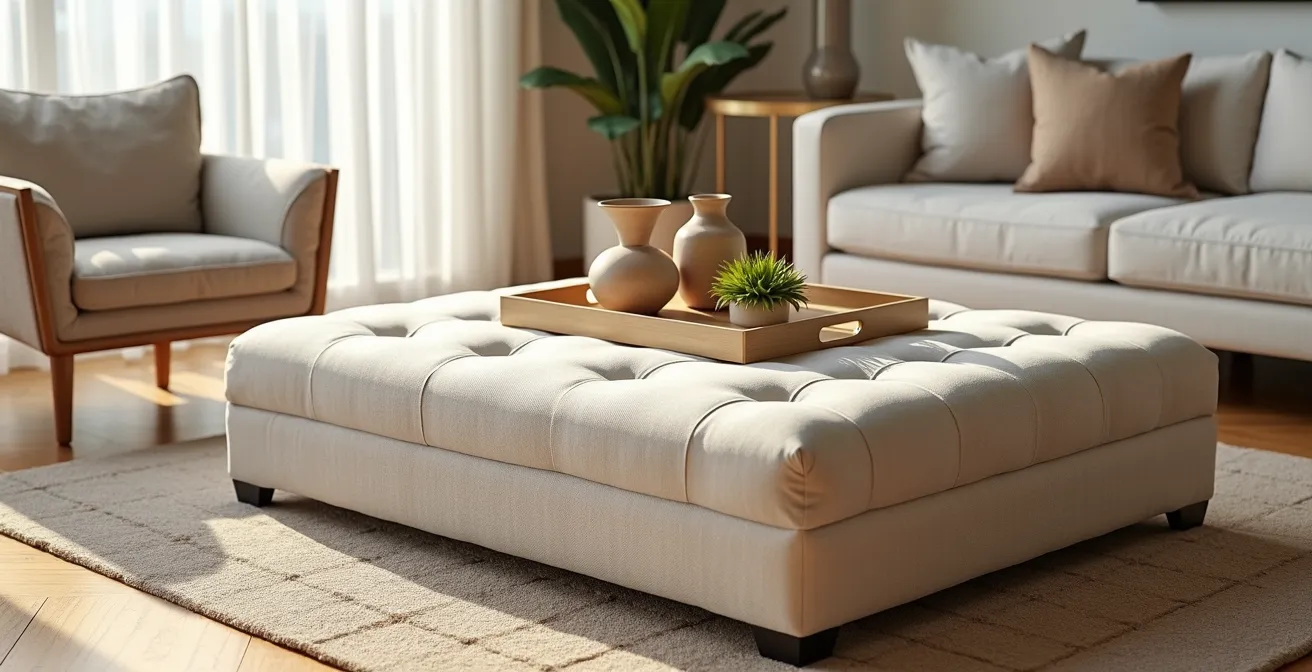
The perfect multifunctional ottoman for a micro-apartment isn’t about finding one piece that does everything, but understanding the hidden trade-offs in stability, space, and usability to maximize your return on investment.
- Firmness is non-negotiable for a coffee table function; look for foam with an ILD rating of 35 or higher.
- A round ottoman creates better traffic flow, but a square one offers 27% more stable surface area for the same diameter.
Recommendation: Prioritize an ottoman with a high-density foam core and certified soft-close hinges. This combination delivers the best value by ensuring both daily usability as a table and safety as a storage unit.
In a micro-apartment, every piece of furniture is an employee expected to work multiple jobs. The multifunctional ottoman promises to be the star performer: a coffee table by day, guest seating by night, and a storage chest in between. The common advice is simple: get one with a lid and put a tray on it. But for a value-oriented buyer living in a compact space, this generic approach often leads to wobbly drinks, cluttered storage, and a piece that does three things poorly instead of one thing well.
The real challenge isn’t about finding a versatile piece, but about navigating the hidden compromises. A plush, comfortable seat makes for a terrible, unstable table. A cavernous storage compartment can become a “black hole” where items get lost. The shape you choose has a direct and quantifiable impact on the “walkway economics” of your tiny living room. This guide moves beyond the obvious to dissect the critical trade-offs. We will focus on the physics of a stable surface, the true usability of storage, and the long-term return on investment (ROI) of your choice.
By understanding these factors, you can select an ottoman that doesn’t just promise versatility but actually delivers functional value for every square inch it occupies. It’s about making a smart investment, not just a purchase. We’ll explore the science behind foam firmness, compare material durability against daily life, analyze spatial efficiency, and even address the safety risks you can’t afford to ignore.
This article provides a complete framework for making an informed decision. Below is a summary of the key areas we will cover, from the foundational elements of a functional ottoman to a high-level analysis of its financial and practical return on investment.
Summary: A Buyer’s Guide to High-Value Multifunctional Ottomans
- Why Soft Ottomans Fail as Coffee Tables (And How to Fix It)?
- How to Style a Tray on an Ottoman to Make It Look Like a Table?
- Leather vs Fabric: Which Ottoman Material Survives Shoes and Snacks?
- The Pinch-Point Risk for Toddlers with Storage Ottomans
- Round vs Square Ottomans: Which Saves More Walkway Space?
- How to Reconfigure Your Sectional for Movie Night vs Cocktail Hour?
- Ottomans vs Coffee Tables: Which Storage Volume Is More Usable?
- Modular Seating vs Fixed Sofas: Which Offers Better ROI for Frequent Entertainers?
Why Soft Ottomans Fail as Coffee Tables (And How to Fix It)?
The primary failure of a multifunctional ottoman is a crisis of identity: it tries to be a soft seat and a hard table simultaneously. A plush, comfortable surface is inherently unstable, turning every coffee cup into a potential spill hazard. This is a deal-breaker for its coffee table function. The solution lies not in abandoning comfort, but in understanding the physics of foam and demanding better materials. The key is to find a balance between a supportive surface and seating comfort.
The secret is in the foam’s specifications. Two metrics are crucial: Indentation Load Deflection (ILD) and density. ILD measures firmness; a rating of 35 or higher is necessary to provide the stable, table-like support needed to hold a drink or a laptop securely. Density, measured in pounds per cubic foot (PCF), indicates durability. For a piece that will endure daily use, a density of at least 2.5 PCF is essential to prevent sagging and maintain its shape. Some high-end ottomans even use a dual-layer approach: a very firm core for structural integrity topped with a thinner, softer layer for seating comfort.

As the image above illustrates, different foam layers provide varying levels of support. A dense base is the foundation of a truly functional coffee table ottoman. With the ottomans market projected to grow at a 5.5% CAGR, manufacturers are increasingly innovating with these advanced foam constructions to meet consumer demand for furniture that is both comfortable and genuinely practical.
How to Style a Tray on an Ottoman to Make It Look Like a Table?
Placing a tray on an ottoman is the standard advice for creating a stable surface, but simply dropping one on top rarely achieves a sophisticated, table-like look. To truly elevate the piece, the approach must be more deliberate, transforming the surface from a temporary fix into an intentional design element. It’s about creating a curated, functional, and visually appealing centerpiece. This aligns with modern consumer trends, as research shows that 42% of consumers prefer furniture stores that offer customization and personalization options.
Interior designers use a structured technique called the “Four Quadrant Styling Rule” to achieve a balanced and dynamic look. Mentally divide the surface of your tray into four equal sections. Then, place items from different categories into each quadrant to create interest and harmony. The categories include:
- Natural Elements: A small vase with fresh flowers, a wooden bowl, or a succulent introduces an organic, grounding feel.
- Practical Items: A set of coasters or a stylish box to conceal remote controls ensures the surface remains functional.
- Height Variation: A tall, sculptural object or a slender candleholder draws the eye upward and adds dimension.
- Textural Contrast: Combine materials to add depth. For example, a smooth, lacquered tray on a nubby bouclé ottoman creates a compelling tactile and visual juxtaposition.
This systematic method prevents the tray from looking like a cluttered catch-all. By curating the items and considering height, texture, and function, you create a composition that makes the ottoman feel less like a footstool with a tray and more like a dedicated, stylish coffee table.
Leather vs Fabric: Which Ottoman Material Survives Shoes and Snacks?
For a piece of furniture that will inevitably host everything from stocking feet to spilled snacks, material choice is a critical investment decision. The battle between leather and fabric isn’t just about aesthetics; it’s about long-term durability, maintenance costs, and lifestyle suitability. For a value-oriented buyer, the right material is the one that withstands daily life with the least amount of worry and upkeep.
Genuine leather is often seen as the premium choice for durability. It’s resilient, easy to wipe clean, and develops a rich patina over time that adds character. However, it requires periodic conditioning to prevent cracking and can be susceptible to scratches from pets or keys. On the other hand, the world of performance fabrics (like Crypton or Sunbrella) has revolutionized fabric upholstery. These materials are engineered to be stain-resistant, water-repellent, and incredibly easy to clean, making them a top contender for high-traffic homes with children or pets. They offer a softer, warmer feel than leather without the high maintenance of standard fabrics.
The table below breaks down the key differences, helping you align your choice with your lifestyle and budget.
| Material Type | Durability Rating | Maintenance | Best For |
|---|---|---|---|
| Performance Fabrics (Crypton, Sunbrella) | High – stain resistant, hydrophobic | Easy – spot clean with water | Families with kids/pets |
| Genuine Leather | High – develops patina over time | Moderate – requires conditioning | Long-term investment, formal spaces |
| Standard Fabric | Medium – varies by weave | Difficult – professional cleaning needed | Low-traffic areas |
| Microfiber | Medium-High – resists stains | Easy – vacuum and damp cloth | Budget-conscious buyers |
Ultimately, the choice reflects a philosophy of use. Leather embraces wear and tear as part of its story, while performance fabrics are designed to resist it entirely. For the demanding environment of a micro-apartment, a high-quality performance fabric often provides the best balance of comfort, style, and stress-free maintenance.
The Pinch-Point Risk for Toddlers with Storage Ottomans
While the storage feature of a multifunctional ottoman is a major selling point, it introduces a significant and often overlooked risk: safety. For households with small children, the heavy, hinged lid of a storage ottoman can pose a serious pinch-point or entrapment hazard. A lid that slams shut can easily injure small fingers, and a child climbing inside could become trapped. From a value perspective, no amount of storage is worth compromising on safety.
Fortunately, responsible manufacturers have engineered solutions to mitigate these dangers. When evaluating a storage ottoman, safety mechanisms should be your top priority. Look for models equipped with soft-close hinges or gas struts. These hydraulic systems prevent the lid from slamming shut and often hold it open at any angle, allowing for safe access. A case study in this is Ashley Furniture’s innovation in their smart ottoman line, which introduced hydraulic systems designed to stay open, directly addressing parental concerns about pinch-point injuries.
Beyond the hinge mechanism, other design features contribute to a safer product. Ensure the lid isn’t excessively heavy and that all corners and edges of the ottoman are rounded to prevent injuries from bumps and falls. Verifying that the foam is CertiPUR-US certified also guarantees it is made without harmful chemicals and has low VOC emissions, contributing to a healthier indoor environment. Before purchasing, it’s essential to perform a hands-on safety audit.
Your 5-Point Safety Audit for Storage Ottomans
- Verify Safety Hinges: Actively look for soft-close mechanisms, gas struts, or lid stays that prevent the lid from slamming shut.
- Test the Lid Weight: Ensure an adult can easily lift the lid with one hand. This is a proxy for how difficult it would be for a child to get out if trapped.
- Inspect the Corners and Edges: Run your hand along all external edges. They should be rounded or well-padded, not sharp or hard.
- Check for Foam Certification: Look for a CertiPUR-US or similar certification tag, confirming the foam is low in harmful VOCs.
- Assess the Closure Gap: When closed, ensure there are no exposed pinch points or gaps between the lid and the base where small fingers could get caught.
Round vs Square Ottomans: Which Saves More Walkway Space?
In a micro-apartment, floor space is the ultimate currency. The shape of your ottoman is not just an aesthetic choice; it’s an economic one that directly impacts your “walkway equity.” The debate between round and square ottomans comes down to a trade-off between usable surface area and traffic flow. Understanding this compromise is key to maximizing the functionality of a small room.
A square or rectangular ottoman is the champion of surface area. It aligns perfectly with a sofa, maximizing the space available for trays, books, and laptops. However, its sharp corners can create awkward, restrictive traffic paths, making a small room feel even more cramped. A round ottoman, by contrast, is the master of flow. Its curved edges allow for smoother, more organic movement around it, which is especially beneficial in tight quarters or high-traffic areas. The downside is a significant reduction in usable surface area.
As the NashCo Furniture Design Team notes in their guide, “Leave at least 18 inches of walking space around the ottoman for comfort and accessibility. Round ottomans are excellent for smaller spaces as they soften corners and provide more fluid traffic flow.” This expert advice underscores the importance of prioritizing movement in compact layouts.
The following table quantifies this spatial trade-off, showing that a 36″ round ottoman has over 27% less surface area than a 36″ square one. This comparative analysis helps visualize the decision: do you need more table space or more floor space?
| Ottoman Shape | Usable Surface Area | Traffic Flow Pattern | Best Room Layout |
|---|---|---|---|
| 36″ Square | 1,296 sq inches | Predictable straight paths | L-shaped sectionals, linear arrangements |
| 36″ Round | 1,018 sq inches (27% less) | Curved, organic flow | Curved sofas, conversation pits |
| Rectangular (24×36″) | 864 sq inches | Directional flow | Narrow spaces, foot of bed |
How to Reconfigure Your Sectional for Movie Night vs Cocktail Hour?
A multifunctional ottoman truly shines when it’s part of a larger, adaptable system, most commonly a modular sectional sofa. This combination creates a living room that can transform in minutes to suit different activities. The key is to see the ottoman not as a static centerpiece but as a mobile component that redefines the room’s function. This level of versatility is becoming essential as average new apartment sizes in the U.S. have shrunk, driving demand for smart, space-saving solutions.
With a lightweight ottoman (ideally under 30 lbs), you can effortlessly switch between layouts. Here are a few common configurations to maximize your space for any occasion:
- Cinema Mode: Push the ottoman directly against the sofa or chaise to create an expansive, comfortable lounge area perfect for movie nights. This extends the seating and allows multiple people to put their feet up.
- Conversation Mode: Center the ottoman between seating areas and place a large tray on top. This creates a communal “coffee table” that encourages interaction, ideal for game nights or having guests over for coffee.
- Cocktail Hour / Flow Mode: When hosting a larger gathering where people will be standing and mingling, move the ottoman to the side of the sectional. It can function as an end table or extra perch, opening up the center of the room to maximize floor space and improve traffic flow.
- Individualized Surfaces: For ultimate flexibility, supplement the ottoman with C-shaped tables. These can slide over the ottoman or the sofa seats, providing stable, personal surfaces for drinks or laptops without taking up permanent floor space.
The ability to quickly reconfigure your living space is the ultimate expression of multifunctional design. It ensures your furniture actively supports your lifestyle, rather than dictating it.
Ottomans vs Coffee Tables: Which Storage Volume Is More Usable?
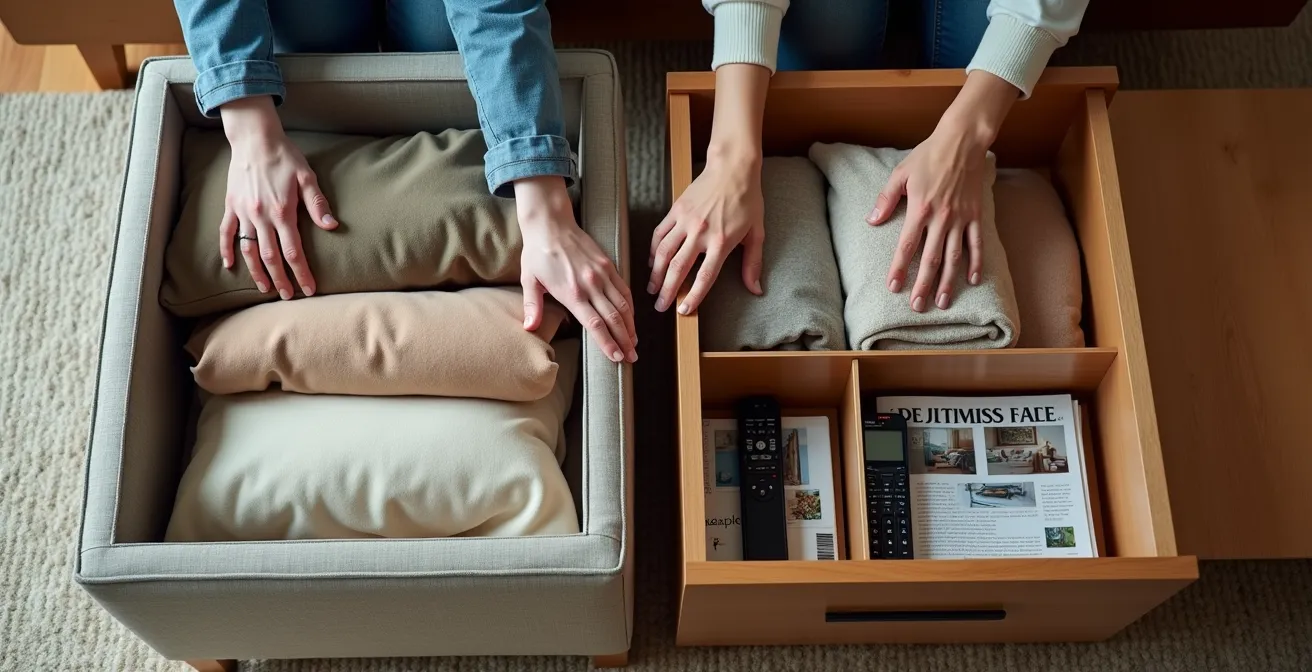
When comparing a storage ottoman to a traditional coffee table with drawers or shelves, the winner isn’t simply the one with the most cubic feet. The more important metric is “usability density”—how accessible and organized that storage volume truly is. A storage ottoman often boasts a massive interior, but its single, top-down access point can create a “black hole” effect. Items at the bottom are hard to reach, turning the space into a disorganized jumble of blankets and rarely used objects.
In contrast, a coffee table with multiple drawers or shelves may offer less total volume but provides several distinct access points. This makes it far easier to organize and retrieve everyday items like remotes, magazines, and coasters. This accessibility challenge is a significant trade-off. As interest in smart storage grows, with 15 million U.S. households projected to own smart furniture by 2025, consumers are demanding more than just empty space.
Case Study: The IKEA KIVIK Storage Solution
IKEA’s KIVIK and UPPLAND ottoman lines provide a real-world example of this challenge. While offering over 8 cubic feet of storage, their single-access design was prone to clutter. In response, IKEA developed solutions like compartmentalized fabric bins and internal dividers. These accessories create designated zones within the ottoman for blankets, pillows, and games, dramatically improving the usability of the storage volume despite having only one access point.
For a value-oriented buyer, this means a raw storage volume figure is misleading. The better investment is an ottoman that either includes or can be easily fitted with an internal organization system. Without it, you’re paying for space you can’t effectively use.
Key Takeaways
- Prioritize foam with an ILD of 35+ to ensure your ottoman can function as a stable coffee table.
- Safety first: Always choose a storage ottoman with soft-close hinges or gas struts to prevent pinch-point injuries.
- The best material for high-traffic, small-space living is often a performance fabric, which offers durability and easy maintenance.
Modular Seating vs Fixed Sofas: Which Offers Better ROI for Frequent Entertainers?
The final and most important consideration for a value-oriented buyer is the long-term Return on Investment (ROI). When you buy a multifunctional ottoman, you’re not just buying one piece; you’re often investing in a flexible furniture *system*. Comparing a modular sectional with an integrated ottoman to a traditional fixed sofa with a separate coffee table reveals a clear winner in both cost and versatility, especially for those who entertain frequently.
Initially, a modular system might seem more expensive. However, when you factor in the additional pieces required to replicate its functionality—a separate coffee table, extra stools for guest seating—the total setup cost is often lower. A modular system with an ottoman eliminates the need for these separate purchases. The true ROI, however, comes from its lifecycle value. A fixed sofa serves one function in one room. A modular system can be reconfigured for countless scenarios, and its pieces can even be split up and used in different rooms if you move, extending its useful life indefinitely.
This financial and functional flexibility is driving the expansion of the multifunctional furniture market. As noted by GM Insights, the sofa segment alone generated $4.9 billion in 2024, largely due to demand from urban dwellers in smaller homes. The analysis below quantifies the total cost of ownership.
| Furniture Type | Initial Cost | Additional Pieces Needed | Total Setup Cost | Versatility Score |
|---|---|---|---|---|
| Fixed Sofa | $2,000 | Coffee table ($500), 2-3 stools ($300) | $2,800 | Low – single configuration |
| Modular System with Ottoman | $2,500 | None – ottoman serves multiple functions | $2,500 | High – infinite configurations |
| Lifecycle Value | One room only | N/A | Limited | Can split for multiple rooms |
For the micro-apartment resident, the choice is clear. The modular system with a multifunctional ottoman isn’t just a piece of furniture; it’s a long-term, high-ROI asset that adapts to your life, saves you money, and maximizes the potential of every square foot.
Start evaluating your space with these critical trade-offs in mind. By moving beyond surface-level features and analyzing the true usability, safety, and long-term value, you can invest in a multifunctional ottoman that will serve you well for years to come.