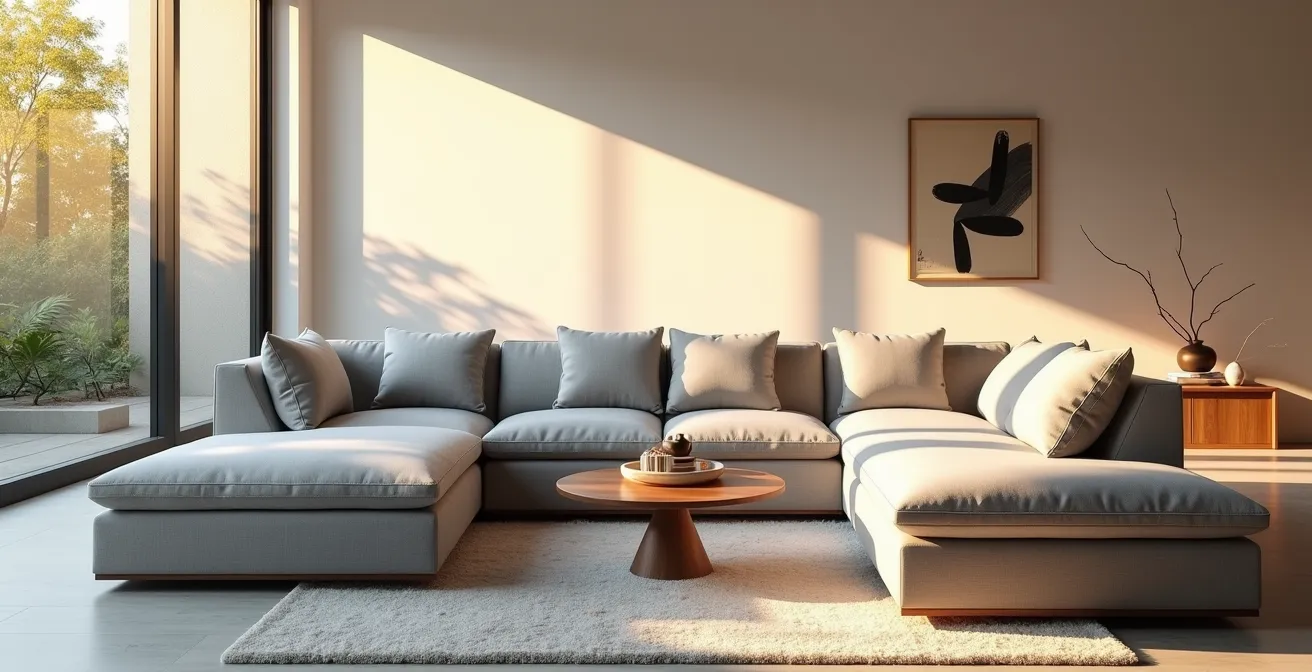
A fixed sofa is a depreciating liability tied to a single space; a modular sofa is a flexible asset with a quantifiable lifecycle value that adapts to your life.
- It eliminates costly replacement cycles driven by moving or family growth, directly lowering your Total Cost of Ownership (TCO).
- It maximizes the utility of your space by reconfiguring for any social event, from a crowded cocktail hour to an intimate movie night.
Recommendation: Evaluate your next sofa based on its long-term Total Cost of Ownership (TCO) and adaptability, not just its initial price tag.
For the frequent entertainer, choosing a sofa often feels like a compromise. You need enough seating for guests, but not so much that it overwhelms your space during quiet times. You fall in love with a piece that fits your current home perfectly, only to face the prospect of it becoming obsolete after your next move. Traditionally, the debate centers on aesthetics versus immediate comfort, but this perspective is fundamentally flawed because it ignores the most critical factor for any significant purchase: the return on investment (ROI).
The conversation must shift from “Which sofa looks best now?” to “Which sofa functions as a better long-term asset?” The true contest isn’t about style; it’s a financial one pitting the rigid, single-purpose nature of a fixed sofa against the dynamic, future-proof design of a modular system. While many articles praise modular sofas for being “flexible,” they fail to quantify what that flexibility means for your wallet. The key isn’t just the ability to change a layout; it’s a strategic approach to furniture ownership that minimizes depreciation and maximizes value over the entire lifecycle of the asset.
This guide reframes the decision as a furniture investment consultant would. We will dissect the ROI of modular seating by analyzing its impact on your Total Cost of Ownership (TCO), its ability to adapt to changing needs, the importance of build quality in preserving value, and its long-term practicality. By the end, you will be equipped to see your next sofa not as a decorative expense, but as a strategic investment in your home’s functionality.
To help you navigate this financial and practical analysis, this article breaks down the core components of modular sofa ROI. We will explore everything from the initial cost savings for renters to the long-term value of gradual expansion and material durability.
Summary: Modular Seating vs Fixed Sofas: Which Offers Better ROI for Frequent Entertainers?
- Why Modular Sofas Are the Best Choice for Renters Who Move Often?
- How to Reconfigure Your Sectional for Movie Night vs Cocktail Hour?
- Alligator Clips vs Straps: Which Connector Type Holds Modules Best?
- The Dye Lot Risk When Adding Modules Years Later
- How to Expand Your Seating Capacity Gradually as Your Family Grows?
- Why Soft Ottomans Fail as Coffee Tables (And How to Fix It)?
- How to arrange Furniture to Guide Movement Between Zones Naturally?
- Are Velvet Sectional Sofas Practical for Households with Pets and Children?
Why Modular Sofas Are the Best Choice for Renters Who Move Often?
For a renter, a traditional fixed sofa is one of the riskiest financial commitments you can make. With the initial investment to furnish an apartment already significant—where renters typically spend around $8,000—the last thing you need is an asset that loses its value with your next lease. A fixed sofa is designed for one specific room. If it doesn’t fit the layout, doorway, or stairwell of your next home, it becomes a liability. You’re forced to sell it at a steep loss or pay exorbitant fees to move and store it. This cycle of buying and replacing dramatically inflates the Total Cost of Ownership (TCO) over time.
A modular sofa fundamentally breaks this expensive cycle. Its design, based on individual, easy-to-move sections, eliminates the financial penalty of relocation. Each module can be carried by one or two people and easily fits through tight spaces, a concept pioneered by brands like Albany Park, whose Kova sofa arrives in easy-to-move boxes. This removes the need for professional movers for that one bulky item, immediately lowering your moving expenses. More importantly, it guarantees the sofa will fit in your next home, regardless of its layout. You simply reconfigure the pieces to suit the new space, preserving your initial investment entirely.
This table illustrates the stark financial difference in moving, a recurring cost for any renter. As this comparative cost analysis shows, the savings are not trivial; they represent a direct return on your investment with every move.
| Cost Factor | Traditional Fixed Sofa | Modular Sofa |
|---|---|---|
| Moving Cost (per move) | $200-$350 | $0 (DIY) |
| Average Weight | 350 pounds | 50-100 lbs per module |
| Sectional Moving Cost | $1,200+ for heavy pieces | $0 (modular breakdown) |
Ultimately, for a renter, the ROI of a modular sofa is clear and immediate. It transforms a high-risk, depreciating expense into a resilient, long-term asset that moves and adapts with you, safeguarding your capital and lowering your TCO from the very first day.
How to Reconfigure Your Sectional for Movie Night vs Cocktail Hour?
A fixed sofa has one configuration and, therefore, one primary function. This limitation directly impacts its ROI, because it fails to adapt to the varied demands of a social host. A cocktail party requires open space for mingling and multiple conversation zones, while a movie night calls for a deep, cozy nest for sprawling out. A modular sofa delivers a high return by being both of these things, effectively doubling its utility without occupying more space. This is the concept of maximizing utility per square foot—extracting more value from the same asset.
The key is understanding how to strategically reconfigure the modules for different events. Think of the pieces as building blocks for social engineering:
- For a Cocktail Hour: Break up a large U-shaped sectional into smaller, separate seating areas. Create a two-seater here, a chaise there, and use ottomans as standalone seats. This encourages movement and conversation between smaller groups. Using a standard seat module, which is often wider, provides more room for guests to sit without feeling cramped.
- For a Movie Night: The goal is maximum comfort and a shared focal point. Connect all the pieces into a large pit or U-shape. Some systems, like Lovesac Sactionals, allow you to rotate the same seat 90 degrees to create a “Deep Seat,” adding several inches of depth perfect for snuggling and lounging.
- For Game Night or Conversation: A semi-circular or corner configuration works best. Using wedge-shaped modules to create 45° or 90° angles can form an intimate conversational pit where everyone can see and engage with each other easily.
The image below visualizes how the same set of modules can be rearranged to create vastly different social environments, demonstrating the adaptability that drives the sofa’s value.
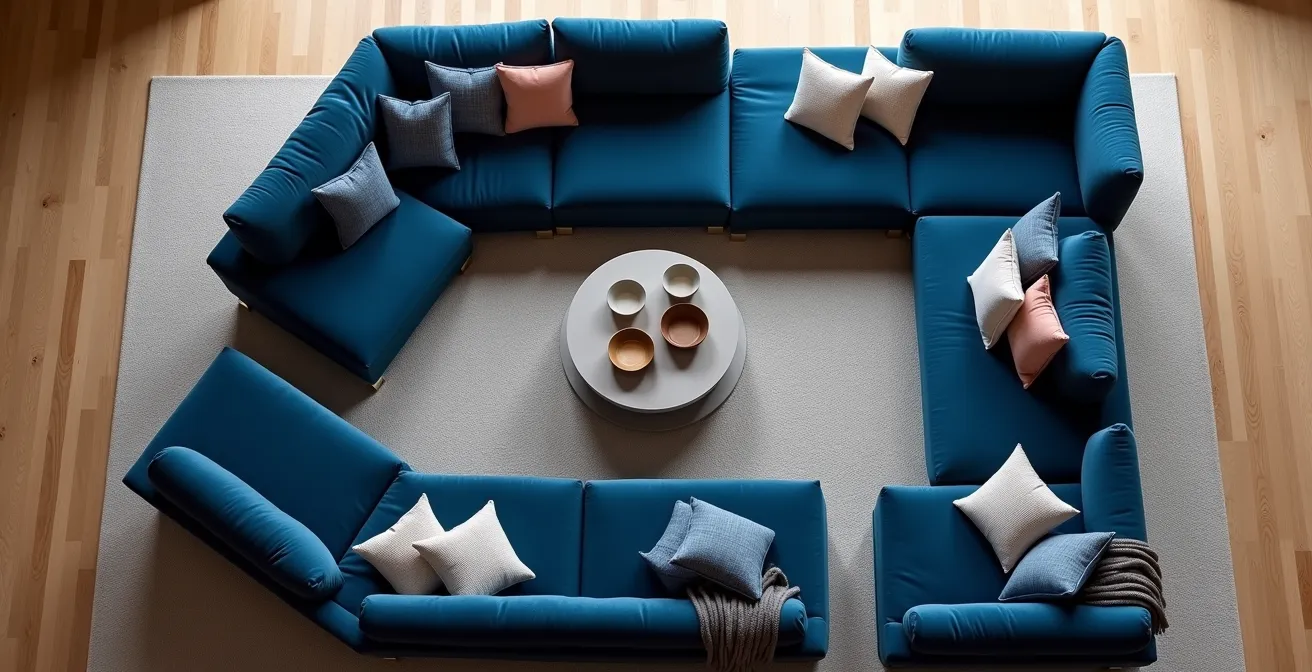
This ability to transform your living room’s function on demand is where the modular sofa’s ROI shines. You are not just buying a piece of furniture; you are investing in a versatile system that enhances your home’s social dynamics, ensuring you always have the perfect setup for any occasion.
Alligator Clips vs Straps: Which Connector Type Holds Modules Best?
A modular sofa’s long-term ROI is only as good as its weakest link: the connectors. If the modules constantly drift apart, the sofa becomes frustrating and feels cheap, negating its value. A secure connection is non-negotiable for preserving the lifecycle value of your investment. An unstable modular sofa will quickly be replaced, making it a poor investment regardless of its flexibility. The two most common types of connectors are basic straps and more robust interlocking metal hardware, often called alligator or crocodile clips.
While simple straps or Velcro might suffice for a rarely used setup, they are inadequate for the dynamic life of a frequent entertainer’s home. They stretch, slip, and wear out over time, leading to constant readjustment and “sofa-creep.” For a secure, long-lasting hold, interlocking metal hardware is vastly superior. These systems, often found on higher-quality modulars, feature teeth that clamp onto a corresponding piece on the adjacent module, creating a firm and stable connection. This is the kind of engineering that ensures a well-built modular sofa can realistically handle over a decade of use.
Premium brands have even developed patented systems to perfect this. Lovesac, for example, uses a combination of steel clamps and non-slip “Shoes” that keep the bases and sides firmly locked together. As the Living Cozy editorial team notes when reviewing high-end systems, the best ones ensure “the modular system stays firmly connected, preventing shifting — a common issue with lesser modular sofas — while still giving you the freedom to reconfigure as needed.” This robust construction is a critical component of future-proofing your investment. A brand that guarantees its connection system is also forward and backward compatible, as Lovesac does, offers the ultimate peace of mind: you know any module you buy years from now will integrate flawlessly with your existing setup.
The Dye Lot Risk When Adding Modules Years Later
The ability to expand your sofa is a core tenet of its long-term ROI. However, this benefit comes with a critical risk that can undermine your investment: the dye lot variance. When you buy a fabric-covered module five years after your initial purchase, the color may not be a perfect match, even if it has the same name. Fabric colors are produced in large batches, or “dye lots,” and slight variations between lots are inevitable. This can leave you with a new, slightly-off-color module that makes your entire sofa look mismatched and devalues the aesthetic.
Mitigating this risk is essential to future-proofing your investment. While a sofa’s frame can be incredibly durable, with some solid hardwood frames typically last 15-25 years, the fabric is what you see. The first line of defense is choosing a brand with a strong track record of consistency and a commitment to its product lines. A fly-by-night company may not even exist, let alone offer the same fabric, in a few years. A second strategy is to choose textured or heathered fabrics, where slight color variations are less noticeable than on a solid, flat-colored fabric.
A proactive approach is the most effective. When making your initial purchase, consider buying one extra ottoman or a small armless piece in the same dye lot. You can use it in another room and integrate it back into the main sofa when you need to expand. Alternatively, embrace the difference by design: plan to add new modules in a contrasting but complementary color for a deliberate, custom look. This turns a potential problem into a style statement. Before you invest, a thorough brand audit is crucial.
Action Plan: Future-Proofing Your Modular Sofa Investment
- Verify Brand Stability: Research the company’s history. Is it an established brand likely to be around for 10+ years to support its product lines?
- Check Fabric Guarantees: Confirm the availability of water-repellent, stain-resistant fabrics with removable and machine-washable covers to extend the life of the original purchase.
- Investigate Long-Term Support: Does the brand offer reupholstery services or guarantee that specific fabric lines will remain in production for a set number of years?
- Consider Color Strategy: For solid colors, ask about their dye lot consistency. For a safer bet, choose a textured/heathered fabric or plan to use a contrasting color for future additions.
- Buy a Buffer Piece: If your budget allows, purchase one small extra piece (like an ottoman) from the original dye lot as a future “color-match” guarantee.
By treating the purchase as a long-term relationship with the brand, you can effectively manage the dye lot risk and ensure your sofa’s value and appearance are preserved for years to come.
How to Expand Your Seating Capacity Gradually as Your Family Grows?
One of the most significant financial advantages of a modular sofa is the ability to scale your investment with your life. A fixed sofa forces you into a difficult prediction: do you buy a small sofa that fits your life now, knowing you’ll need to replace it when you have kids? Or do you over-invest in a massive sofa that clutters your space for years “just in case”? Both are poor financial strategies. The first guarantees a replacement cost, and the second leads to inefficient use of both capital and space.
Modular seating offers a financially intelligent third option: incremental investment. You can start with a 2 or 3-seat configuration that perfectly suits a couple in a small apartment. As your family or social circle grows, you simply purchase additional modules—an armless chair, a corner piece, or an ottoman—to expand your seating. This “pay-as-you-grow” model aligns your expenditure directly with your needs, maximizing capital efficiency. You never over-spend on seating you don’t currently require. Brands like Albany Park build their entire Kova line around this principle, allowing you to go from a two-seater all the way to a massive six-piece pit sectional over time.
This approach significantly improves the sofa’s lifecycle value. Instead of the asset becoming obsolete, it evolves. The table below, based on market price analysis, shows how your investment can be staged over time to match your life phases without the financial shock of a full replacement.
| Configuration | Price Range | Ideal For |
|---|---|---|
| 2-3 Seat Starter | $1,000-$2,000 | Couples/Small Apartments |
| 4-5 Seat Medium | $2,000-$4,000 | Small Families |
| 6+ Seat Large/U-Shape | $5,000+ | Large Families/Entertaining |
Many systems also offer modules with integrated storage, such as consoles or storage ottomans, adding another layer of utility as family needs for blanket and toy storage increase. This gradual, needs-based expansion is the cornerstone of a smart furniture investment strategy, ensuring your sofa remains a perfect fit for your home and your budget at every stage of life.
Why Soft Ottomans Fail as Coffee Tables (And How to Fix It)?
In the quest for maximum ROI, every module in a sectional system must pull its weight. The ottoman is often the most versatile piece, serving as a footrest, extra seating, or a makeshift coffee table. However, its effectiveness in this last role is often compromised. A standard soft-top ottoman is a terrible coffee table; drinks are unstable, items sink into the padding, and it lacks a firm, usable surface. This failure to perform a key function reduces the overall utility of the system. With the trend toward smaller living spaces, where urbanization boosts small-space living, every piece of furniture must be multifunctional.
Fixing this issue transforms the ottoman from a passive accessory into an active, value-adding asset. The goal is to introduce a hard surface without sacrificing the ottoman’s comfort as a seat or footrest. Fortunately, there are several elegant and practical solutions that enhance its functionality:
- Large Serving Trays: The simplest and most flexible solution. A large, sturdy tray (in wood, metal, or lacquered composite) provides a stable surface for drinks and decor. It can be easily removed when you want to use the ottoman for seating.
- C-Shaped Side Tables: These tables are designed to slide over the edge of the sofa or ottoman, providing a cantilevered hard surface without compressing the foam. They offer a stable spot for a laptop or a drink while leaving most of the ottoman’s surface soft.
- Custom Ottoman Inserts: Some manufacturers offer ottomans with removable, hard-surface inserts or nesting components that convert part of the surface into a stable table.
- Reinforced-Top Ottomans: Look for ottoman designs specifically engineered with a firmer top foam and reinforced structure, making them more suitable for holding items without significant sinking.
- Adjacent Consoles: Adding a slim console table behind a floating sofa section or next to an ottoman provides dedicated, stylish surface space for lamps, drinks, and storage.
By implementing one of these solutions, you reclaim the center of your seating area as a functional hub. You increase the utility per square foot of your living room and ensure that every component of your modular investment is delivering maximum value, both during quiet nights and lively social gatherings.
How to arrange Furniture to Guide Movement Between Zones Naturally?
A frequent entertainer’s greatest challenge is managing the flow of people in a space. A poorly arranged room creates bottlenecks, awkward dead ends, and prevents guests from mingling naturally. A large, fixed sofa is often the biggest culprit; it acts like a wall, dictating a rigid and often inefficient traffic pattern. This limitation reduces the functional value of your entire living area. The ROI of a modular sofa extends beyond the furniture itself—it enhances the value of your entire space by allowing you to become an architect of social flow.
The ability to break apart and re-form the sofa gives you control over pathways and zones. Instead of one monolithic block, you can create multiple, smaller seating arrangements that guide movement. For a large party, you might split a sectional into a three-seater against one wall and two separate chairs angled in a corner, creating a wide, inviting path through the center of the room. This encourages guests to circulate and interact. As the Joybird Design Team aptly puts it:
With a modular seating system, you can design a customized modular sectional sofa that fits your living room but easily move pieces into the dining room if you need extra seating at a moment’s notice. And, if you’re the nomadic type who moves often, rest easy knowing your modular sofa can be reconfigured to accommodate whatever space constraints your new living quarters throws at it, from a studio apartment to a cozy living room.
– Joybird Design Team, Modular Sofas, Sectionals, & Couches
This principle of dynamic zoning is a powerful tool. You can use an ottoman to close off a U-shape for an intimate movie night, then move it to the side to open up the area for a birthday party. A single armless chair can be pulled away to create a quiet reading nook in the morning and then re-integrated into the main sectional for evening entertaining. This level of control, made possible by fast and secure interlocking systems, ensures your room’s layout serves the event, not the other way around. By optimizing traffic flow, you make your entire home feel larger, more welcoming, and more functional, delivering a return on investment that impacts every social gathering you host.
Key Takeaways
- A modular sofa’s primary financial benefit is minimizing the Total Cost of Ownership (TCO) by eliminating replacement costs associated with moving or life changes.
- The true ROI is realized through its adaptability, which maximizes the “utility per square foot” by allowing one piece of furniture to serve multiple social functions.
- Future-proofing your investment through quality connectors, brand longevity research, and smart fabric choices is essential to preserving its long-term lifecycle value.
Are Velvet Sectional Sofas Practical for Households with Pets and Children?
For an investment to have a positive ROI, it must be resilient. A beautiful sofa that is destroyed by pets or children within a year is a catastrophic loss. Historically, velvet has been perceived as a delicate, high-maintenance fabric—the antithesis of a practical choice for a bustling family home. This perception, however, is largely based on outdated cotton velvets. The advent of modern performance velvet has completely changed the game, making it not only a practical option but a remarkably durable one that protects your investment.
Performance velvets are typically made from 100% polyester, which gives them inherent durability and stain resistance. Unlike natural fibers, the synthetic pile is not a loop, so there’s nothing for pet claws to snag on, drastically reducing the risk of pulls and tears. Furthermore, the dense pile makes it difficult for pet hair to weave itself into the fabric; it tends to sit on the surface, making cleanup with a lint roller or vacuum surprisingly easy. This durability is a key factor in the sofa’s long-term value proposition.
Case Study: Modern Performance Velvet Durability
To address concerns about practicality, many leading brands now use performance fabrics exclusively. In durability tests, these materials are designed to withstand common household spills. For instance, some fabrics are engineered to be water-repellent and stain-resistant, easily handling liquids like coffee, ketchup, and even red wine. This level of resilience ensures that accidental spills, a certainty in any active household, do not result in a permanent blemish that would devalue the furniture. It transforms a perceived liability into a durable, worry-free asset.
From an investment perspective, choosing a modular sectional in performance velvet is a savvy move. You get the luxurious, high-end aesthetic of velvet without the associated fragility. This resilience ensures the sofa maintains its visual appeal and structural integrity for years, even under the duress of daily life with kids and pets. It means your asset won’t rapidly depreciate due to cosmetic damage, securing its place as a smart, long-lasting centerpiece in your home.
To make the smartest financial decision for your home, start evaluating your next sofa not by its price tag, but by its potential for a long-term Return on Investment. Analyze its Total Cost of Ownership, its adaptability to your evolving life, and its resilience against daily wear and tear.