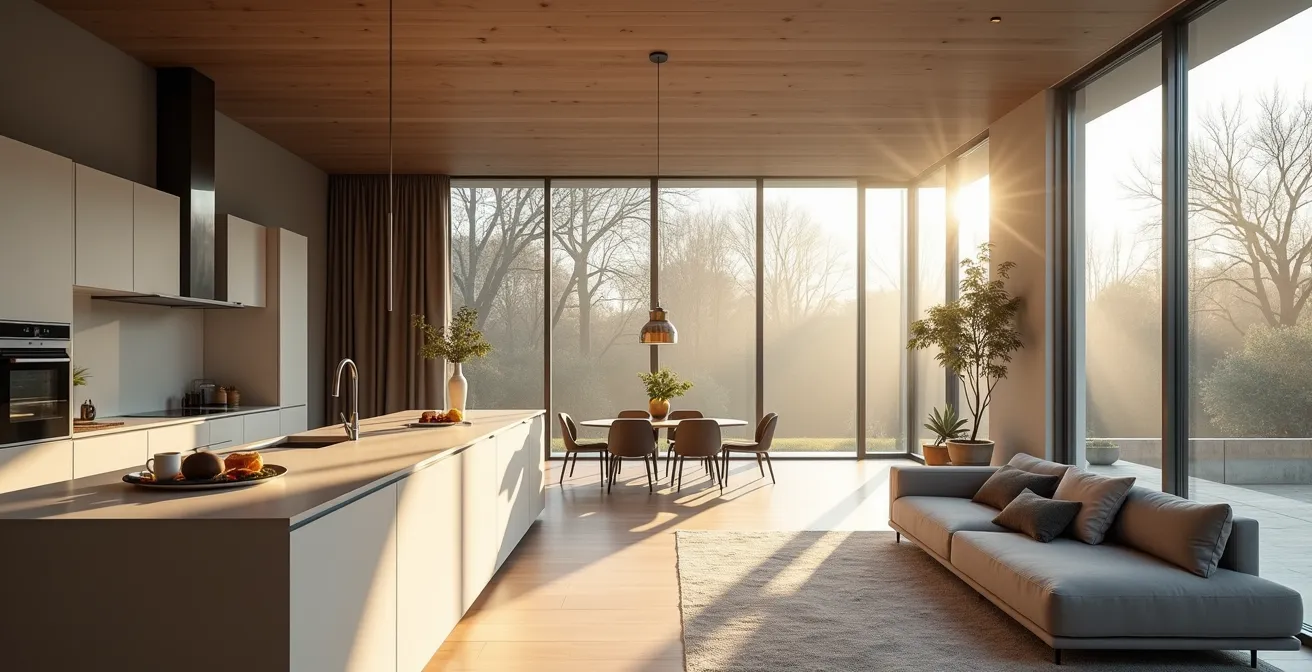
From a real estate appraiser’s perspective, an ill-conceived open-plan renovation often becomes a financial liability, not an asset.
- It frequently introduces unforeseen structural weaknesses, even when removing non-load-bearing walls.
- It can lead to significantly higher energy bills and fails basic comfort tests for acoustics, privacy, and odor control.
Recommendation: Prioritize a professional structural assessment and explore “broken-plan” alternatives to create a more valuable and genuinely livable home.
The allure of the open-plan concept is powerful. Homeowners dream of knocking down walls to create a vast, light-filled area perfect for entertaining and family gatherings. The promise is one of enhanced flow, modernity, and a perceived increase in property value. It’s an idea reinforced by countless home renovation shows and design magazines, presenting it as the default upgrade for any dated, cellular floor plan. This decision, however, often involves a significant investment, with renovation costs frequently running into tens of thousands of dollars.
But what if this pervasive trend isn’t the universal solution it’s made out to be? From a pragmatic appraiser’s viewpoint, the reality on the ground is often far more complex. The pursuit of “openness” can inadvertently introduce a host of functional compromises, hidden structural risks, and ongoing financial liabilities. These issues don’t just affect daily comfort; they can actively detract from a home’s marketability and overall value when scrutinized by a discerning buyer or professional.
The true key to a successful and valuable home layout isn’t a binary choice between ‘open’ or ‘closed’. It lies in a deeper understanding of structural integrity, functional zoning, and sensory comfort. This article will deconstruct the popular open-plan myth, moving beyond the surface-level appeal to dissect the practical challenges that are rarely discussed before the demolition begins. We will explore the technical, financial, and lifestyle-related downsides, providing a realistic framework to help you evaluate if this major renovation is truly the right move for your home and your investment.
This guide will walk you through the critical considerations that a professional appraiser evaluates, from hidden energy costs and structural red flags to the often-overlooked problems of acoustics and clutter. By understanding these potential pitfalls, you can make an informed decision that enhances both your comfort and your property’s long-term value.
Summary: The Unseen Downsides of Open-Concept Living
- Why Your Energy Bill Spikes by 30% in an Open-Plan House?
- How to Hide Kitchen Clutter in an Open Plan When Guests Arrive Unexpectedly?
- Broken Plan vs Open Plan: Which Suits a Family with Teenagers Better?
- The Cooking Odor Problem That No One Tells You About Before Renovation
- When to Consult a Structural Engineer: Signs Your Wall Removal Is Risky
- Why Removing a Non-Load Bearing Wall Can Still Cause Sagging?
- The Acoustics Oversight That Makes Open Plans Unbearable for Introverts
- When to Hire a Structural Engineer: A Guide for Wall Removal Projects
Why Your Energy Bill Spikes by 30% in an Open-Plan House?
One of the most immediate and quantifiable downsides of an open-plan layout is the impact on your utility bills. Creating one large, unified space eliminates the ability to zone heating and cooling effectively. In a traditional layout, you can close doors to unused rooms, containing conditioned air where it’s needed most. In an open plan, your HVAC system is forced to heat or cool a much larger volume of air, often leading to a significant and sustained increase in energy consumption. This financial drain is a serious consideration, especially when the initial renovation can be a major expense, with home renovation data from 2024 showing costs can average around $41,600.
The problem is exacerbated by features common in open-plan designs, such as large windows and high ceilings. While visually appealing, these elements contribute to heat loss in the winter and heat gain in the summer. The result is an environment that is not only expensive to maintain but also often less comfortable, with persistent drafts or hot spots. From an appraiser’s standpoint, a home with demonstrably high energy costs is a less attractive asset. Fortunately, if you already have an open plan, several measures can mitigate these costs:
- Install energy-efficient windows: Double or triple-pane glass is essential to prevent heat transfer.
- Use smart thermostats with zone control: While not as effective as physical barriers, they can help reduce heating in lesser-used areas by up to 30%.
- Add thermal curtains: These can block the sun’s hot rays in summer and provide an extra layer of insulation in winter.
- Switch to LED lighting: They use up to 75% less energy than traditional incandescent bulbs, which also produce excess heat.
- Monitor energy usage: Smart home systems can help you identify peak consumption times and adjust your habits accordingly.
Ultimately, the “open” feeling comes at the tangible cost of thermal inefficiency. A prospective buyer who is energy-conscious will see this as a significant long-term liability, potentially impacting your home’s value.
How to Hide Kitchen Clutter in an Open Plan When Guests Arrive Unexpectedly?
In an open-concept home, the kitchen is perpetually on display. There is no door to close on the aftermath of meal preparation—the dirty dishes, countertop appliances, and general cooking paraphernalia. This creates a constant pressure to maintain a showroom-level of tidiness, a state that is incompatible with the reality of a busy family life. What is sold as a social hub for cooking and entertaining quickly becomes a source of stress when every piece of clutter is visible from the living and dining areas.
This “visual clutter” is more than just an aesthetic issue; it detracts from the calm and relaxing atmosphere a living space should provide. A smart solution that is gaining traction in high-end design is the reintroduction of a modern scullery or a “hidden kitchen.” This is a secondary prep area, concealed behind pocket doors or seamless paneling, that houses the functional, messy aspects of a working kitchen. It allows the main kitchen island and counters to remain pristine for guests.

As the illustration demonstrates, this approach provides the best of both worlds: the visual openness when desired, and the practical concealment needed for everyday life. It’s a form of functional zoning that acknowledges the reality of a working home. From a value perspective, a thoughtfully designed solution like a scullery is a significant upgrade that signals a high level of design intelligence, far more impressive than a simple, undifferentiated open space.
Broken Plan vs Open Plan: Which Suits a Family with Teenagers Better?
For families, particularly those with teenagers, the “one big room” concept of an open plan often fails spectacularly. It forces disparate activities—watching TV, doing homework, listening to music, having a private conversation—to compete in the same acoustic and visual space. This lack of separation can be a constant source of conflict and sensory overload. A superior alternative that addresses this is the “broken-plan” layout. This design philosophy uses clever zoning techniques to create distinct areas without reverting to a fully cellular floor plan.
A designer in a Paris apartment, for instance, successfully used partial walls and archways to create acoustic separation while maintaining a feeling of spaciousness. The design allows glimpses into adjacent rooms, creating intrigue while providing the privacy needed for different family members’ activities. This is achieved using elements like glass partitions, freestanding shelving units, or split levels to delineate zones. These semi-private nooks can be claimed and personalized by teenagers, giving them a sense of territory that is impossible in a fully open plan.
The following table, based on insights from design and architecture firm Resi, breaks down the key differences for family living.
| Feature | Broken Plan | Open Plan |
|---|---|---|
| Acoustic Privacy | Glass partitions provide sound barriers while maintaining visual connection | No sound barriers – TV, music, conversations all audible throughout |
| Teenage Territory | Semi-private zones can be claimed and personalized | No defined personal spaces within main living area |
| Flexibility | Zones easily adapted as children grow (play area → homework nook → gaming station) | Surprisingly rigid functional layout despite openness |
| Implementation Cost | Lower-cost solutions like shelving or partitions are effective | Higher heating/cooling costs due to larger volume |
| Visual Connection | Maintains sightlines through glass or partial walls | Complete visual openness |
For a family with evolving needs, a broken plan offers a flexible, harmonious, and ultimately more valuable solution than the rigid, one-size-fits-all approach of a purely open concept.
The Cooking Odor Problem That No One Tells You About Before Renovation
While the idea of cooking while chatting with guests is appealing, the reality includes the unavoidable byproduct of cooking: odors. In a traditional layout, kitchen smells are largely contained. In an open plan, the aroma of fried fish or sizzling garlic quickly permeates every corner of your living space, lingering on sofas, curtains, and rugs. This sensory intrusion is a significant comfort issue that is often underestimated until after the renovation is complete. A powerful and properly specified ventilation system is not an optional luxury; it is an absolute necessity.
Simply installing a standard range hood is often insufficient. Effective odor control in a large, open volume of air requires a professional approach. A case study from the Sims Hilditch design studio highlights a successful project in a London townhouse, where Crittall glass doors were used to separate the kitchen and living spaces. This maintained the flow of natural light while creating an effective barrier against both odors and noise, proving that physical, not just mechanical, barriers are highly effective. For those committed to a fully open space, a robust mechanical solution is critical.
Your Action Plan: Professional Solutions for Odor Control
- Calculate Required CFM: Measure your room’s volume (length × width × height in feet) and multiply by 15. This gives you the target CFM (Cubic Feet per Minute) for your exhaust fan to ensure adequate air changes.
- Specify a Ducted Hood: Your exhaust hood must be ducted to the outside and rated for your cooktop’s heat output. A common rule is a minimum of 100 CFM for every 10,000 BTU of your cooktop’s power.
- Install a Make-Up Air System: In tightly sealed modern homes, a powerful exhaust fan can create negative pressure. A make-up air system is required to bring fresh air in to balance the pressure.
- Optimize Cooktop Position: If possible, position cooktops on perimeter counters rather than on a central island. This allows for more efficient exhaust ducting.
- Consider Physical Barriers: Even partial barriers like glass partitions can dramatically help contain odors and grease while preserving a sense of openness.
Failing to address ventilation properly can make a home unpleasant to live in and can be a major red flag for potential buyers, directly impacting its desirability and value.
When to Consult a Structural Engineer: Signs Your Wall Removal Is Risky
The most critical—and potentially catastrophic—risk in an open-plan renovation is compromising your home’s structural integrity. While most homeowners know to be cautious with “load-bearing” walls, identifying them is not always straightforward. A load-bearing wall supports the weight of the structure above it (such as a second floor or the roof) and transfers that load down to the foundation. Removing one without properly redirecting that load with a new beam and supports can lead to sagging floors, cracked drywall, and in the worst cases, catastrophic failure.
There are several telltale signs that a wall is likely carrying a load. One of the most reliable indicators can be found in the attic or basement. If the ceiling or floor joists run perpendicular to the wall and rest on top of its top plate, the wall is almost certainly load-bearing. This direct connection shows that the wall is actively supporting the weight of those joists and whatever is above them. An amateur assessment is never sufficient; the stakes are simply too high.
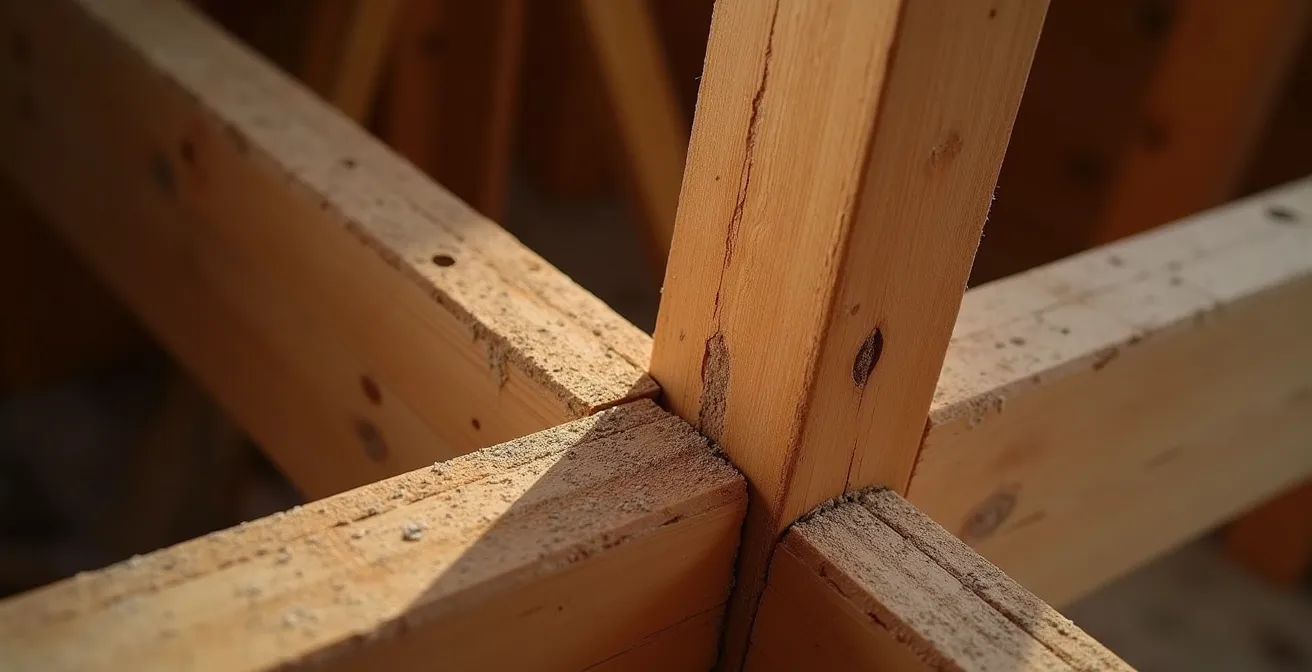
As the image shows, this structural relationship is a clear warning sign. Beyond this, any renovation project involving wall removal requires a systematic safety check. Making the wrong call is a multi-thousand-dollar mistake that can render a home unsafe.
Your Checklist: Deciding on Professional Wall Removal
- Check Location: Is the wall on the ground floor of a multi-story house? If yes, it’s highly suspect. Always consult an engineer.
- Measure Thickness: Is the wall thicker than other interior walls, typically over 6 inches? This could indicate it contains structural supports.
- Assess Material: Is the wall made of masonry or brick? These are almost always structural components. Get a professional assessment.
- Examine the Roof: Does your house have a complex roof structure with hips, valleys, or dormers? The loads may be distributed in non-obvious ways.
- Inspect the Joists: Check the attic or basement. If joists are perpendicular to the wall and rest on top, it’s a critical red flag. It is likely load-bearing.
Ignoring these signs is a gamble against the structural integrity of your home. The cost of an engineer’s consultation is a tiny fraction of the potential repair costs and the loss of value from a compromised structure.
Why Removing a Non-Load Bearing Wall Can Still Cause Sagging?
Here lies one of the most dangerous misconceptions in DIY renovation: that a “non-load-bearing” wall can be removed without consequence. This is fundamentally untrue. While a partition wall may not carry vertical loads from the floor above, it often plays a crucial, hidden role in the overall structural system. Many older homes, for example, were built with very long ceiling joists that, over time, are prone to bowing or sagging under their own weight. Partition walls, even if not directly under a load, often serve as mid-span bracing, preventing this deflection.
A structural analysis of Victorian homes converted to open-plan layouts revealed this exact issue. In several cases, the removal of supposedly non-structural partition walls led to a progressive ceiling sag over 2-3 years, with deflection increasing by up to two inches. The walls were not carrying the roof, but they were stiffening the entire floor/ceiling assembly. The drywall itself, when properly installed, contributes to this effect. As one expert in the Journal of Building Science notes:
When properly installed, drywall acts as a diaphragm, adding significant bracing to the entire wall and ceiling assembly.
– Structural Engineering Expert, Journal of Building Science
When you remove this diaphragm, you can introduce unanticipated flex and movement into the structure, leading to cosmetic issues like drywall cracks far from the renovation site, or more serious problems like sagging ceilings. This is why a structural engineer’s assessment is vital even for walls that appear to be simple partitions. They analyze the *entire system*, not just one component in isolation.
The Acoustics Oversight That Makes Open Plans Unbearable for Introverts
The most common complaint about open-plan living is noise. Sound travels unimpeded, turning the entire space into an echo chamber where the television, a phone call, and the dishwasher all compete for attention. For introverts or anyone sensitive to their environment, this constant auditory stimulation can be mentally exhausting. This isn’t just a matter of preference; it’s rooted in environmental psychology. Prospect-Refuge Theory, when applied to residential spaces, explains this perfectly. Open plans maximize “prospect” (clear, long sightlines) but completely eliminate “refuge” (small, protected spots where one can retreat and feel safe).
This lack of refuge creates a persistent feeling of exposure and overstimulation. Research referenced by Apartment Therapy’s analysis of environmental studies found that introverts reported 40% higher stress levels in fully open spaces compared to broken-plan layouts that incorporated quiet zones. This acoustic chaos is a major detractor from a home’s comfort and, therefore, its livability and value. Addressing acoustics in an open plan requires deliberately re-introducing sound-absorbing and sound-blocking elements:
- Add Soft Furnishings: A large, thick rug can reduce reverberation time (the time it takes for a sound to fade) by 15-20%. Upholstered furniture, heavy curtains, and throw pillows also absorb sound.
- Install Acoustic Panels: Modern acoustic panels can be disguised as artwork and, when placed on about 25% of wall surfaces, can dramatically improve sound quality.
- Create “Acoustic Shadows”: Use tall bookshelves, screens, or other large furniture pieces to create physical barriers that block the direct path of sound waves.
- Use Ceiling-Mounted Clouds: In spaces with high ceilings, acoustic clouds or baffles suspended from the ceiling are highly effective at stopping sound from reflecting off hard surfaces.
A home that feels acoustically chaotic is a home that is fundamentally uncomfortable. A savvy buyer will notice this during a viewing, and it can be a significant mark against the property.
Key Takeaways
- Open-plan layouts carry significant hidden costs related to energy inefficiency and poor acoustics that detract from comfort and value.
- Structural integrity is paramount and far more complex than simply identifying a “load-bearing” wall; even partition walls can play a critical bracing role.
- “Broken-plan” designs, which use smart zoning techniques, offer a superior and more flexible alternative that balances openness with necessary privacy and function.
When to Hire a Structural Engineer: A Guide for Wall Removal Projects
After reviewing the myriad of potential issues—from soaring energy bills to sagging ceilings—one conclusion becomes undeniable: any plan to remove a wall requires professional consultation. Attempting to self-assess a wall’s function is a high-stakes gamble. A structural engineer is the only professional qualified to accurately analyze your home’s structure and design a safe, lasting solution. The cost of this consultation is a modest and necessary investment in your property’s safety and value, with a typical structural engineer fee for a residential wall assessment ranging from $500 to $1,500. This fee is insignificant compared to the potential cost of rectifying a structural failure.
The engineer’s role extends far beyond a simple “yes” or “no” on a wall’s load-bearing status. They provide a comprehensive service that ensures the long-term health of your home’s structure. Understanding the full scope of their work demonstrates why their involvement is non-negotiable for any responsible homeowner.
| Service | What Engineer Provides | Why It Matters |
|---|---|---|
| Beam Specification | Correct size and material selection (LVL, steel I-beam, engineered wood) | Prevents future sagging and structural failure |
| Support Design | Column placement and foundation requirements | Ensures load properly transfers to the ground |
| Official Drawings | Stamped architectural plans for permits | Legal requirement for building permits |
| Load Calculations | Analysis of dead loads, live loads, and load paths | Protects against overloading the remaining structure |
| Code Compliance | Ensures design meets local building codes | Prevents costly corrections during inspection |
In essence, hiring an engineer is not an expense; it is insurance. It protects your financial investment, ensures the safety of your family, and guarantees that the renovation adds, rather than subtracts, value from your home. From an appraiser’s viewpoint, a renovation backed by an engineer’s stamped drawings is a documented asset; one done without it is a potential liability.
Therefore, before you pick up a sledgehammer, your first and most critical step is to schedule a consultation with a qualified structural engineer. This single action is the most important investment you can make in ensuring your renovation is a safe, successful, and valuable improvement to your home.