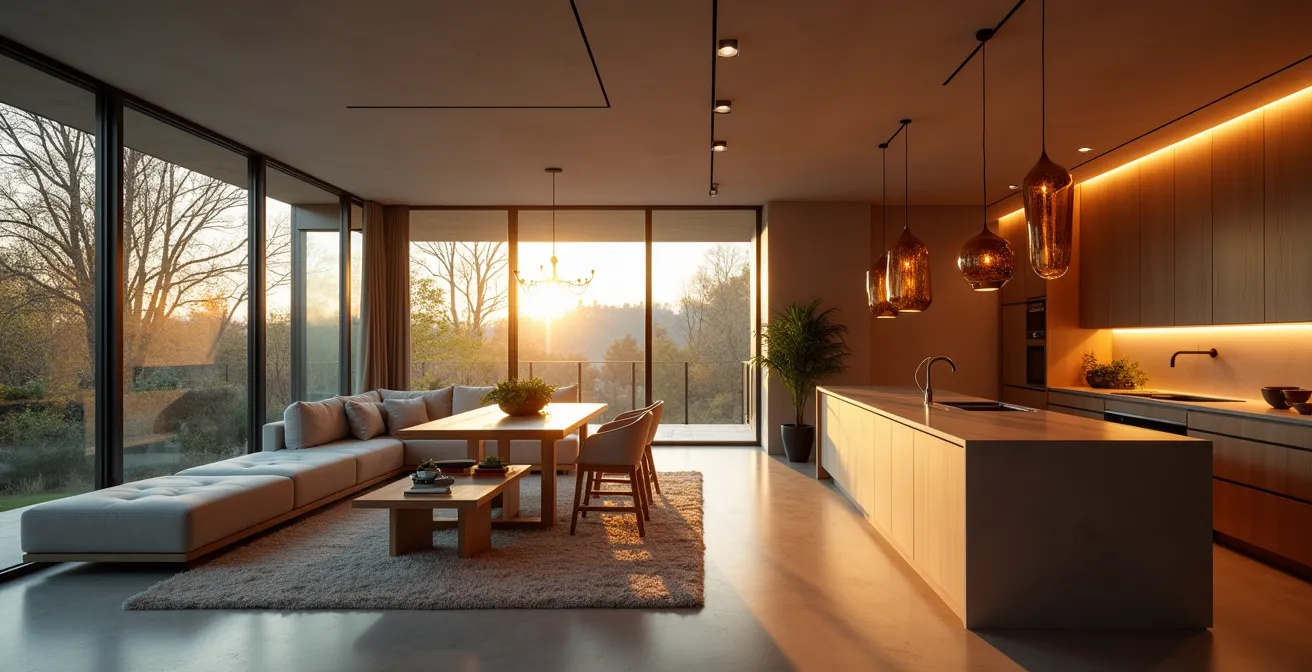
Defining spaces in an open plan isn’t about physical barriers; it’s about creating subconscious sensory cues that reduce stress and restore order.
- Effective zoning relies on layered lighting and varied color temperatures to create ‘rooms of light’.
- Leveraging acoustic materials and smart furniture placement carves out quiet zones and guides natural movement.
Recommendation: Start by analyzing your family’s natural movement and noise patterns, then apply targeted sensory solutions instead of just adding furniture dividers.
The open-plan home was sold as a dream of airy, light-filled family togetherness. The reality for many, however, is a daily battle with noise, visual clutter, and a complete lack of personal space. One person’s Zoom call bleeds into another’s TV show, cooking smells permeate the entire floor, and the sense of a peaceful retreat is lost in a single, chaotic environment. You’ve likely been told the standard fixes: use a large rug to anchor the living area or position a bookshelf as a makeshift divider. These are not bad ideas, but they often fail to solve the core problem.
But what if these physical fixes are just band-aids? The real issue isn’t the absence of walls; it’s the lack of sensory boundaries. Without clear visual, acoustic, and even tactile cues, your brain is forced to process the entire space as one continuous, demanding environment. This constant stream of stimuli leads to a state of high cognitive load, increasing stress levels for the whole family and making it especially challenging for introverts to recharge.
This guide moves beyond simple furniture placement to explore the psychological impact of effective zoning. We will delve into how to use light, sound, texture, and natural flow as sophisticated tools to create distinct, functional areas that feel separate, even when they’re not. By mastering these strategies, you can transform your open-plan space from a source of stress into a harmonious and highly functional home that caters to everyone’s needs.
To navigate these concepts, this article is structured to build from the psychological problem to the practical, sensory solutions. You’ll find a detailed breakdown of each strategy in the table of contents below, allowing you to focus on the areas most relevant to your home.
Summary: A Consultant’s Guide to Open-Plan Zoning
- Why Lack of Visual Boundaries Increases Family Stress Levels?
- How to Use Lighting Circuits to Visually Separate Dining and Living Zones?
- Continuous Flooring vs Thresholds: Which Is Best for Visual Zoning?
- The Acoustics Oversight That Makes Open Plans Unbearable for Introverts
- How to Arrange Furniture to Guide Movement Between Zones Naturally?
- Hand-Scraped vs Wire-Brushed: Which Texture Hides Scratches Better?
- Why Hanging Lights Too High Kills the Intimacy of a Dinner Party?
- Why Do Open-Plan Areas Sometimes Decrease Home Value and Comfort?
Why Lack of Visual Boundaries Increases Family Stress Levels?
In an undefined open-plan space, your brain has no “off” switch. Every object, movement, and sound across the entire area competes for your attention, forcing you into a state of high alert. This isn’t just a feeling of being distracted; it’s a measurable neurological strain known as cognitive load. Without visual cues to signal “this is the work zone” or “this is the relaxation zone,” your mind must constantly process extraneous stimuli. Research confirms that disorganized environments can reduce productivity by up to 77% while increasing levels of the stress hormone cortisol by 27%.
This problem is compounded by noise. The lack of walls means sound travels freely, creating a constant auditory clutter. What might seem like ignorable background noise has a significant impact. For instance, research from Cambridge University demonstrates that even moderate noise levels can lead to a 27% increase in reported fatigue. When family members are engaged in different activities—one on a video call, another watching a movie—the conflicting sounds create a stressful sensory soup. The brain works overtime to filter and focus, depleting mental energy and raising irritability.
Ultimately, the absence of defined zones erodes the fundamental feeling of having personal territory. This lack of a “recharge zone” where one can retreat from the family’s shared sensory experience is a primary driver of stress. Creating clear visual anchors and dedicated functional areas isn’t just about organization; it’s a crucial strategy for reducing mental fatigue and restoring a sense of calm and control in a busy home.
How to Use Lighting Circuits to Visually Separate Dining and Living Zones?
Lighting is one of the most powerful and underutilized tools for creating “walls” without walls. Instead of thinking of one overhead light for the entire space, a layered lighting strategy using multiple circuits allows you to “paint” with light, creating distinct zones that can appear and disappear on command. The key is to treat each functional area—living, dining, kitchen—as its own room deserving of a dedicated lighting plan. This involves using a mix of ambient, task, and accent lighting for each zone.
The psychological effect of light is profound and can be manipulated through color temperature. By assigning different color temperatures to different zones, you send subconscious signals about each area’s function. For example, a warm, inviting glow in the living area promotes relaxation, while a slightly cooler, brighter light over the dining table encourages sociability. Advanced systems like Philips Hue’s SpatialAware technology even use room mapping to orchestrate light, creating natural gradients between zones automatically.
The following table breaks down how to apply this concept practically. By installing dimmer switches on each circuit, you gain precise control over the mood and visual hierarchy of the space at any given time.
| Zone | Optimal Color Temperature | Psychological Effect | Dimming Range |
|---|---|---|---|
| Living Area | 2700K (warm white) | Relaxation, intimacy | 10-60% |
| Dining Zone | 3000K (soft white) | Sociable, appetizing | 30-80% |
| Work Corner | 4000K (cool white) | Focus, alertness | 60-100% |
| Transition Areas | 3500K (neutral) | Balanced, transitional | 20-50% |
For instance, during dinner, you can dim the living area lights to just 10% intensity while keeping the dining pendant light at 80%. This creates a dramatic focus on the dining table, making the surrounding space visually recede. The living room doesn’t disappear, but it becomes part of the quiet periphery, establishing a powerful sensory boundary that defines the dining experience.
Continuous Flooring vs Thresholds: Which Is Best for Visual Zoning?
The floor is the canvas of your open-plan space, and your choice of material and layout can either unify the area or subtly divide it. The most common approach is to use continuous flooring throughout to create a seamless, expansive feel. This is highly effective for making a space feel larger and more cohesive. However, without other zoning cues, it can contribute to the “one big room” problem, where functional areas lack definition.
To counteract this, you can introduce “soft thresholds” without breaking the flow. One of the most effective methods is to change the direction of the flooring planks. For example, you can have straight-laid planks in the kitchen and walkway areas, which then transition to a herringbone or chevron pattern in the living area. This change in pattern creates a distinct visual shift, signaling a change in the room’s function without introducing a physical barrier.
This image illustrates how a subtle transition in flooring pattern, accented by a decorative inlay, can create a powerful visual boundary between zones.

As the visual demonstrates, this technique establishes a clear “room within a room,” a concept supported by Houzz research which highlights how different flooring materials or levels provide a strong sense of functional distinction. An even simpler method is the strategic use of area rugs. A large rug in the living area or under the dining table does more than add color and texture; it creates a defined island of activity. It tells your brain, “this is a contained zone for conversation” or “this is where we eat,” effectively breaking up the visual expanse of the floor.
The Acoustics Oversight That Makes Open Plans Unbearable for Introverts
In the conversation about open-plan living, acoustics are often the most critical and most overlooked element. For introverts or anyone sensitive to noise, a home with poor acoustics isn’t just loud—it’s physically and mentally draining. Hard surfaces like concrete floors, large windows, and plasterboard walls cause sound waves to bounce around relentlessly, a phenomenon known as high reverberation. This creates an environment where every clatter of a plate and every conversation is amplified and prolonged.
This isn’t a matter of simple annoyance; it has a physiological impact. Sustained ambient noise triggers the body’s stress response. For example, according to research, ambient noise over 65 dBA, a level easily reached in a busy open-plan home, increases sympathetic nervous system activity. This is the “fight or flight” system, and its constant activation leads to exhaustion and heightened anxiety. For an introvert who needs quiet to recharge, this environment makes it impossible to find respite, turning their home into a source of stress rather than a sanctuary.
Solving this requires a strategy of “acoustic zoning”—actively using materials to absorb and block sound in targeted areas. This goes far beyond simply adding a rug. It involves thinking about surfaces, furniture, and even decorative items as tools for sound management. By creating pockets of acoustic comfort, you can build invisible walls of silence that make the space livable for everyone.
Your Action Plan: Advanced Acoustic Zoning Solutions
- Install decorative acoustic panels: Use panels from brands like Artnovion that function as wall art while absorbing sound, turning a functional need into a design feature.
- Choose absorptive upholstery: Opt for fabrics like bouclé, velvet, or thick weaves over leather, as they can increase sound absorption by up to 40%.
- Use open-back shelving as barriers: Position large, open shelving units filled with books and soft objects to act as semi-permeable acoustic diffusers between zones.
- Create ‘bubbles of silence’: Strategically place a white noise machine in a home office nook to mask distracting household sounds and create a focused work zone.
How to Arrange Furniture to Guide Movement Between Zones Naturally?
Furniture is often seen as a tool for division, but its most sophisticated use in an open plan is as a guide for movement. Instead of creating hard stops, smart furniture arrangement creates intuitive pathways and subtle suggestions that direct flow and define zones without blocking sightlines. The goal is to work with the room’s natural “desire paths”—the routes people instinctively take—rather than fighting against them. Before placing a single item, observe how your family moves through the space.
A key technique is using ‘floating furniture’. For example, positioning a sofa in the middle of the room with its back to the kitchen or dining area creates a powerful psychological boundary. As noted by the design firm Gunter & Co, this simple act of turning a sofa’s back on another zone naturally signals separation. To enhance this, place a console table behind the sofa. This not only defines the edge of the living zone but also provides a functional surface for lamps or decor, creating a polished and intentional “end” to the space.
Circulation is paramount. A common mistake is pushing furniture too close together, creating awkward bottlenecks. The professional standard is to leave a minimum of 36 inches (or 90 cm) for main pathways between zones. This ensures movement is fluid and effortless, preventing the space from feeling cramped. Another effective strategy is anchoring conversational groupings. Placing the front legs of all seating—sofas and armchairs—onto a large area rug visually consolidates the furniture into a single, cohesive zone. This small detail tells your brain, “this is a unified area for gathering,” clearly separating it from the surrounding transitional spaces.
Hand-Scraped vs Wire-Brushed: Which Texture Hides Scratches Better?
When selecting flooring for a high-traffic open-plan area, texture is as important as color. A smooth, glossy floor may look sleek initially, but it acts as a perfect canvas for every scratch, scuff, and speck of dust, creating constant maintenance stress. Textured flooring, on the other hand, is a practical ally. It’s designed to camouflage the daily wear and tear of family life, particularly from pets and children.
The two most popular textures, hand-scraped and wire-brushed, offer distinct advantages. Hand-scraped flooring features long, irregular grooves that give it a rustic, undulating appearance. This heavy texture is exceptionally forgiving; new scratches and dents tend to blend in with the existing distressed character of the wood. It offers a grounded, artisanal feel underfoot. In contrast, wire-brushed flooring has a more subtle texture. The process removes the softer wood grain, leaving the harder grain slightly raised. This creates a uniform, linear texture that feels smoother underfoot and offers a more modern, less rustic look. It’s effective at hiding fine scratches but less so with deeper gouges.
The following image provides a close-up comparison, highlighting the tactile and visual difference between the deep, rustic grooves of hand-scraped wood and the subtle, linear grain of a wire-brushed finish.

Your choice depends on your aesthetic and lifestyle. For a bustling family home where durability and low-maintenance are top priorities, hand-scraped flooring is often the superior choice for hiding damage. For a more contemporary aesthetic where minor wear is acceptable, a wire-brushed finish provides a good balance of texture and subtlety.
| Texture Type | Scratch Resistance | Feel Underfoot | Light Reflection | Acoustic Diffusion |
|---|---|---|---|---|
| Hand-Scraped | Excellent (deep grooves mask damage) | Rustic, grounded feel | Creates depth with shadows | Moderate diffusion |
| Wire-Brushed | Good (subtle texture) | Smooth, calming | Uniform, modern look | Minimal diffusion |
Why Hanging Lights Too High Kills the Intimacy of a Dinner Party?
A common lighting mistake in open-plan homes is hanging a pendant light too high above the dining table. When a light source is elevated and diffuse, it illuminates the entire space evenly, creating a bright, functional, but ultimately impersonal atmosphere reminiscent of a cafeteria. This kills any sense of intimacy because it fails to create a dedicated “zone” for the dining experience. It visually merges the dining area with the rest of the open plan, inviting distractions from the surrounding environment.
The solution is to create what designers call a “psychological ceiling.” By lowering the pendant light, you create a pool of light that is focused tightly on the tabletop and the guests around it. This creates a bubble of intimacy. The surrounding areas fall into softer shadow, visually receding and minimizing their importance. This directs everyone’s focus inward, to the food and the conversation, fostering a cozier, more engaging atmosphere. It’s a technique used by high-end restaurants to make patrons feel like they are in their own private world, even in a crowded room.
There is a clear guideline for achieving this effect. As a rule of thumb, interior design experts confirm the standard that the bottom of a pendant light should hang between 30-36 inches (75-90 cm) above the surface of the dining table. This height is low enough to create the desired pool of light without obstructing views across the table. When combined with dimmers, this single adjustment can dramatically transform the feeling of a space, proving that the height of your light is just as important as the fixture itself.
Key Takeaways
- Effective zoning prioritizes ‘sensory boundaries’ (light, sound, texture) over physical barriers to reduce cognitive load and stress.
- Layered lighting with varied color temperatures and correct pendant height creates ‘rooms of light’ that define zones without walls.
- Acoustic comfort is not a luxury; using absorptive materials to create ‘bubbles of silence’ is essential for making open-plan living tolerable, especially for introverts.
Why Do Open-Plan Areas Sometimes Decrease Home Value and Comfort?
While open-plan living is often marketed as a desirable feature that increases home value, the opposite can be true when it’s poorly executed. A home that is just one large, undefined, and acoustically harsh space is not comfortable to live in. Potential buyers can often sense this during a viewing; they may not be able to articulate it in design terms, but they feel the lack of privacy, imagine the noise, and perceive the space as chaotic rather than liberating. A space that fails to provide functional, comfortable zones for living, working, and relaxing is a liability, not an asset.
The value of an open-plan design is only realized when it is intelligently zoned. A home that successfully uses sensory strategies—where light creates intimate nooks, where quiet conversation is possible despite other activities, and where movement flows naturally—feels both spacious and orderly. It offers the best of both worlds: the airiness of an open concept and the functional comfort of a traditional layout. This is what adds true value and desirability.
Ultimately, a successful open-plan home is a testament to thoughtful design, not just the removal of walls. It demonstrates an understanding that human comfort depends on more than just square footage; it depends on creating a psychologically supportive environment. By applying the principles of sensory zoning, you’re not just organizing your furniture; you are investing in your family’s well-being and the long-term comfort and value of your home.
To put these strategies into practice, the next logical step is to perform a sensory audit of your own space, identifying the primary sources of visual and acoustic stress before implementing targeted solutions.